
The impaired driving landscape has changed in the past decade. Canadian communities are seeking new tools and more localized data to effectively identify, understand, and address the problem.
Mandatory alcohol screening and other enforcement tools are raising public awareness about impaired driving. This creates an opportunity for media and community partners to build visibility for this issue by sharing what has changed and why it matters.
New Impaired Driving Coalition of Canada fact sheets provide practical, data-driven tools to support communities, public health, police services, Indigenous communities and local organizations to strengthen impaired driving prevention strategies.
Ottawa, Ontario--(Newsfile Corp. - March 20, 2026) - As we are nearing the end of National Impaired Driving Prevention Week, we are reminded of the devastating toll impaired driving takes on the lives and health of Canadians across our roads and trails. After decades of progress, the recent erosion of gains is a stark reminder that impaired driving poses a concerning risk to the safety and well-being of Canadian communities. Whether impairment is due to alcohol, cannabis, or other substances, impaired driving puts all road users at risk. As part of important conversations about road safety taking place across the country, communities are increasingly calling for better local data to guide decision-making. To help fill this gap, the Traffic Injury Research Foundation (TIRF) has released a new suite of impaired driving fact sheets from its Impaired Driving Coalition of Canada (IDCC). TIRF partnered with Diageo North America in early 2022 to establish the IDCC and create a National Action Plan. These new resources are designed to support municipalities, police services, and community groups in responding to today's rapidly changing impaired driving landscape. The IDCC combines the knowledge and expertise of 21 organizations that are working collaboratively to tackle education, technology, and data action items.
These new resources are the direct result of insights shared during TIRF's series of four regional impaired driving community workshops held across Canada over the past year. The workshops involved 28 communities drawn from semi-urban and rural areas. Participants represented a cross-section of practitioners including police and other first responders, health and public health, engineers, local government, public safety, Indigenous communities, Tribal Councils, educators and advocates. They voiced a need for more consistent data, greater public awareness about policing tools, such as mandatory alcohol screening (MAS), and more guidance to support community-level prevention strategies.
Results from TIRF's Road Safety Monitor 2025: Drinking & Driving in Canada underscore the need for greater support for impaired driving prevention efforts across Canadian communities. In 2025, self-reported drinking and driving behaviours increased sharply, with approximately one in ten (9.2%) of drivers admitting to driving when they believed they were over the legal limit; up from 5.9% in 2024. Policing, public health and prevention are all facing challenges with declining or reallocated resources and shifting priorities.
"Self-reported national data continues to show concerning trends related to impaired driving, even as some other risky driving behaviours have stabilized following the pandemic," said Robyn Robertson, TIRF President & CEO. "Against this backdrop, these new IDCC resources provide communities with timely, accessible and user-friendly tools to assess impaired driving locally and communicate effectively about changing enforcement practices."
New resources created by communities, for communities
The fact sheets released today reflect consolidated feedback from municipalities, police services, health and safety partners, Indigenous communities, and community organizations nationwide. They include:
Community Survey Toolkit | Collecting Impaired Driving Data is designed to help local governments, safety coalitions, public health units, and other local organizations gather and analyze self-reported impaired driving data within their own region. Combining quantitative data sources with local-level surveys helps create a current, clearer, more accurate picture of the problem and, more importantly, use that information to drive change.
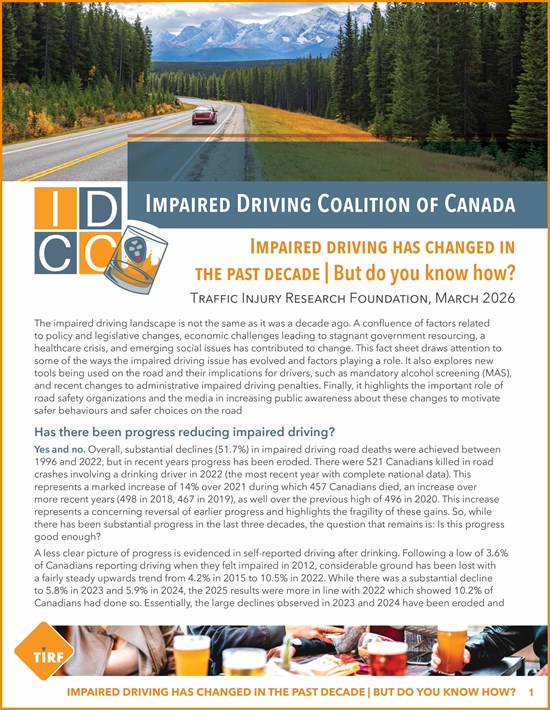
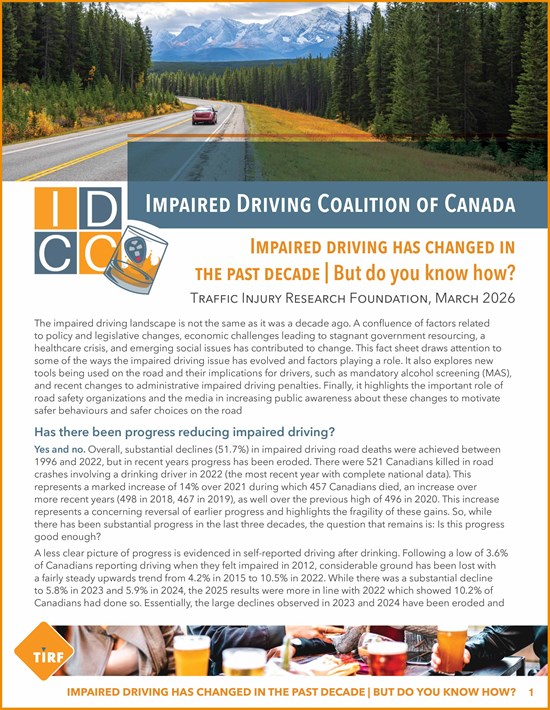
Impaired driving has changed in the past decade | But do you know how? is a fact sheet clarifying how impaired driving and enforcement has evolved, including how mandatory alcohol screening works, why it deters impaired driving, and the implications of reducing impaired driving charges to negligent driving.
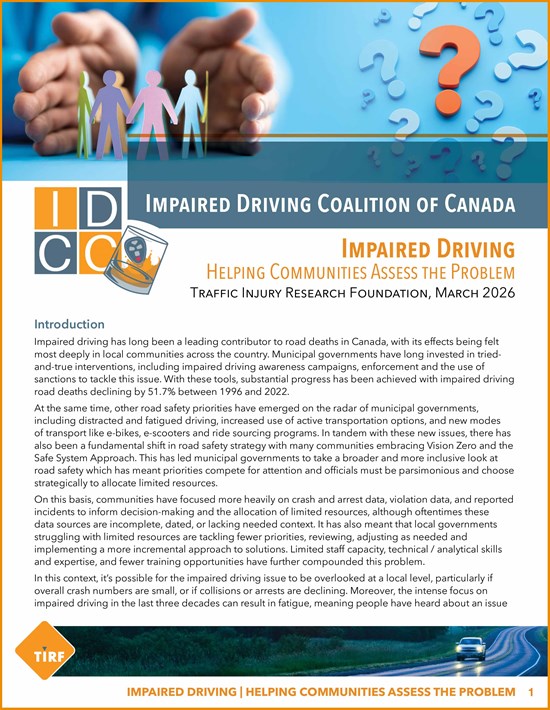
Impaired Driving | Helping Communities Assess the Problem contains a series of questions to guide local governments in the collection of quantitative and help them identify important sources of qualitative data, so they do not mistakenly overlook or underestimate impaired driving as a priority. These alternative data sources have become increasingly important in light of often lengthy delays associated with finalizing crash, arrest or conviction data.
Together, these resources offer a comprehensive approach to support communities in improving data collection, strengthening public awareness, and building more effective impaired driving strategies.
Communities looking to enhance data collection or are interested in piloting the Community Survey Toolkit are invited to connect with TIRF for guidance, training, and implementation support.
Download and share the fact sheets:
- Community Survey Toolkit | Collecting Impaired Driving Data
- Impaired driving has changed in the past decade | But do you know how?
- Impaired Driving | Helping Communities Assess the Problem
For more information about National Impaired Driving Prevention Week, visit: https://www.canada.ca/en/public-safety-canada/campaigns/national-impaired-driving-prevention-week.html.
Use link in the press release to download the fact sheet
To view an enhanced version of this graphic, please visit:
https://images.newsfilecorp.com/files/10180/288909_562eecc1f467483b_001full.jpg
Use link in the press release to download the fact sheet
To view an enhanced version of this graphic, please visit:
https://images.newsfilecorp.com/files/10180/288909_562eecc1f467483b_002full.jpg
Use link in the press release to download the fact sheet
To view an enhanced version of this graphic, please visit:
https://images.newsfilecorp.com/files/10180/288909_562eecc1f467483b_003full.jpg
About the Traffic Injury Research Foundation:
The vision of the Traffic Injury Research Foundation (TIRF) is to ensure people using roads make it home safely every day by eliminating road deaths, serious injuries and their social costs. TIRF's mission is to be the knowledge source for safe road users and a world leader in research, program and policy development, evaluation, and knowledge transfer. TIRF is a registered charity and depends on grants, awards, and donations to provide services for the public. Visit www.tirf.ca or find all TIRF websites and social media at https://linktr.ee/tirfcanada.

To view an enhanced version of this graphic, please visit:
https://images.newsfilecorp.com/files/10180/288909_562eecc1f467483b_004full.jpg
To view an enhanced version of this graphic, please visit:
https://images.newsfilecorp.com/files/10180/288909_562eecc1f467483b_005full.jpg
- 30 -
For more information, please contact:
Karen Bowman
Director, Communications & Programs
Traffic Injury Research Foundation
613.238.5235 (office)
250.797.0833 (direct)
1.877.238.5235 (toll-free)
karenb@tirf.ca

To view the source version of this press release, please visit https://www.newsfilecorp.com/release/288909
For more information about National Impaired Driving Prevention Week, visit: https://www.canada.ca/en/public-safety-canada/campaigns/national-impaired-driving-prevention-week.html
Source: Traffic Injury Research Foundation
