New tool helps Georgia leaders prepare for changing climate conditions and strengthen long-term resilience
ATLANTA, GA / ACCESS Newswire / March 30, 2026 / Drawdown Georgia today announced the launch of the Drawdown Georgia Climate Outlook Maps, a new tool designed to help civic, business, and community leaders understand and visualize how Georgia's climate may change between now and 2050-and what those changes could mean for infrastructure, agriculture, public health, and economic development.
Introduced at the Super South conference in Atlanta, the maps allow users to compare today's climate conditions with projected conditions in 2050 under several possible emissions pathways. By visualizing potential changes in extreme heat, rainfall, and growing seasons, the maps help communities anticipate risks and make more informed long-term decisions about how Georgia builds, grows, and manufactures in the decades ahead.
Developed by Dr. William Drummond of Georgia Tech, the maps translate global climate models used in federal climate assessments into Georgia-specific projections.
"What makes these maps valuable is that they turn global climate science into a practical planning tool," Dr. Drummond said. "Users can see how heat, rainfall, and growing conditions may shift in their own regions and use that insight to guide long-term resilience decisions."
Unlike many climate projections that focus on the year 2100, the Drawdown Georgia team selected 2050 as a practical planning horizon. Roads, stormwater systems, industrial facilities, farms, and hospitals built today are likely to remain in service through mid-century.
"For too long, climate information has been buried in science journals and the halls of academia. Drawdown Georgia's new Climate Outlook Maps are making this data accessible to the public, stakeholders, and decision-makers," said Dr. Marshall Shepherd, former president of the American Meteorological Society and Regents Professor at the University of Georgia. "Given our exposure to an array of climate extremes in Georgia, this release is quite timely."
Each map set compares present-day conditions with projections for 2050 under three emissions scenarios. Viewing the scenarios side by side allows users to explore how future climate conditions could differ depending on global emissions trends.
The Drawdown Georgia Climate Outlook Maps are available free of charge on the Drawdown Georgia website as part of a growing suite of data-informed tools and trackers designed to support business and civic leaders who are responsible for scaling climate solutions and resilience planning across the state.
"Drawdown Georgia is focused on scaling practical climate solutions across the state, but communities also need tools to prepare for the changes already underway," said John A. Lanier, executive director of the Ray C. Anderson Foundation and a founding member of Drawdown Georgia. "These maps give us a clearer picture of what Georgia's climate could look like within the lifetime of today's infrastructure-and help us plan accordingly."
For more information and to explore the maps, visit:
www.drawdownga.org/maps
About Drawdown Georgia
Drawdown Georgia is a statewide research-based initiative launched in 2020 that was born from a multi-university collaboration, funded by the Ray C. Anderson Foundation. Taking inspiration from Project Drawdown, the world's leading resource for taking action on climate change, Drawdown Georgia localized that work by identifying the 20 highest-impact solutions for reducing greenhouse gas emissions in our state over the next decade.
This framework focuses on climate solutions in five sectors: transportation, buildings & materials, food & agriculture, electricity, and land sinks. It considers how these solutions can reduce emissions and advance "beyond carbon" priorities, including equity, economic development, public health, and nurturing the larger environment.
Drawdown Georgia has grown into a "leader-full" movement, bringing together many organizations, universities, companies, leaders, and funders who are working to advance climate solutions in Georgia, including Drawdown Georgia Research, the Drawdown Georgia Business Compact, Drawdown Georgia Congregations, and Drawdown Georgia Higher Education. Learn more at drawdownga.org.
Media Contact:
Lisa Lilienthal: lisa@dialoguemarketing.com, 404.661.3679
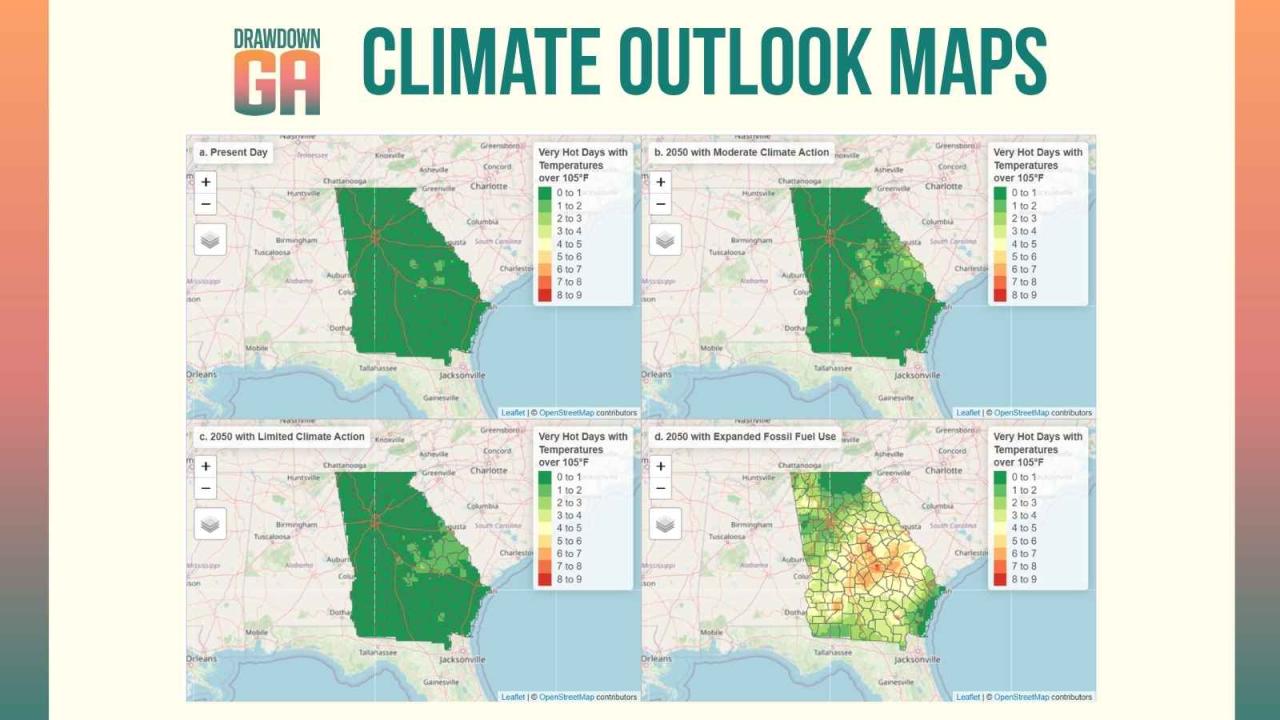
Example of one scenario with Climate Outlook Maps
Find more stories and multimedia from Ray C. Anderson Foundation at 3blmedia.com.
Contact Info:
Spokesperson: Ray C. Anderson Foundation
Website: https://www.3blmedia.com/profiles/ray-c-anderson-foundation
Email: info@3blmedia.com
SOURCE: Ray C. Anderson Foundation
View the original press release on ACCESS Newswire:
https://www.accessnewswire.com/newsroom/en/business-and-professional-services/drawdown-georgia-launches-climate-outlook-maps-to-help-communiti-1152990