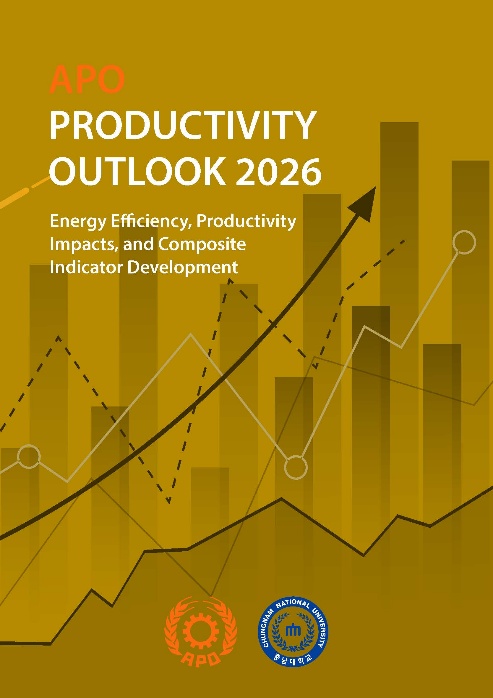
TOKYO, April 06, 2026 (GLOBE NEWSWIRE) -- The Asian Productivity Organization (APO) has released the APO Productivity Outlook 2026, which examines the relationship between energy efficiency and productivity performance and its implications for the sustainable development of the 21 APO member economies in the Asia-Pacific region.
The report highlights that improving energy efficiency enables economies to produce more output with less energy input, positioning it as a key driver of both economic performance and environmental sustainability. As energy demand rises and climate challenges intensify, strengthening energy efficiency has become increasingly important for maintaining competitiveness and resilience.
Drawing on cross-economy analysis, the publication finds that the impact of energy efficiency on productivity varies across income levels and sectors. These differences underline the need for tailored policy approaches that reflect each economy's structural conditions and stage of development.
The report highlights institutional experiences from APO members such as the Republic of Korea and Japan, showing how strong energy data systems and systematic indicator frameworks can support reliable measurement and benchmarking, evidence-based policymaking, and regional comparisons. In addition, the publication outlines key policy directions to support productivity-enhancing energy transitions. These include promoting technological innovation, strengthening institutional coordination, advancing digitalization, and expanding green finance and incentive mechanisms. It also recommends that APO members integrate energy efficiency into productivity strategies under the Green Productivity framework.
"Energy efficiency must be understood as a core component of productivity strategy. As highlighted in the APO Productivity Outlook 2026, improving how energy is used allows economies to achieve more with less while advancing both economic performance and environmental sustainability. This is essential for building resilient and future-ready productivity systems across the region," said Dr. Indra Pradana Singawinata, Secretary-General of the APO.
By linking energy efficiency with productivity performance, the APO Productivity Outlook 2026 provides practical insights for policymakers seeking to achieve sustainable, low-carbon growth while enhancing economic efficiency across the region.
The publication can be accessed through the following link:
APO Productivity Outlook 2026
To support a better understanding of the report's findings, the APO will feature the APO Productivity Outlook 2026 in its Productivity Talk (P-Talk) series on 21 April 2026 at 14:00 JST, to be streamed via the APO's official YouTube channel. The session will feature Dr. Ingul Baek, Associate Professor in the Department of Economics at Kongju National University, the Republic of Korea, and a contributor to the publication, who will share key insights and practical implications for policymakers and stakeholders across the region.
About the APO
The Asian Productivity Organization (APO) is a regional intergovernmental organization dedicated to improving productivity in the Asia-Pacific region through mutual cooperation. It is nonpolitical, nonprofit, and nondiscriminatory. Established in 1961 with eight founding members, the APO currently comprises 21 member economies: Bangladesh; Cambodia; the Republic of China; Fiji; Hong Kong; India; Indonesia; Islamic Republic of Iran; Japan; the Republic of Korea; Lao PDR; Malaysia; Mongolia; Nepal; Pakistan; the Philippines; Singapore; Sri Lanka; Thailand; Turkiye; and Vietnam.
The APO is shaping the future of the region by fostering the socioeconomic development of its members through national policy advisory services, acting as a think tank, institutional capacity-building initiatives, and knowledge sharing to increase productivity.
For details, contact the APO Digital Information Unit: pr@apo-tokyo.org.
Website: https://www.apo-tokyo.org
A photo accompanying this announcement is available at https://www.globenewswire.com/NewsRoom/AttachmentNg/75f1d910-4b17-4a93-8292-e71591b397ac