Federal agencies argue MMJ faces "no irreparable harm." The record - and the law - say otherwise stated, Duane Boise , CEO MMJ International Holdings.
WASHINGTON, DC / ACCESS Newswire / April 14, 2026 / A recent article by Marijuana Moment suggests that the federal government's motion to dismiss litigation challenging the Centers for Medicare & Medicaid Services (CMS) hemp access initiative exposes weaknesses in the case brought by MMJ International Holdings and other plaintiffs.
It does.
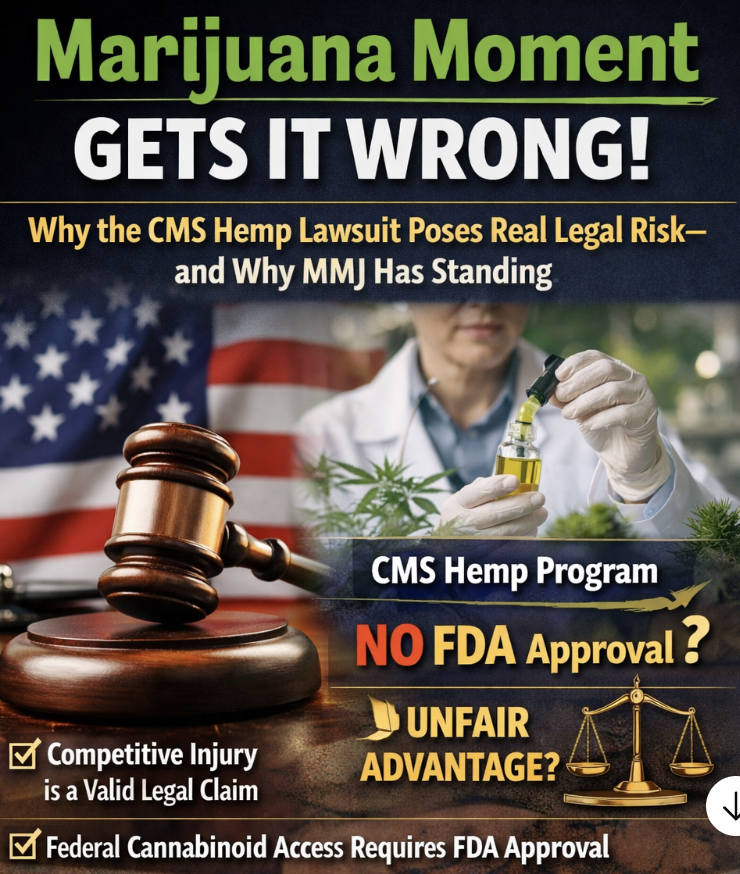
Because, the government's motion confirms exactly why the lawsuit matters: CMS has created a federal cannabinoid access pathway inside Medicare infrastructure without requiring FDA drug approval, while simultaneously holding pharmaceutical developers like MMJ to the highest clinical standards in the world.
That contradiction is precisely what courts exist to review.
Marijuana Moment Repeats the Government's Litigation Narrative-Not the Legal Reality
The article largely echoes arguments advanced by federal lawyers representing U.S. Department of Health and Human Services and CMS, including claims that:
plaintiffs lack standing
CMS is not reimbursing products directly
MMJ cannot demonstrate irreparable harm
the program is merely voluntary
But repeating a litigation argument is not the same as analyzing whether that argument will survive judicial scrutiny.
The federal brief itself acknowledges MMJ's role as a new plaintiff-while simultaneously attempting to minimize its injuries.
That contradiction alone signals the case is legally consequential.
Competitive Injury Is a Recognized Basis for Standing
The government claims MMJ's injuries are "speculative projections about a market MMJ has not entered."
That claim ignores a central fact:
MMJ is already inside the FDA botanical drug development pathway.
Courts have repeatedly recognized that when federal policy advantages one regulatory pathway while disadvantaging another, companies pursuing the more rigorous pathway can demonstrate competitive injury.
Here's the key distinction:
CMS is enabling provider furnished cannabinoid products inside Medicare delivery environments while MMJ is required to complete: by the FDA
chemistry manufacturing controls validation
strain standardization
stability testing
IND clinical authorization
controlled manufacturing approvals
before patients can receive its therapy.
That is not speculation.
That is regulatory asymmetry.
The "CMS Doesn't Pay for Hemp" Argument Misses the Point
Marijuana Moment highlights the government's statement that:
"CMS does not pay for hemp products under the BEI."
Technically correct.
Legally incomplete.
Under the BEI structure:
providers furnish products inside Medicare delivery infrastructure
shared-savings incentives create reimbursement pathways
ACO performance benchmarks determine financial outcomes
This is federal healthcare integration, even if it is not fee-for-service reimbursement.
Courts evaluate economic reality, not labeling strategy.
The Case Is Not About Hemp vs Marijuana
Another repeated claim is that the lawsuit improperly conflates hemp with marijuana.
Congress indeed drew a statutory distinction in the Agriculture Improvement Act of 2018 (Farm Bill).
But the legal issue in this litigation is different:
whether CMS may introduce therapeutic cannabinoids into Medicare infrastructure without FDA drug approval while simultaneously requiring pharmaceutical developers to obtain that approval.
That is a procedural fairness question-not a botanical classification question.
CMS Innovation Authority Is Not Unlimited
The government also argues that CMS innovation models are historically implemented without notice and comment rule making.
True.
But historically, CMS innovation models tested:
payment models
delivery coordination
provider incentives
-not the introduction of a new therapeutic product class into federal care infrastructure.
Cannabinoids are not billing modifiers.
They are pharmacologically active compounds.
That distinction matters.
Marijuana Moment Overlooks the Strongest Legal Issue in the Case
The article treats standing as the central dispute.
It is not.
The central dispute is whether CMS can:
introduce cannabinoids into Medicare delivery environments
without FDA approval
without rulemaking
without clinical-trial validation
without parity with botanical drug developers
while those same developers remain blocked by federal manufacturing delays.
That is the core administrative-law question.
MMJ's Position Is Stronger Than the Government Suggests
Federal lawyers argue MMJ cannot demonstrate irreparable harm.
Yet MMJ:
holds an active cannabinoid drug development program
received FDA clinical-trial feedback requiring additional extract supply
faces DEA manufacturing delays affecting trial progression
and competes in the exact therapeutic category CMS is introducing into Medicare infrastructure
Those facts are not hypothetical.
They are documented.
And courts routinely recognize this type of regulatory displacement as actionable injury.
The Lawsuit Will Shape the Future of Cannabinoid Medicine
This litigation is not simply about one CMS initiative.
It will determine whether federal healthcare infrastructure:
prioritizes validated medicine
or permits parallel access pathways outside FDA approval
The outcome will affect:
botanical drug developers
clinical-trial sponsors
Medicare beneficiaries
and the integrity of the federal drug-approval system itself.
Bottom Line
Marijuana Moment framed the government's motion as evidence the case lacks merit.
In reality, the motion confirms something else entirely:
the federal government recognizes the stakes-and is moving aggressively to prevent judicial review.
That alone signals the case is far from symbolic.
It is foundational to the future regulatory structure of cannabinoid medicine in the United States.
Madison Hisey
MHisey@mmjih.com
203-231-85832
SOURCE: MMJ International Holdings
View the original press release on ACCESS Newswire:
https://www.accessnewswire.com/newsroom/en/healthcare-and-pharmaceutical/why-the-cms-hemp-cbd-program-lawsuit-poses-real-legal-risk-1157359