

North Berwick, Scotland--(Newsfile Corp. - April 29, 2026) - WESTERN GOLD EXPLORATION LTD. (TSXV: WGLD) (the "Company") is pleased to announce the second tranche of exploration results from the Lyon and Orchy Crown Estates applications, as part of the joint venture (the "JV") with Acrux Gold Limited (see 25 November 2025 Press Release). Results comprise rock-grab sampling, vein mapping and trial soil sampling recently completed by Company geologists, bringing the total number of rock-grab samples assayed to 494 across both licence areas to date.
"These latest findings continue to build a compelling picture of an emerging gold district," commented Harry Dobson, Chairman. "The focus is now on advancing known prospects to drill-ready status. Our next phase of work will combine backpack drilling and channel sampling with drone-mounted magnetic surveying and systematic soil sampling. We are building a genuine pipeline and are on track to advance targets towards drilling this summer."
Lyon Application Highlights
Newly identified Chruitein Vein of a similar nature to veining at neighbouring Cononish mine.
Grab-sampling returned up to 36 g/t Au and 2760 g/t Ag*.
Up to 10m wide with at least 500m strike extent.
High-grade gold (up to 40.5 g/t Au grab sample*) discovered in sulphide-poor vein float from the newly identified Gleann Cailliach prospect (see 30 March 2026 press release).
Historically overlooked mineralisation style now included in sampling criteria.
Orientation soil sampling showed known veins can be traced beneath cover. This is now being rolled out across both application areas.
Known structures confirmed and previously unidentified features detected at Creag Sheileach and Coire a'Ghabhalach - implying multiple targets at each prospect.
Orchy Application Highlights
Historical high-grade gold assays confirmed from the sampling:
Grap samples up to 95.9 g/t Au* at River Vein (including visible gold).
Grab samples up to 43.7 g/t Au* and 2,260 g/t Ag* at Beinn Udlaidh NE.
*Note: Grab samples are inherently selective and may not reflect the true grade of the mineralisation, although they are taken from exposed outcrop. Float samples, by contrast, consist of transported material that is not in situ and therefore act only as indicators of potential nearby mineralisation.
Geological Overview
The Caledonian Gold Project is situated within the highly prospective Grampian Terrane, a key segment of the Caledonian mineral belt that stretches from Northern Britain and Ireland to Scandinavia and North America. This district is already proven for gold, hosting deposits such as Cononish, which sits directly along strike to the Lyon area as well as Cavanacaw and the world-class Curraghinalt deposit (Dalradian Resources; Measured, Indicated and Inferred Resources > 6 Moz Au - 43-101 Technical Report for the Curraghinalt Gold Project, Northern Ireland dated June 22, 2018 by SRK Consulting (Canada) Inc.).
The reader is cautioned that mineralisation on adjacent properties is not necessarily indicative of what can or will be found within any projects upon which the JV may be granted exploration licences.
Rock Grab Samples
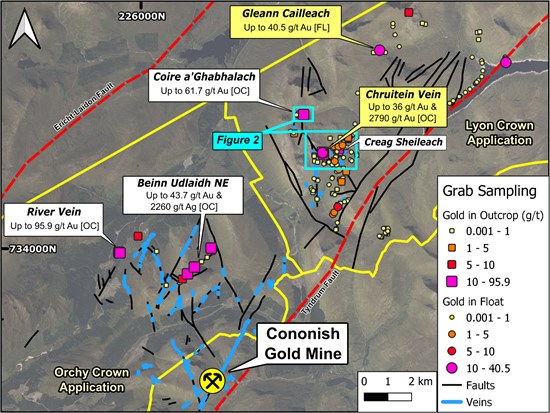
Figure 1. Aerial imagery map of the Lyon and Orchy applications, showing the distribution of the second tranche of rock grab sampling and mapped quartz veins and faults. Note the proximity to the active Cononish Gold Mine. OC = outcrop, FL = float.
To view an enhanced version of this graphic, please visit:
https://images.newsfilecorp.com/files/9801/294719_b1fee9d214105b35_002full.jpg
A total of 155 outcrop grab and 140 float grab samples have been collected and assayed as part of the second tranche of rock-grab sampling (see Figure 1 above). Rock samples returning high-grade gold and silver are hosted in quartz-sulphide veins and breccias, consistent with historical descriptions. Notably, high-grade gold has also been identified in quartz-only veins at Gleann Cailleach - broadening the range of exploration targets across the project.
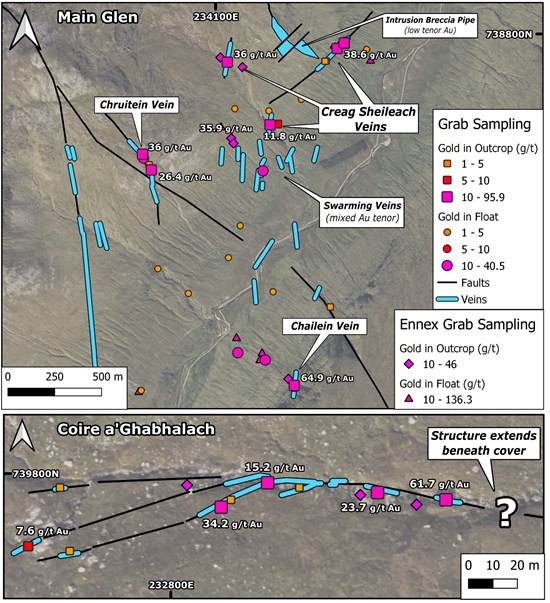
Figure 2. Top - Aerial imagery vein map of the Creag Sheilleach area, highlighting the scale and variety of mapped and sampled high-grade gold veins. Bottom - Aerial imagery vein map of the Coire a'Ghabhalach prospect, highlighting distribution of sampling and morphology of vein-structures. Note: the true extent of all veins is understated since they become concealed beneath cover.
To view an enhanced version of this graphic, please visit:
https://images.newsfilecorp.com/files/9801/294719_b1fee9d214105b35_003full.jpg
Future Drill Targets - Prospect Descriptions
Note: All grades mentioned herein relate to grab samples. Grab samples are inherently selective and may not reflect the true grade of the mineralisation, although they are taken from exposed outcrop.
Lyon Licence
Coire a'Ghabhalach (CaG): Structurally controlled, gold-bearing quartz-sulphide veins are exposed in a stream section over a minimum 180m strike extent, reaching up to 3m in width (see Figure 2 above). Veins are sub-vertical and E-W trending, extending beneath cover in both directions. Gold grades reach 61.7 g/t Au, accompanied by silver (up to 70 g/t), lead (up to 1.8%) and zinc (up to 5%). Trial soil sampling returned anomalous gold values at the known structure, confirming the prospect whilst potentially identifying additional structures - soils outboard of the main vein returned values up to 0.64 g/t Au.
Creag Sheileach: The highest density of veining within the Lyon licence. A primary ENE-trending, sub-vertical, sulphide-rich vein (up to 20% sulphide) hosts gold grades up to 38.6 g/t Au (see Figure 2 above). Multiple high-grade subsidiary NE-trending structures have been identified to the west within river sections. Alteration haloes extending several metres from the main vein grade 1.0-3.0 g/t Au. To the SE, a quartz-breccia vein swarm hosts low-tenor gold up to 3 g/t Au in outcrop; however, adjacent float grading up to 89.2 g/t Au implies high-grade gold-bearing veins extend beneath cover in this zone. Trial soil sampling has identified multiple parallel mineralised structures below cover outboard of the main vein. The density of veining suggests this area was a focus of structural movement and hydrothermal fluid flow.
Chruitein Vein: A 5-10m wide multi-generational quartz-lode vein exposed in a cliff face, with subsidiary outcrop to the south over a minimum 500m strike extent (see Figure 2 above). Quartz generations range from massive and branching to open-space banded textures. High-grade intervals return up to 36 g/t Au and 2,790 g/t Ag; lower-grade portions average c. 1 g/t Au. Notably, quartz-only samples have returned grades up to 26.4 g/t Au. Further work is planned to characterise the key gold-bearing vein episodes within the wider lode.
Coire Leaceach (as reported in the 30 March 2026 Press Release): A series of 1.0-2.0m wide quartz veins and subcropping boulder trains located c. 0.5km south of Coire a'Ghabhalach. Subcropping float has returned high gold grades up to 252 g/t Au, while outcropping and subcropping veins record both high-grade gold (30.5 g/t Au) and silver (2,190 g/t Ag).
Chailein Vein: A 1.0-2.0m wide, NE-trending quartz-sulphide vein grading up to 64.9 g/t Au in outcrop, traceable for c. 50m along strike before extending beneath cover (Figure 2 above). Subsidiary quartz-K-feldspar-pyrite veins in proximity to the main structure carry moderate low-grade gold enrichment up to 1 g/t Au.
Orchy Licence
Beinn Udlaidh NE: Part of a large-scale, multi-generational NE-SW trending quartz-lode system up to 20m wide and 3.5km along strike (see Figure 1 above). High-grade gold mineralisation cross-cuts earlier low-tenor quartz generations and is characterised by grey-blue quartz with 5-20% sulphide, predominantly pyrite and base-metal sulphides including galena. High-grade mineralisation has been confirmed at three separate locations across 1.8km of strike extent, returning up to 43.7 g/t Au and 2,260 g/t Ag.
River Vein: The highest-grade prospect identified by Company geologists within the Orchy licence, returning up to 95.9 g/t Au, with historic assays up to 383 g/t Au (see Figure 1 above). The structure is WNW-trending - unique amongst the gold veins of the wider project area - and 0.5-1.0m wide, currently observed over c. 70m within a river section. Mineralisation is characterised by grey quartz with pyrite, galena, sphalerite and minor silver-bearing tellurides.
Future Objectives
Backpack drilling and channel sampling of key prospects.
Drone mounted magnetic geophysics survey over key prospects.
Implementation of proven soil sampling technique across key prospects, identifying concealed extent of auriferous structures beneath cover.
A second stage drainage sampling programme will be carried out in smaller tributaries within the main drainage basins to better refine target areas.
Continued boots-on-the-ground exploration across underexplored areas.
Geology
The Lyon area is underlain by the Dalradian Supergroup, a thick package of metasedimentary rocks that were deformed and metamorphosed during the Ordovician Grampian Orogeny. Subsequent late-Caledonian strike-slip tectonism during the Silurian-Devonian created major NE-SW fault corridors and drove emplacement of high-K calc-alkaline intrusions-both key ingredients in forming high-grade gold-silver quartz-sulphide veins throughout the district.
Importantly, age-dating from the Cononish deposit indicates gold mineralisation occurred around 410-406 Ma, coincident with a regional shift to transtensional tectonics, a setting known to enhance fluid flow and vein development. This same fertile geological environment underpins the exploration potential of the Lyon licence application.
About Western Gold Exploration
The Company is a mineral exploration company that is listed on the TSX Venture Exchange under the symbol "WGLD". The Company is focused on the exploration of gold, silver and critical minerals in Scotland.
In November 2025, WGLD formed the Glen Lyon Joint Venture with Acrux Gold Limited to explore for gold, silver, and critical minerals as part of the Caledonian Gold Project in central Scotland. The JV has applied for two Crown Estates Mines Royal Option Agreements (exploration licences) across the Tyndrum Mineral District, specifically the Orchy and Lyon licence areas, which form the Caledonian Gold Project. The Company also operates at the Lorne Project, which includes both Lagalochan and Ardlochan prospects, and are located in the highly prospective Lorne Porphyry District of the wider Caledonian belt.
For further information, please contact:
Ross McLellan, CEO
Phone: +44 7779 161441
Email: info@westerngoldexploration.com
Website: www.westerngoldexploration.com
Review by Qualified Person, Quality Control and Reports
David Pym (CGeol), a consultant of the Company, is the Qualified Person (as defined by National Instrument 43-101) who supervised, verified and approved the scientific and technical disclosure in this press release on behalf of the Company. The results presented in this press release are from the Company's own sampling and provide an important validation of historical assays quoted in previous press releases. Historical assay results have not been checked consistently against assay certificates, nor is there significant QAQC information available.
Rock-chip material was collected from in-situ outcrops as well as float found within burns and scree slopes. Each sample was crushed, split, and pulverised prior to analysis. Multi-element geochemistry (48 elements, including silver and base metals) was determined using a four-acid digestion followed by ICP-MS analysis (method ME-MS61L). Gold was assayed using a 30 g fire assay with an ICP-MS finish, providing a detection limit of 0.005 ppm (Au-AA23). Trial soil sampling was conducted at the Coire a'Ghabhalach and Creag Sheileach prospects. Approximately 0.5kg of soil was collected and each sample was crushed and split prior to analyses. The method that produced the most repeatable results involved soil sampling via auger, allowing consistent sampling of an brown-orange soil horizon beneath 0.5 - 2.0m of vegetation and peat. Three analytical procedures were tested to verify known gold-bearing structures: Ionic leach, conventional method and course fraction conventional. Three different analytical methods were tested on the soil samples: 1) Ionic Leach (ME-MS23), (2) fine fraction aqua-regia with fire assay finish (ME-TL43, AuAA23) and (3) coarse fraction aqua-regia with fire assay finish (ME-TL43). Ionic Leach samples were analysed using a partial sodium cyanide leach with an ICP-MS finish, yielding a gold detection limit of 0.01ppb. Samples 2 & 3 were split into fine and coarse (>150µm) fractions before dissolution via aqua regia with an ICP-MS finish. Following the return of results, data were compared to known-outcrops and method 2 (fine-fraction) was determined as the most representative and repeatable.
All analytical work was undertaken by ALS Global, Ireland. ALS Geochemistry laboratories operate under a unified Global Geochemistry Quality Manual in accordance with ISO/IEC 17025:2017 and use a global laboratory information management system (LIMS) to ensure consistent, high-quality, and reproducible analytical results.
CAUTIONARY STATEMENT REGARDING FORWARD-LOOKING STATEMENTS: This news release includes certain "forward-looking statements" under applicable Canadian securities legislation. Forward-looking statements include, but are not limited to, statements with respect to timing and receipt of the Crown Estates Mines Royal Option Agreements (exploration licences) applied for by the JV, timing and completion of any drilling and work programs on the properties of the Company and the proposed properties of the JV, estimates of mineralisation from drilling and sampling, geological information projected from drilling and sample results, potential for minerals and/or mineral resources, and statements regarding the plans, intentions, beliefs, and current expectations of the Company and the JV with respect to the future business activities and operating performance of the Company and the JV that may be described herein. Forward-looking statements consist of statements that are not purely historical, including any statements regarding beliefs, plans, expectations or intentions regarding the future. Such information can generally be identified by the use of forward-looking wording such as "may", "expect", "estimate", "anticipate", "intend", "believe" and "continue" or the negative thereof or similar variations. Readers are cautioned not to place undue reliance on forward-looking statements, as there can be no assurance that the plans, intentions or expectations upon which they are based will occur.
By their nature, forward-looking statements involve numerous assumptions, known and unknown risks and uncertainties, both general and specific, that contribute to the possibility that the predictions, estimates, forecasts, projections and other forward-looking statements will not occur. These assumptions, risks and uncertainties include, among other things, the state of the economy in general and capital markets in particular, accuracy of assay results, geological interpretations from drilling results, timing and amount of capital expenditures; performance of available laboratory and other related services, future operating costs, and the historical basis for current estimates of potential quantities and grades of target zones, as well as those risk factors discussed or referred to in the Company's Management's Discussion and Analysis for the year ended December 31, 2024, and the period ended September 30, 2025 available at www.sedarplus.ca, many of which are beyond the control of the Company. Forward-looking statements contained in this press release are expressly qualified by this cautionary statement.
The forward-looking statements contained in this press release are made as of the date of this press release. Except as required by law, the Company disclaims any intention and assumes no obligation to update or revise any forward-looking statements, whether as a result of new information, future events or otherwise. Additionally, the Company undertakes no obligation to comment on the expectations of, or statements made by, third parties in respect of the matters discussed above.
Neither the TSX Venture Exchange nor its Regulation Service Provider (as that term is defined in the policies of the TSX Venture Exchange) accepts responsibility for the adequacy or accuracy of this release.
NOT FOR DISTRIBUTION OR DISSEMINATION IN THE UNITED STATES. FAILURE TO COMPLY WITH THIS RESTRICTION MAY CONSTITUTE A VIOLATION OF UNITED STATES SECURITIES LAWS

To view the source version of this press release, please visit https://www.newsfilecorp.com/release/294719
Source: Western Gold Exploration Ltd.
