

- Delivered record first quarter operating revenues of $5.8 billion driven by strong demand across the network
- Operating income of $117 million and record first quarter adjusted EBITDA* of $623 million
- Generated $1.8 billion in net cash flows from operating activities and $1.6 billion in free cash flow*
- Suspended full-year 2026 guidance and introduced second quarter 2026 financial guidance providing near-term visibility
- Demand remains solid and resilient amid elevated geopolitical instability
MONTRÉAL, April 30, 2026 (GLOBE NEWSWIRE) -- Air Canada today reported its financial results for the first quarter of 2026 and provided financial guidance for the second quarter 2026. Given the volatility and uncertainty in relation to jet fuel prices for the second half of the year, Air Canada has suspended its full-year 2026 financial guidance.
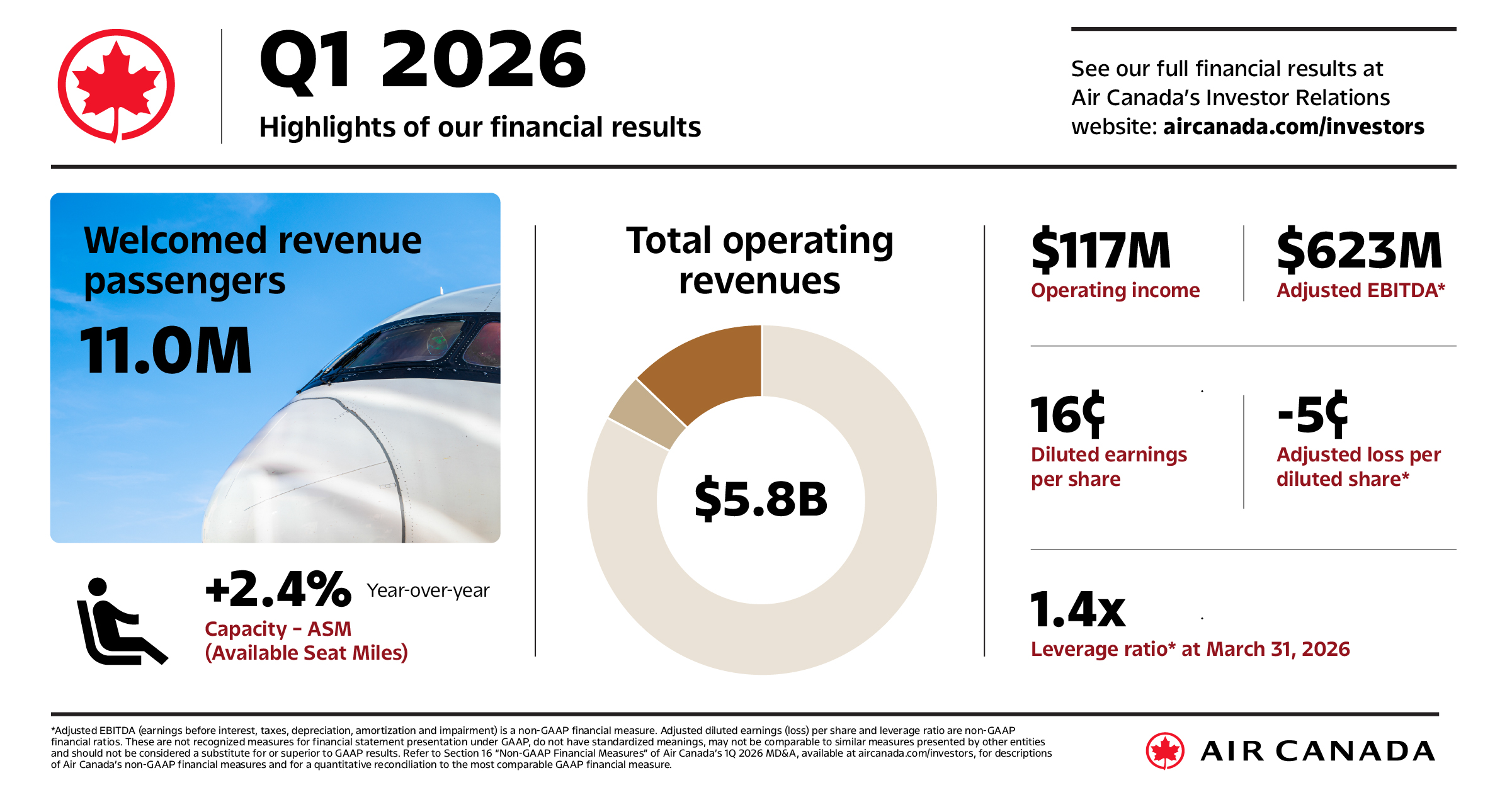
"In the first quarter, Air Canada built on the momentum of our best-ever fourth quarter to launch strongly into 2026. We reported record operating revenues of $5.8 billion, up more than 11 per cent from the same period in 2025. Our operating income of $117 million was a positive $225 million swing from a year ago, and we generated record adjusted EBITDA of $623 million, up 61%. These results show the efficacy of our strategy and the dedication of our employees, whom I thank for their hard work," said Michael Rousseau, President and Chief Executive Officer.
"We are committed to maintaining a strong financial footing while delivering long-term shareholder value. During the quarter, we generated $1.8 billion in cash from operating activities, $1.6 billion in free cash flow and repurchased more than $140 million of our shares. This performance reflects our prudent approach to capital allocation and balance sheet management, allowing us to invest in the business, manage debt and return capital to shareholders while preserving financial flexibility.
"Supported by solid demand, our second quarter 2026 guidance reflects our expectation to offset between 50 per cent and 60 per cent of the estimated incremental fuel expense through various commercial and cost actions. We continue to see strong demand across the network and throughout the booking window for the latter half of the year. I believe Air Canada is very well positioned from a financial, fleet and network perspective. As evidenced by two consecutive record quarters, the airline is performing well and the team is consistently executing on our long-term strategy," said Mr. Rousseau.
- Adjusted CASM, adjusted EBITDA (earnings before interest, taxes, depreciation- amortization and impairment), adjusted EBITDA margin, leverage ratio, net debt, adjusted pre-tax income (loss), adjusted net income (loss), adjusted earnings (loss) per share - diluted, and free cash flow are referred to in this news release. Such measures are non-GAAP financial measures, non-GAAP ratios, or supplementary financial measures, are not recognized measures for financial statement presentation under GAAP, do not have standardized meanings, may not be comparable to similar measures presented by other entities and should not be considered a substitute for or superior to GAAP results. Leverage ratio of 1.3 at March 31, 2025. Adjusted EBITDA and operating income for the trailing 12-month periods ended March 31, 2026 were $3.360 billion and $1.143 billion, respectively ($3.520 billion and $1.144 billion, respectively for the trailing 12-month periods ended March 31, 2025)- Refer to the "Non-GAAP Financial Measures" section of this news release for descriptions of these measures, and for a reconciliation of Air Canada non-GAAP measures used in this news release to the most comparable GAAP financial measure.
First Quarter 2026 Financial Results
- Operating revenues of $5.785 billion
- Operating expenses of $5.668 billion
- Operating income of $117 million with an operating margin of 2.0% and record adjusted EBITDA of $623 million with an adjusted EBITDA margin* of 10.8%
- Income before income taxes of $123 million and adjusted pre-tax income* of $18 million
- Net income of $48 million and diluted earnings per share of $0.16
- Adjusted net loss* of $16 million and adjusted loss per diluted share* of $0.05
- Adjusted CASM* of 16.11 cents
- Net cash flows from operating activities of $1.798 billion and free cash flow of $1.604 billion
- Long-term debt and lease liabilities of $12.301 billion and net leverage ratio* of 1.4x
Outlook
Given ongoing disruption in global energy markets caused by recent developments in the Middle East and the significant volatility in jet fuel prices, the reliability of any fuel forecast for the second half of 2026 is materially reduced. Air Canada has determined that suspending its full year 2026 guidance and providing financial guidance for the second quarter of 2026 is more appropriate in the current environment.
Air Canada's financial guidance for the second quarter of 2026 is as follows:
| Metric | Second Quarter 2026 Guidance |
| Adjusted EBITDA | $575 million to $725 million |
| ASM capacity | 0.5% to 1% increase from the second quarter of 2025 |
Major Assumptions
Air Canada made assumptions in providing its guidance-including current demand trends continuing for the second quarter of 2026 and that the Canadian dollar will trade, on average, at C$1.36 per U.S. dollar for the second quarter of 2026. Air Canada is assuming that the price of jet fuel will average at approximately C$1.28 per litre for the second quarter of 2026, which includes an estimated hedging gain of C$0.21 per litre. Our assumption is based on the forward curve as of April 28, 2026, adjusted to reflect Air Canada's specific supply chain environment, including Air Canada's fuel infrastructure at Canadian hubs, where fuel is typically contracted and received on a one- to two-month forward basis, as well as pricing exposure at international station locations. These jet fuel estimates reflect Air Canada's capacity plans and remain subject to ongoing volatility in global energy markets.
Air Canada also assumes it can offset between 50 to 60 per cent of the estimated incremental jet fuel expense above prior assumptions for the second quarter of 2026, which includes the expected hedging gains in the quarter.
Air Canada's guidance constitutes forward-looking information within the meaning of applicable securities laws and is subject to important risks and uncertainties, including in relation to statements or actions by governments and uncertainty relating to the imposition of (or threats to impose) tariffs on Canadian exports or imports and their resulting impacts on the Canadian, North American and global economies and travel demand. In addition, aircraft fuel prices have been, and continue to be, subject to high volatility as a result of the ongoing conflict in the Middle East. Moreover, there has been significant disruption to international shipping trade routes through the Strait of Hormuz, further exacerbating the impact on fuel supply and prices, including for aircraft fuel. A prolonged or escalating conflict could further disrupt global energy markets and cause aircraft fuel prices to remain elevated or raise even higher. We cannot predict future supply constraints, price volatility or cost of aircraft fuel, or how long current or future conflicts will last or their ultimate impact on global energy markets and across the aviation industry. Please see the discussion below under Caution Regarding Forward-looking Information.
2028 targets and 2030 aspirations
Air Canada announced the following long-term 2028 financial targets and 2030 aspirations in December 2024:
| Metric | 2028 Targets | 2030 Aspirations |
| Operating revenues | Approximately $30 billion | Exceed $30 billion |
| Adjusted EBITDA margin* | Greater than or equal to 17% | Between 18% and 20% |
| Net cash flows from operating activities as a percentage of adjusted EBITDA* | Approximately 90% | Approximately 90% |
| Additions to property, equipment and intangible assets as a percentage of operating revenues* | Lower than or equal to 12% | Lower than 12% |
| Free cash flow margin* | Approximately 5% | Approximately 5% |
| Return on invested capital* | Not provided | Greater than or equal to 12% |
| Fully diluted share count | Lower than 300 million shares | Lower than 300 million shares |
- Adjusted EBITDA (earnings before interest, taxes, depreciation, amortization and impairment), adjusted EBITDA margin, net cash flows from operating activities as a percentage of adjusted EBITDA, additions to property, equipment and intangible assets as a percentage of operating revenues, free cash flow margin and return on invested capital are referred to in this news release. Such measures are non-GAAP financial measures, non-GAAP ratios, or supplementary financial measures, are not recognized measures for financial statement presentation under GAAP, do not have standardized meanings, may not be comparable to similar measures presented by other entities and should not be considered a substitute for or superior to GAAP results. Refer to the "Non-GAAP Financial Measures" section of this news release for descriptions of these measures, and for a reconciliation of Air Canada non-GAAP measures used in this news release to the most comparable GAAP financial measure.
The 2028 long-term targets and 2030 aspirations provided in this news release do not constitute guidance or outlook but rather are provided for the purpose of assisting the reader in measuring progress toward Air Canada's objectives. Readers are cautioned that these targets and aspirations may change as conditions evolve and are referred to the assumptions, risks and uncertainties described in the 2024 Investor Day presentations which are available in the events section at aircanada.com/investors and elsewhere in this news release, including assumptions relating to demand trends, jet fuel supply, prices and forward curves, the ability to significantly recapture elevated fuel prices, increasing revenues, growing fleet and network capacity, and successfully executing on other key investments and initiatives.
Non-GAAP Financial Measures
Below is a description of certain non-GAAP financial measures and ratios used by Air Canada to provide readers with additional information on its financial and operating performance. Such measures are not recognized measures for financial statement presentation under GAAP, do not have standardized meanings, may not be comparable to similar measures presented by other entities and should not be considered a substitute for or superior to GAAP results. The non-GAAP financial measures or ratios described in this section typically have exclusions or adjustments that include one or more of the following characteristics, such as being highly variable, difficult to project, unusual in nature, significant to the results of a particular period or not indicative of past or future operating results. These items are excluded because the company believes these may distort the analysis of certain business trends and render comparative analysis across periods less meaningful and their exclusion generally allows for a more meaningful analysis of Air Canada's operating expense performance and may allow for a more meaningful comparison to other airlines.
Air Canada excludes the effect of impairment of assets, if any, when calculating adjusted CASM, adjusted EBITDA, adjusted EBITDA margin, adjusted pre-tax income (loss) and adjusted net income (loss) as it may distort the analysis of certain business trends and render comparative analysis across periods or to other airlines less meaningful. Air Canada did not record charges for impairment of assets in the first quarter of 2026, the full year 2025 or 2024.
A charge of $34 million was recorded in the third quarter of 2024 in other operating expenses related to estimated costs associated with contractual lease obligations. Air Canada excluded this expense in computing adjusted CASM, adjusted EBITDA, adjusted pre-tax income and adjusted net income.
In 2025 Air Canada recorded a one-time pension past service cost and other labour related charges of $194 million, including from the pension plan amendments made in conjunction with the collective agreement reached with the Canadian Union of Public Employees (CUPE) and an operating expense related to the streamlining of Air Canada's management structure. In 2024, with ratification of the collective agreement with the Air Line Pilots Association (ALPA), Air Canada recorded a one-time pension past service cost of $490 million in the fourth quarter of 2024. Air Canada has excluded these charges in computing its adjusted EBITDA, adjusted CASM, adjusted pre-tax income and adjusted net income.
Adjusted CASM
Air Canada uses adjusted CASM to assess the operating and cost performance of its ongoing airline business without the effects of aircraft fuel expense, the cost of ground packages at Air Canada Vacations, freighter costs and other items. These items may distort the analysis of certain business trends and render comparative analysis across periods less meaningful and their exclusion generally allows for a more meaningful analysis of Air Canada's operating expense performance and may allow for a more meaningful comparison to that of other airlines.
In calculating adjusted CASM, aircraft fuel expense is excluded from operating expense results as it fluctuates widely depending on many factors, including international market conditions, geopolitical events, jet fuel refining costs and Canada/U.S. currency exchange rates. Air Canada also incurs expenses related to ground packages at Air Canada Vacations which some airlines, without comparable tour operator businesses, may not incur. In addition, these costs do not generate ASMs and therefore excluding these costs from operating expense results provides for a more meaningful comparison across periods when such costs may vary.
Air Canada also incurs expenses related to the operation of freighter aircraft which some airlines, without comparable cargo businesses, may not incur. Air Canada had six Boeing 767 dedicated freighter aircraft in service as at March 31, 2026, and as at March 31, 2025. These costs do not generate ASMs and therefore excluding these costs from operating expense results provides for a more meaningful comparison of the passenger airline business across periods.
The following tables provide the adjusted CASM reconciliation to GAAP operating expense for the periods indicated.
| (Canadian dollars in millions, except where indicated) | First Quarter | ||||||||
| 2026 | 2025 | Change | |||||||
| Operating expense - GAAP | - | 5,668 | - | 5,304 | - | 364 | |||
| Adjusted for: | |||||||||
| Aircraft fuel | (1,194 | - | (1,186 | - | (8 | - | |||
| Ground package costs | (432 | - | (373 | - | (59 | - | |||
| Freighter costs (excluding fuel) | (42 | - | (42 | - | - | ||||
| Operating expense, adjusted for the above-noted items | - | 4,000 | - | 3,703 | - | 297 | |||
| ASMs (millions) | 24,829 | 24,240 | 2.4 | - | |||||
| Adjusted CASM (cents) | - | 16.11 | - | 15.27 | - | 0.84 | |||
Adjusted EBITDA and Adjusted EBITDA Margin
Adjusted EBITDA (earnings before interest, taxes, depreciation, amortization and impairment) and adjusted EBITDA margin (adjusted EBITDA as a percentage of operating revenues) are commonly used in the airline industry and are used by Air Canada as a means to view operating results and the related margin before interest, taxes, depreciation, amortization and impairment and other items. These items can vary significantly among airlines due to differences in the way airlines finance their aircraft and other assets.
Adjusted EBITDA and adjusted EBITDA margin are reconciled to GAAP operating income as follows:
| First Quarter | Second Quarter | ||||||||
| (Canadian dollars in millions, except where indicated) | 2026 | 2025 | Change | 2025 | |||||
| Operating income (loss) - GAAP | - | 117 | - | (108 | - | - | 225 | - | 418 |
| Add back: | |||||||||
| Depreciation, amortization and impairment | 506 | 495 | 11 | 491 | |||||
| Adjusted EBITDA | - | 623 | - | 387 | - | 236 | - | 909 | |
| Operating revenues | - | 5,785 | - | 5,196 | - | 589 | - | 5,632 | |
| Operating margin | 2.0 | (2.1 | - | 4.1 pp | (8) | ||||
| Adjusted EBITDA (2) | 623 | 387 | 236 | ||||||
| Adjusted EBITDA margin (2) (%) | 10.8 | 7.4 | 3.4 pp | ||||||
| Income (loss) before income taxes | 123 | (167 | - | 290 | |||||
| Net income (loss) | 48 | (102 | - | 150 | |||||
| Adjusted pre-tax income (loss) (2) | 18 | (215 | - | 233 | |||||
| Adjusted net (loss) (2) | (16 | - | (150 | - | 134 | ||||
| Total liquidity (3) | 8,798 | 9,464 | (666 | - | |||||
| Net cash flows from operating activities | 1,798 | 1,526 | 272 | ||||||
| Free cash flow (2) | 1,604 | 831 | 773 | ||||||
| Net debt (2) | 4,860 | 4,665 | 195 | ||||||
| Long-term debt and lease liabilities | 12,301 | 12,726 | (425 | - | |||||
| Diluted earnings (loss) per share | 0.16 | (0.40 | - | 0.56 | |||||
| Adjusted earnings (loss) per share - diluted (2) | (0.05 | - | (0.45 | - | 0.40 | ||||
| Operating Statistics (4) | 2026 | 2025 | % Change | ||||||
| Revenue passenger miles (RPMs) (millions) | 21,373 | 19,887 | 7.5 | ||||||
| Available seat miles (ASMs) (millions) | 24,829 | 24,240 | 2.4 | ||||||
| Passenger load factor % | 86.1 | - | 82.0 | - | 4.0 pp | ||||
| Passenger revenue per RPM (Yield) (cents) | 22.4 | 21.8 | 2.9 | ||||||
| Passenger revenue per ASM (PRASM) (cents) | 19.3 | 17.9 | 8.0 | ||||||
| Operating revenue per ASM (TRASM) (cents) | 23.3 | 21.4 | 8.7 | ||||||
| Operating expense per ASM (CASM) (cents) | 22.8 | 21.9 | 4.3 | ||||||
| Adjusted CASM (cents) (2) | 16.1 | 15.3 | 5.5 | ||||||
| Average number of full-time-equivalent (FTE) employees (thousands) (5) | 35.9 | 37.2 | (3.3 | - | |||||
| Aircraft in operating fleet at period-end | 355 | 359 | (1.1 | - | |||||
| Seats dispatched (thousands) | 13,405 | 13,339 | 0.5 | ||||||
| Aircraft frequencies (thousands) | 92.0 | 91.3 | 0.8 | ||||||
| Average stage length (miles) (6) | 1,852 | 1,817 | 1.9 | ||||||
| Fuel cost per litre (cents) | 97.9 | 97.7 | 0.2 | ||||||
| Fuel litres (thousands) | 1,205,173 | 1,191,444 | 1.2 | ||||||
| Revenue passengers carried (thousands) (7) | 10,960 | 10,383 | 5.6 | ||||||
| (1) | Operating margin is a supplementary financial measure and is defined as operating income (loss) as a percentage of operating revenues. | |
| (2) | Adjusted EBITDA (earnings before interest, taxes, depreciation, amortization and impairment), adjusted EBITDA margin, adjusted pre-tax income (loss), adjusted net income (loss), free cash flow, net debt, adjusted earnings (loss) per share, and adjusted CASM are non-GAAP financial measures, capital management measures, non-GAAP ratios or supplementary financial measures. Such measures are not recognized measures for financial statement presentation under GAAP, do not have standardized meanings, may not be comparable to similar measures presented by other entities and should not be considered a substitute for or superior to GAAP results. Refer to section "Non-GAAP Financial Measures" of this release for descriptions of Air Canada's non-GAAP financial measures and for a quantitative reconciliation of Air Canada's non-GAAP financial measures to the most comparable GAAP measure. | |
| (3) | Total liquidity refers to the sum of cash, cash equivalents, short and long-term investments, and the amounts available under Air Canada's credit facilities. Total liquidity, as at March 31, 2026, of $8,798 million, consisted of $7,441 million in cash, cash equivalents, and short- and long- term investments, and $1,357 million available under undrawn credit facilities. As at March 31, 2025, total liquidity of $9,464 million consisted of $8,061 million in cash, cash equivalents, short- and long-term investments and $1,403 million available under undrawn credit facilities. These amounts also include funds ($259 million as at March 31, 2026 and $197 million as at March 31, 2025) held in trust by Air Canada Vacations in accordance with regulatory requirements governing advance sales for tour operators. | |
| (4) | Except for the reference to average number of full-time equivalent (FTE) employees, operating statistics in this table include third party carriers operating under capacity purchase agreements with Air Canada. | |
| (5) | Reflects FTE employees at Air Canada and its subsidiaries. Excludes FTE employees at third-party carriers operating under capacity purchase agreements with Air Canada. | |
| (6) | Average stage length is calculated by dividing the total number of available seat miles by the total number of seats dispatched. | |
| (7) | Revenue passengers are counted on a flight number basis (rather than by journey/itinerary or by leg), which is consistent with the IATA definition of revenue passengers carried. | |
| (8) | The acronym "pp", is a measure of the arithmetic / absolute difference between two percentages. |
A photo accompanying this announcement is available at https://www.globenewswire.com/NewsRoom/AttachmentNg/4aeb168e-8bec-4788-adf9-b5f1c90867be

