WASHINGTON, D.C. / ACCESS Newswire / May 5, 2026 / A recent video series from the Teddy Roosevelt Conservation Partnership continues the organization's near decade-long practice of spreading misinformation about the Atlantic menhaden fishery. From substituting anecdotes for real science to misidentifying the companies involved in the fishery to mischaracterizing the state of the stock, the videos paint a misleading picture of a sustainable and economically vital fishery.
Menhaden Are Important - But the "Most Important Fish in the Sea" Claim Is Misleading
The videos repeatedly refer to menhaden as "the most important fish in the sea," which also serves as the title for the series. This phrase comes from the title of a 2007 book by H. Bruce Franklin, a former Rutgers University English professor. While menhaden are an ecologically and economically important species, the moniker of "most important fish in the sea" has historically been misused by industry opponents to suggest that menhaden play an outsized role in the ecosystem compared to other forage species. This is not borne out by the science.
A 2015 analysis of the diets of five major predator species in the Chesapeake Bay found that Atlantic menhaden was not one of the top four most important prey species. Menhaden was found to be significant for just one predator, striped bass, while bay anchovy was significant for four of the species and was even more important for striped bass than menhaden. Similarly, a 2025 study of Gulf menhaden using cutting-edge stable isotope analysis found that they do not play an outsized role in predator diets and that there is no "most important" prey species in the Gulf.
Anecdotes Are Not a Substitute for Science
Besides misleading monikers, the videos frequently use anecdotes as stand-ins for real science. In one video, a drone operator states that she saw menhaden on 76 days in 2023, and just 24 days in 2025. In another, a filmmaker states that she is seeing fewer menhaden inshore, while a few years ago there were "acres and acres of menhaden all summer long" and "you could almost walk on [them]." She also falsely states that the "biggest threat facing menhaden is overfishing."
While the observations of those on the water can in some cases guide sound science, individual anecdotes are not a substitute for the work of numerous scientists and fisheries managers who have found the menhaden population is healthy and sustainable. The Atlantic States Marine Fisheries Commission (ASMFC) has repeatedly found that menhaden are not overfished and overfishing is not occurring. Moreover, the fishery is certified sustainable by the Marine Stewardship Council (MSC), the international gold standard for seafood sustainability.
The Videos Misidentify the Companies Involved in the Fishery
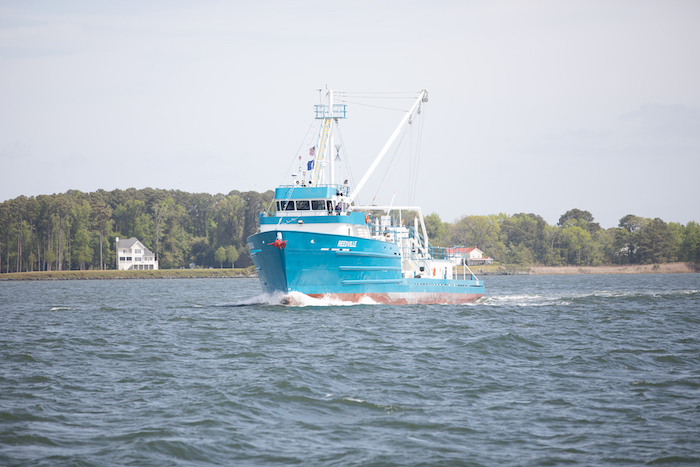
Another video featuring a charter captain is replete with falsehoods. In it, the captain accuses an "industrial company, Omega [Protein]" of "taking more than the Bay can handle - it's not sustainable." This is not only incorrect on the merits - again, the fishery is managed for sustainability by the ASMFC and has been certified sustainable by MSC - but also misidentifies the company that harvests fish. Fishing is conducted by Ocean Harvesters, an American company based in Reedville, Virginia; Omega Protein is a processing company that does no fishing.
Sustainability Is Measured by Science, Not Visual Impressions
The charter captain further states, "you can sit out here and watch them pull up a gigantic net full of [menhaden] and you look at it and it's like 'how is that sustainable?'" The size of the net has nothing to do with the sustainability of a species that is measured in millions of metric tons. The menhaden fishery adheres to quotas set by federal managers and states based on the best available science. That is how sustainability is measured - not by the size of individuals nets.
The Osprey Narrative Ignores Scientific Complexity
The video series also features frequent fishery detractor Chris Moore of the Chesapeake Bay Foundation continuing to drive the narrative that menhaden fishing is responsible for problems with osprey productivity in the Bay. This claim is echoed by Remy Moncrieffe of the National Audubon Society, who states that a "lack of science in regards to the menhaden population, especially in the Bay, is one of the biggest deterrents we have towards effectively managing menhaden."
Menhaden is one of the most studied fish species on the Atlantic coast. Menhaden fishery members have partnered with the Science Center for Marine Fisheries for the past decade, leading to numerous scientific publications and graduate-level theses. Landings data from the industry is used by NOAA scientists and the ASMFC in their menhaden stock assessments. And the industry is supportive of a new effort to produce a research roadmap for menhaden in the Chesapeake Bay.
There is no scientific consensus that menhaden fishing is related to osprey issues in the Bay. U.S. Geological Survey (USGS) scientists have pointed out that osprey populations have leveled off in numerous areas around the country, including places like California and Washington where there are no menhaden, and that there are numerous environmental factors that impact osprey productivity. Fisheries scientists have also questioned the statistical basis that some avian researchers used to draw a link between menhaden fishing and osprey.
Menhaden Is Already Managed With Extraordinary Precaution
The videos call for "more precautionary management" of menhaden "while we get more science," ignoring the fact that menhaden are already managed with extraordinary precaution, including the use of ecological reference points specifically designed to account for predator needs. This call echoes a TRCP petition to remove the fishery from the Chesapeake Bay, which would effectively lead to its shutdown. The idea of shuttering a fishery that has operated continuously for nearly 150 years, is not overfished nor experiencing overfishing, and is certified sustainable by the world's preeminent seafood certifier flies in the face of all traditional fisheries management. Advocacy videos from TRCP using anecdotes, mischaracterizations, and straight up falsehoods do not change the truth about this fishery.
About the Menhaden Fisheries Coalition
The Menhaden Fisheries Coalition (MFC) is a collective of menhaden fishermen, related businesses, and supporting industries. Comprised of businesses along the Atlantic and Gulf coasts, the Menhaden Fisheries Coalition conducts media and public outreach on behalf of the menhaden industry to ensure that members of the public, media, and government are informed of important issues, events, and facts about the fishery.
Press Contact
Menhaden Fisheries Coalition
(202) 595-1212
www.menhaden.org
SOURCE: Menhaden Fisheries Coalition
View the original press release on ACCESS Newswire:
https://www.accessnewswire.com/newsroom/en/food-and-beverage-products/trcp-video-series-is-latest-campaign-to-spread-falsehoods-about-atlantic-1164016