"As Federal Courts Review the Legality of the CMS BEI Program, Washington's Cannabinoid Policy Is Colliding With Itself" stated Duane Boise CEO, MMJ International Holdings.
WASHINGTON, D.C. / ACCESS Newswire / May 13, 2026 / The federal government is now simultaneously expanding cannabinoid access inside Medicare connected healthcare systems while directing federal law enforcement agencies to crack down on cannabinoid products that "threaten consumer safety."
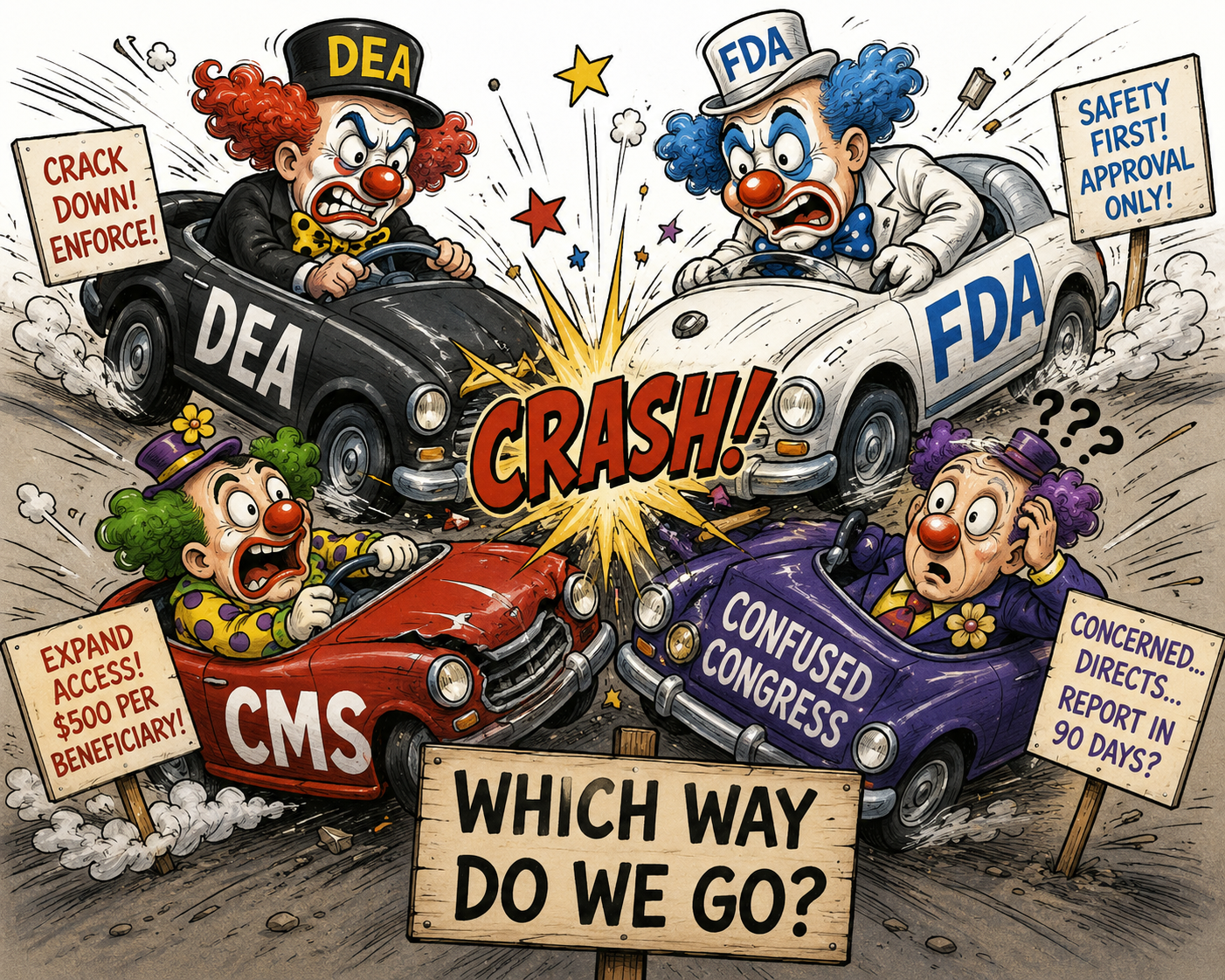
That contradiction now sits directly before a federal court in Washington.
On one side, the Centers for Medicare & Medicaid Services continues advancing the Substance Access Beneficiary Engagement Incentive (BEI) program - a CMS Innovation Center initiative allowing participating healthcare organizations to furnish hemp-derived cannabinoid products inside Medicare-aligned care models.
On the other side, a powerful congressional committee has now directed the Drug Enforcement Administration and the U.S. Food and Drug Administration to take enforcement action against intoxicating cannabinoid products that:
"threaten consumer safety."
The result is a federal policy structure increasingly at war with itself.
Washington Is Sending Two Opposite Messages
Through CMS, the federal government is effectively saying:
cannabinoid products may be integrated into Medicare-connected healthcare systems under physician-supervised models.
At the exact same time, Congress is directing DEA and FDA to:
investigate cannabinoid products
crack down on intoxicating hemp derivatives
enforce controlled substance laws
and address products viewed as operating outside federal safety standards.
The contradiction is staggering.
Federal Courts Are Now Being Asked to Decide Which Agency Actually Controls Medicine
That conflict is now central to:
Smart Approaches to Marijuana et al. v. Robert F. Kennedy Jr. et al.
Case No. 1:26-cv-01081 (D.D.C.)
The lawsuit challenges whether CMS exceeded its statutory authority by creating cannabinoid furnishing pathways inside Medicare-connected systems without traditional FDA drug approval standards.
Judge Trevor N. McFadden heard arguments May 1 and is expected to rule soon.
But since that hearing, the federal environment surrounding cannabinoids has deteriorated rapidly:
Congress ordered DEA/FDA enforcement action
FDA leadership descended into instability
Europe questioned CBD safety standards
cannabis companies were hit with class-action lawsuits over alleged health claims
and the White House moved closer toward restricting intoxicating hemp products nationally.
Europe Says Safety "Cannot Be Established." CMS Expanded Access Anyway.
In March 2026, the European Food Safety Authority (EFSA) concluded that the safety of a hemp extract associated with Charlotte's Web Holdings:
"cannot be established."
The EFSA opinion cited:
incomplete toxicology
unresolved safety questions
insufficient human safety data
and chemically uncharacterized portions of the extract.
Yet companies including:
Charlotte's Web Holdings
cbdMD
Cornbread Hemp
continue positioning themselves for participation in CMS linked healthcare channels.
Meanwhile, CMS allows participating organizations to furnish up to:
$500 annually per Medicare beneficiary
in eligible cannabinoid products.
At retail pricing estimates of roughly:
$0.50 to $1.00 per gummy
that translates into:
500 to 1,000 gummies per senior annually
flowing through Medicare-connected healthcare infrastructure.
The FDA Pathway Was Bypassed - And Companies That Followed It Are Watching
While consumer-market cannabinoid companies expanded into healthcare supply channels, MMJ International Holdings spent years inside the FDA-and-DEA-controlled pharmaceutical framework pursuing:
FDA Investigational New Drug applications
DEA registration
pharmaceutical manufacturing controls
orphan-drug clinical development
analytical laboratory infrastructure
That process required:
toxicology studies
chemistry validation
clinical trial infrastructure
manufacturing oversight
and federal compliance at every level.
The BEI framework required none of it.
The Federal Government Is Now Contradicting Itself in Public
This is no longer a simple cannabis policy debate.
The federal government is now simultaneously arguing:
Through CMS:
Cannabinoid access should expand inside Medicare-connected healthcare systems.
Through Congress, DEA and FDA:
Many cannabinoid products may threaten consumer safety and require enforcement action.
Both positions cannot comfortably coexist.
And now a federal judge must decide whether CMS moved ahead of the science, ahead of the FDA, and possibly ahead of its legal authority.
The Core Question Facing Washington
If Congress is now directing DEA and FDA to crack down on intoxicating cannabinoid products that threaten consumer safety -
then why did CMS move first?
That question may soon define the future of cannabinoid medicine, federal healthcare policy, and the limits of administrative power in the United States.
Madison Hisey
MHisey@mmjih.com
203-231-8583
SOURCE: MMJ International Holdings
View the original press release on ACCESS Newswire:
https://www.accessnewswire.com/newsroom/en/healthcare-and-pharmaceutical/congress-orders-dea-crackdown-on-intoxicating-cannabinoids-while-cms-1166429