NASHVILLE, TN / ACCESS Newswire / May 19, 2026 / Patrick O'Connell, CFA| Director-Responsible Investing Portfolio Solutions and Research
John Huang, CFA| Director of Responsible Investments, Data and Technology-Responsibility
Kathleen Dumes, CFA| Senior Investment Strategist

New research connects intensifying natural perils to their future implications for asset classes.
When it comes to measuring our vulnerability to nature's extremes, investors often lean on past data and simply assume that risks will rise. But new groundbreaking research has removed considerable guesswork, particularly among four key natural hazards facing the world this century.
Global Experts Unite to Predict Natural Hazard Threat Levels
New projections from Columbia Climate School build on its pioneering Natural Hazards Index (NHI), launched in 2016 to assess risk-level exposure from floods, drought and a dozen other extreme events nationwide. In 2023, we partnered with the university on a version 2.0 release, which includes an interactive map of natural hazard exposures for thousands of individual US communities.
2025's upgrade broadens Columbia's and AB's collaboration among leading academic and public institutions, including NASA. Applying the latest weather science, climate research and sophisticated modeling, NHI 3.0 can now project the relative location, trajectory and magnitude of the four natural hazards it tracks at midcentury and end-of-century.
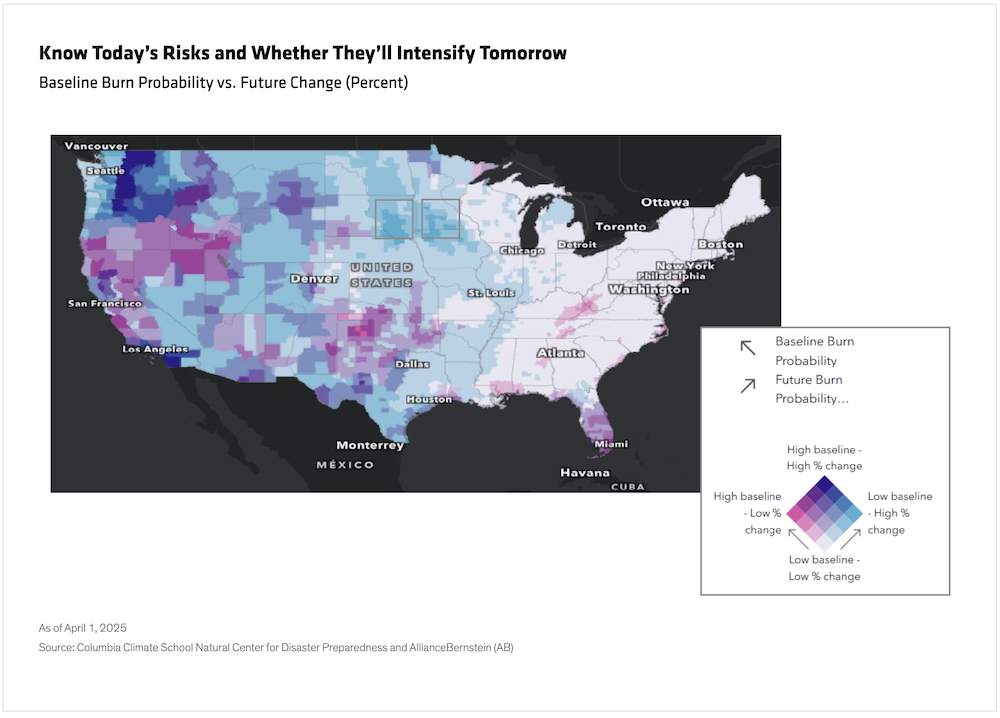
The NHI 3.0 not only tells us the ways a particular hazard has evolved, but also how it's likely to evolve in the future. Wildfires, for example, have increased in frequency and intensity. New data not only predicts fires to worsen where they're already commonplace, such as Southern California and Washington State, but also in areas where incidences are currently rare, like Minnesota and South Dakota (Display).
Newly forecasted tornado patterns are alarming too, with more outbursts likely stretching beyond the Midwest "alley" and much further east.
The NHI also anticipates where hazards will intersect. Sometimes, a disaster ebbs because of an equally disruptive event. The index shows that Louisiana, for instance, will likely suffer fewer wildfires but ties that to expected more frequent hurricanes, which lead to more flooding.
Tying Natural Hazard Vulnerabilities to Investable Assets
Columbia Climate School's new data provide essential inputs for planning disaster responses and anticipating hazards' long-range effects on people, the environment and economies. We believe it also can help investors see better around corners-which is particularly useful as climate change grows more unpredictable and hyperphysical.
With this in mind, we are incorporating key components of NHI 3.0 into our proprietary Physical Hazard Investment Risk (PHIR) tool, which overlays a financial element for each NHI hazard across more than 3,100 US counties. The expanded research now helps PHIR factor future local risk exposures to wildfires, hurricanes, tornadoes and rising sea levels in the US-considered the top four natural threats through 2050.
As an investment tool, the PHIR can assess hazard-risk exposure across municipal bonds and residential mortgage-backed securities. After all, homes, schools, hospitals, power plants and airports are all location specific, which means issuers and lenders are exposed to distinctly local trends in climate change.
Active equity investing can also benefit from the PHIR's expanded data. Companies of all stripes can be just as exposed to local hazards-if not now, then in the coming decades. A company's degree of risk could be exponential, since many operate in multiple locations that face elevated risk.
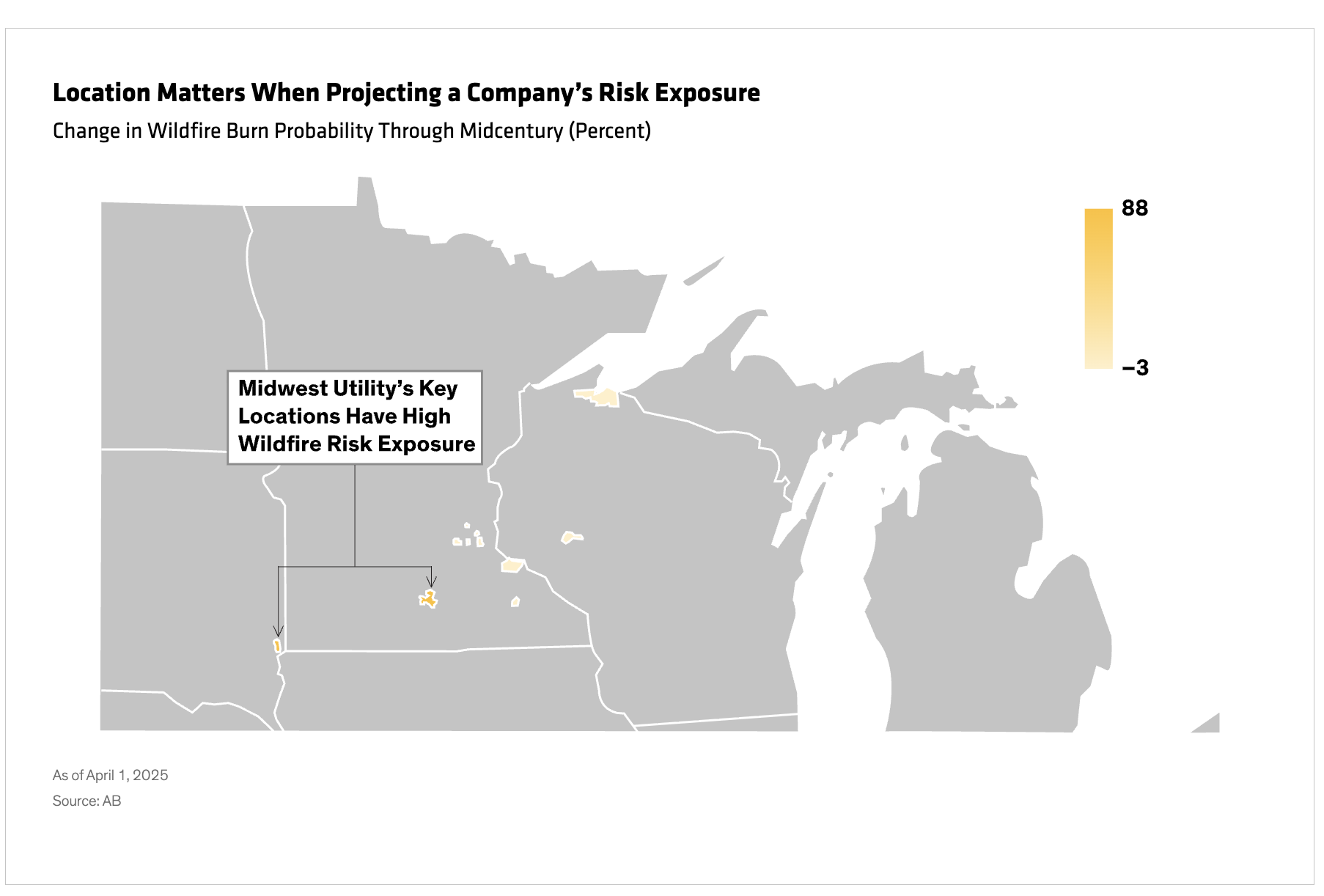
Wildfire projections offer a prime example of how a single company can reveal several risk profiles. A large utility with facilities in Minnesota and South Dakota may be situated in low-risk areas currently. But the wildfire outlook changes dramatically by midcentury. This region shows an increase in wildfire exposure of 88% (Display), a material factor that we believe the company-and those in similar situations-should address. In this case, we engaged the company's leadership about applying lessons learned from its properties in wildfire-prone Colorado to their Midwest operations.
The Local Threats Are Clear, but Not Always Observed
Not all risk scenarios will be as easily navigated. Add the rising threat of higher sea levels, tornadoes and hurricanes, and the future strain on businesses and industries is dire yet actionable. Investors don't always take notice, however. Our expanded PHIR data set helps identify potentially mispriced investment opportunities where hazard exposure isn't yet fully factored into market valuations.
Tomorrow's hazards won't look like yesterday's, but they can inform today's decisions. Locally mapping future natural hazard intensity and addressing its implications will be important steps to dealing with disasters as the century plays out. We think the new predictive analysis will likely save lives and livelihoods. But this forward-looking lens can also help investors understand what natural hazard exposure means for physical assets, while motivating companies and bond issuers to offset such risks on their bottom lines.
The views expressed herein do not constitute research, investment advice or trade recommendations, do not necessarily represent the views of all AB portfolio-management teams and are subject to change over time.
Learn more about AB's approach to responsibility here.
Find more stories and multimedia from AllianceBernstein at 3blmedia.com.
Contact Info:
Spokesperson: AllianceBernstein
Website: https://www.3blmedia.com/profiles/alliancebernstein
Email: info@3blmedia.com
SOURCE: AllianceBernstein
View the original press release on ACCESS Newswire:
https://www.accessnewswire.com/newsroom/en/banking-and-financial-services/alliancebernstein-how-tomorrows-natural-disasters-can-inform-todays-1168203