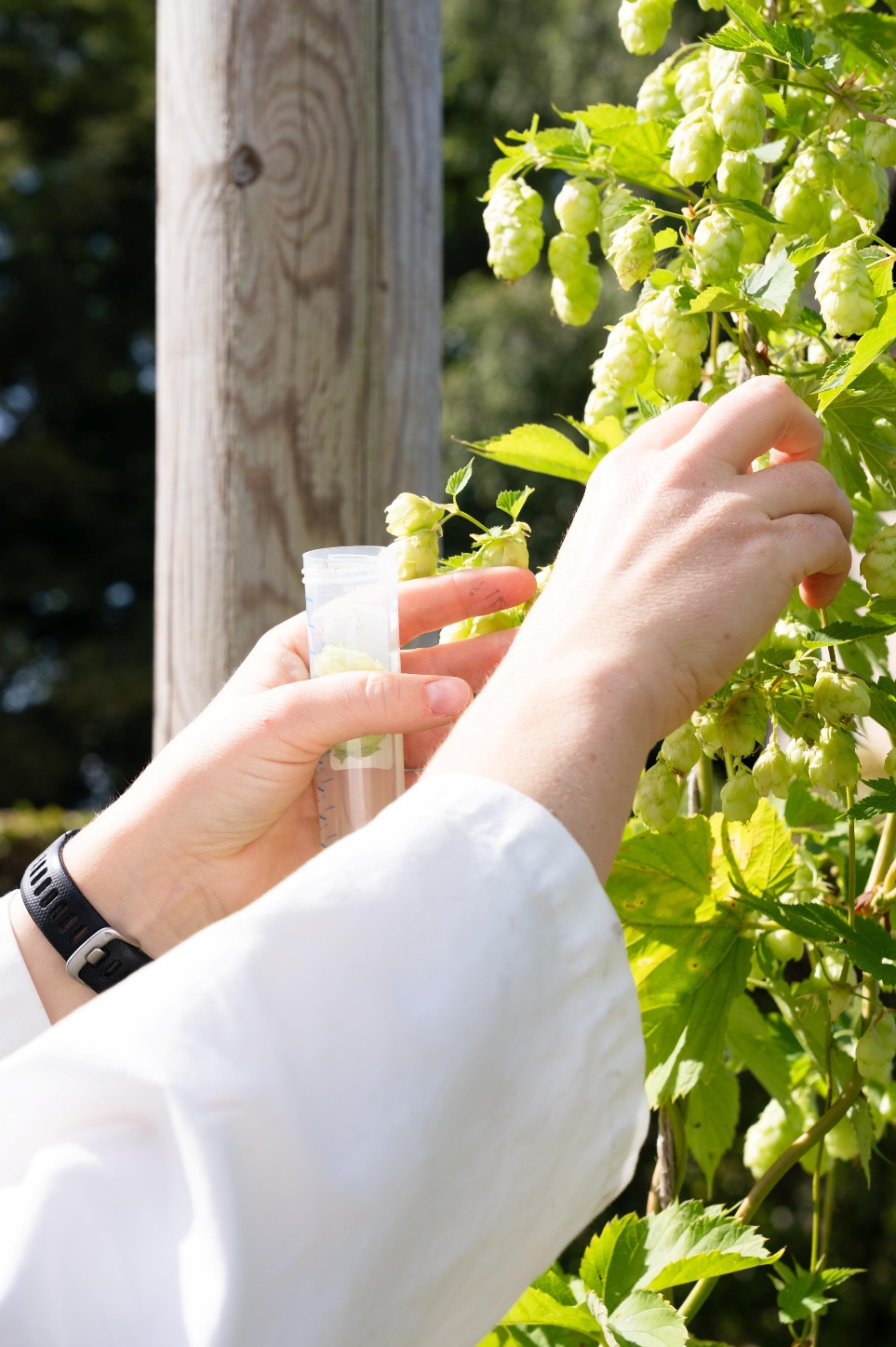
New research published in Nature Communications is being shared freely to help scientists, farmers and brewers worldwide protect and improve one of beer's most essential ingredients
Copenhagen, 27 May 2026: Climate change is putting increased pressure on hop production. In key growing regions, rising temperatures, prolonged droughts and unpredictable weather are already affecting both the yield and the quality of the hops harvested.
Now, the Carlsberg Research Laboratory (CRL) has taken a major step to help address that challenge. CRL scientists have produced the most detailed genetic map of hops to date, giving researchers an unprecedented view of the crop's genetic complexity and its potential for improvement. The breakthrough, now published in the prestigious scientific journal Nature Communications, provides a powerful new foundation for developing hops that can better withstand climate change, while unlocking new possibilities for flavour and quality. In keeping with Carlsberg's long-standing belief that "like beer, science should be shared," the research is being published to benefit the broader brewing, farming and scientific communities.
"Challenges like climate change are bigger than any one company," said Birgitte Skadhauge, Vice President and Head of the Carlsberg Research Laboratory. "By sharing our hop genome research in Nature Communications, we are giving scientists and breeders everywhere tools to protect crops, to innovate, and to help secure the future of beer."
This new research also marks a significant scientific milestone for CRL. Having previously contributed to landmark genome research in barley and yeast, the laboratory has now advanced the understanding of the three traditional non-water ingredients in beer, barley, yeast, and hops, strengthening the scientific foundation of brewing.
Decoding the complex genetics of hops
Behind every hop flower lies an extraordinarily complex genetic system. The hop genome is large, comparable in size to the human genome, highly repetitive and further complicated by an uncommon reproductive biology among flowering plants: male and female flowers grow on separate plants, but only the female plants produce the cones prized by brewers.
In this new research, CRL scientists created a high-resolution map of all the chromosomes that make up the genome of a commercially important hop variety. Like humans, hops carry two versions of each chromosome in every cell, one from each parent, and CRL's map captures both versions in detail. This matters because modern hop breeding often brings together diverse European and North American genetic lineages to create varieties with better brewing performance. The new map allows researchers to see how those lineages are organized in the plant's DNA and how they contribute to key brewing traits.
Put simply, the team has created a high-resolution "DNA map" of hops, showing where important traits are located and how they are inherited.
"Hops are genetically far more complex than most people realise, and that complexity has limited how quickly we can improve them," said Ilka Braumann, Head of Hop Development at the Carlsberg Research Laboratory. "By separating the European and North American lineages in the genome, we can now see how different traits come together, giving us a much clearer path to developing better, more resilient hop varieties."
What this breakthrough could unlock
This is where the real impact lies, not just for Carlsberg, but for the entire brewing and agricultural community.
With the hop genome now decoded and shared, scientists and breeders can improve and accelerate breeding with a far more precise, targeted approach.
That opens the door to:
- Climate-resilient hops: New varieties that can better tolerate heat, drought and changing growing conditions, helping safeguard supply for the future and stabilize yields for farmers.
- New flavours and aromas: A deeper understanding of the molecules behind taste could unlock entirely new flavour profiles. From fruit-forward to floral to previously undiscovered sensory experiences.
- Faster innovation: What once took more than a decade of crossbreeding and testing can now be accelerated with genetic insight.
- More sustainable agriculture: Crops that are naturally more resilient and efficient, requiring fewer inputs while maintaining quality.
In short, this research provides a roadmap for the future of hops, one that could help protect both the availability of beer and the diversity of flavours consumers enjoy.
Brewing up breakthroughs that are bigger than beer.
Founded in 1875 by brewer and philanthropist J.C. Jacobsen, the Carlsberg Research Laboratory helped lay the scientific foundation for modern brewing. But its legacy goes far beyond what's in your glass. From inventing the pH scale to Nobel Prize-winning chemistry developed by one of CRL's researchers to pioneering crop technologies that could address global food insecurity amidst climate change, the Carlsberg Research Laboratory has always pursued science with long-term, society-shifting impact. Thanks to grants from the Carlsberg Foundations, the CRL can pursue the type of important long-term, scientific research that is too slow and too risky for other corporations to pursue.
More information, including a copy of the paper with a full list of authors, can be found online at https://www.nature.com/articles/s41467-026-72379-8