JUDGE McFADDEN SAID MMJ HAS "NO PRODUCT." THE RECORD SAYS OTHERWISE.
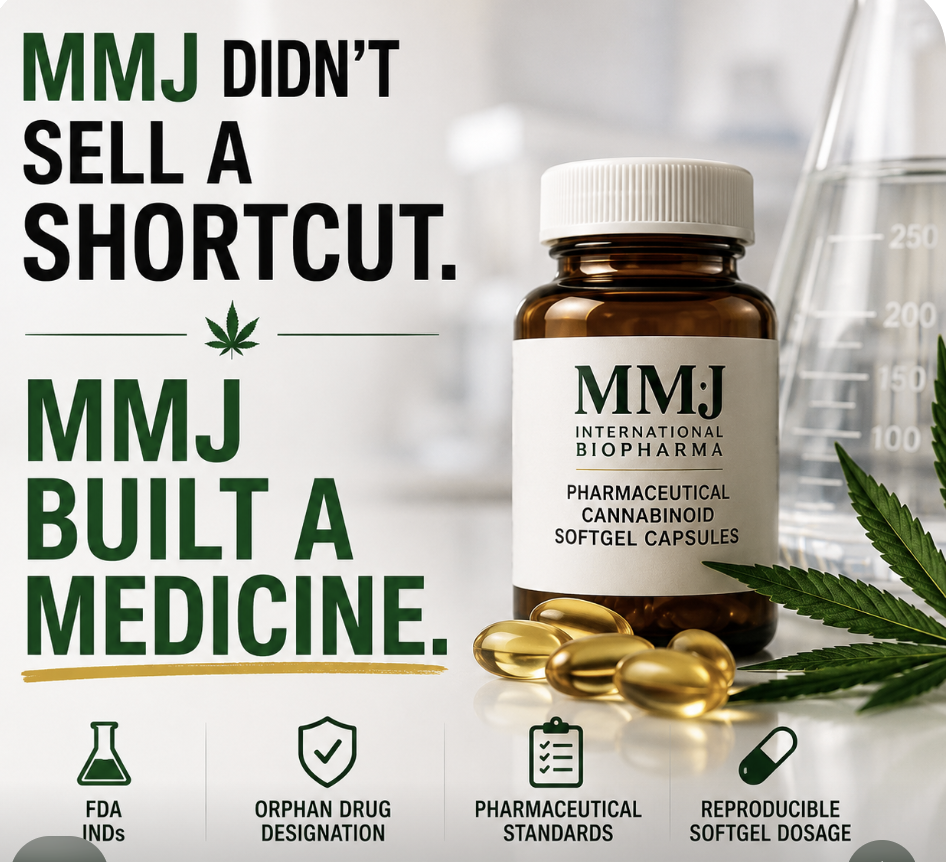
How Can a Company With FDA INDs, Orphan Drug Designation, Manufactured Soft gel Capsules, and Reproducible Chemistry Be Described as Having "No Product"? asked Duane Boise, CEO MMJ International Holdings.
WASHINGTON, D.C. / ACCESS Newswire / May 30, 2026 / One sentence from Judge Trevor McFadden's dismissal of Smart Approaches to Marijuana challenge to CMS's cannabinoid reimbursement program may ultimately become one of the most consequential statements in the entire litigation.
The Court concluded that MMJ International Holdings was not a direct competitor in the market and noted that the company had "no product" currently being sold into the Medicare marketplace.
Legally, that statement formed part of the Court's standing analysis.
Scientifically, however, it raises a much larger question:
What exactly constitutes a "product" in pharmaceutical development?
Because by any traditional FDA measure, MMJ is not a company with an idea.
It is not a company with a concept.
It is not a company with a business plan.
It is a company that spent years creating a standardized cannabinoid medicine under FDA botanical drug guidance.
MMJ's cannabinoid formulation is not a loose plant material, a gummy, a tincture, or a wellness supplement.
The company developed a pharmaceutical softgel dosage form containing standardized cannabinoid content intended for FDA clinical investigation.
The formulation was manufactured as a final dosage form.
The chemistry was characterized.
The ingredients were standardized.
The manufacturing process was documented.
The product was designed to be reproducible from batch to batch, which is precisely what FDA requires for botanical drug development.
That distinction matters.
One of the biggest challenges facing botanical medicines is demonstrating that the product administered to Patient A is materially the same as the product administered to Patient B.
FDA's botanical drug guidance exists because consistency matters.
Reproducibility matters.
Chemistry matters.
MMJ's entire development program was built around meeting those standards.
The company obtained two FDA Investigational New Drug applications.
The company received Orphan Drug Designation for Huntington's disease.
The company established a DEA-registered analytical laboratory.
The company pursued pharmaceutical manufacturing instead of commercial cannabis sales.
The company followed the pathway federal regulators repeatedly encouraged.
Yet when standing was analyzed, MMJ found itself in a strange position.
Companies selling cannabinoid products today were viewed as market participants.
The company attempting to obtain FDA approval for a cannabinoid medicine was viewed as having no product in the market.
That observation highlights a growing contradiction in federal cannabinoid policy.
The government has spent years telling developers that if they want legitimacy, they must follow the pharmaceutical pathway.
Conduct the chemistry.
Characterize the active ingredients.
Manufacture a reproducible dosage form.
Submit INDs.
Perform clinical trials.
Demonstrate safety and efficacy.
MMJ did exactly that.
The result?
The company now finds itself being told it lacks competitive standing partly because it followed a pathway that requires years of scientific validation before commercial launch.
The irony is difficult to ignore.
Had MMJ abandoned the FDA process years ago and entered the cannabinoid marketplace through alternative commercial channels, it might have possessed the exact market presence the Court found lacking.
Instead, it chose the path federal regulators said was necessary.
The larger issue extends beyond one company.
Every pharmaceutical developer considering cannabinoid drug development is watching.
Investors are watching.
Researchers are watching.
Universities are watching.
Because the question is no longer whether cannabinoid medicines can be developed.
The question is whether the federal government will continue rewarding those who follow the scientific pathway it created.
MMJ's softgel capsule exists.
Its chemistry exists.
Its manufacturing records exist.
Its stability work exists.
Its FDA submissions exist.
Its orphan-drug designation exists.
Its regulatory history exists.
The debate is not whether a product was developed.
The debate is whether federal law recognizes the difference between a scientifically characterized medicine and a commercial cannabinoid product that never entered the FDA process.
That question may prove far more important than the standing decision itself.
CONTACT:
Madison Hisey
MHisey@mmjih.com
203-231-8583
SOURCE: MMJ International Holdings
View the original press release on ACCESS Newswire:
https://www.accessnewswire.com/newsroom/en/healthcare-and-pharmaceutical/mmj-et-al-prepares-appeal-cms-hemp-program-how-can-a-company-with-a-m-1172026