KELLOGG, Idaho and VANCOUVER, British Columbia, June 01, 2026 (GLOBE NEWSWIRE) -- Bunker Hill Mining Corp.?("Bunker Hill"?or the "Company") (TSX: BNKR | OTCQB: BHLL)?reports further successful results from the ongoing exploration drill program testing the high-grade silver-lead Cate-8 Vein discovery adjacent to current development in the upper area of the Bunker Hill mine (the "Bunker Hill Mine"). Seven holes have been drilled to date for a total of 2,750 feet from the 8 Level. Assay results for the first five drillholes show significant intercepts, summarized below (results for BHE26-01 and BHE26-02 reported in the Company's press releases dated May 4, 2026 and May 12, 2026). The last two drill holes, BHE26-06 and BHE26-07, also both intersected siderite-galena veins ranging from 1 to 6 feet in length; these holes have been logged, and samples have been submitted to the assay lab.
HIGHLIGHTS:
- Exploration Target Model Estimate for Cate-8 Vein indicates a range of 50,174-167,821 tons at a grade of 9.32-5.75 oz/ton AgEq, with potential to expand through additional drilling
- Drill Hole BHE26-02: 28.6ft length at 5.06 oz AgEq per ton (173.6 AgEq g/t), 280 ft from current mine development
- Drill Hole BHE26-03: 15.5ft length at 11.34 oz AgEq per ton (388.79 AgEq g/t), 310 ft from current mine development
- This new high-grade silver discovery supports the objective of restoring the mine's metal mix to its historic 50% silver and 50% base metals earlier than expected
Sam Ash, President and CEO, commented: "As we prepare to restart operations this month, these results from the Cate 8 exploration program already exceed our expectations. In particular, the consistency, grade, and thickness of mineralization indicate a new discovery, which will assist with our goal of returning the mine to its historic 50% silver and 50% base-metal mix. Based on this, we are planning to expand the program to potentially define a resource that can be incorporated early in the mine plan. Because of its proximity to existing development and potentially significant tonnage and silver grades in preliminary target estimates, I anticipate that, with continued drill success, we will add the Cate I area to the mine plan in ways that could improve the 2027 and 2028 silver production profile."
WEBINAR
The Company will also host a live investor webinar on Wednesday, June 3, 2026, at 10 am PT to discuss the exploration results and the upcoming June restart of operations at the Bunker Hill Mine. Investors, shareholders, analysts, and other interested parties are encouraged to attend.
Registration Link: https://us06web.zoom.us/meeting/register/NIxnjmAbSWW_9d8rqbtGXw
Table 1: Drill intercepts from maiden drill program on Cate-8 Vein Target

Note: Intercepts listed are drilled length; true thickness is unknown from current data: estimated at 50% of drilled length for BHE26-02 and 03, 60% for BHE26-04, 95% for BHE26-02 and 80% for BHE26-05. Strongly mineralized vein intervals were put on rush assay; lower-grade visually mineralized intervals surrounding these intercepts are awaiting results. Core recovery was good (>95%) in mineralized zones other than BHE26-03 (~25%) and BHE26-04 (50.7%), which were drilled at a very low angle to the Cate-8 structure; these intervals will be drilled from a more ideal location for inclusion of those zones in a potential future resource estimate.
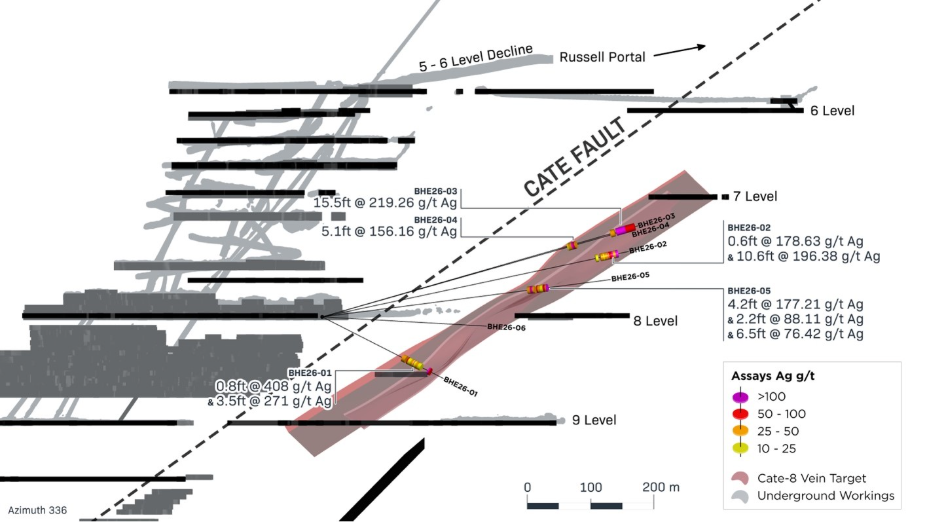
Figure 1: Cross Section of Cate-8 Vein Drill Intercepts. View looking flat at 350 azm; 100-foot grid spacing
The first five drill holes into the Cate-8 Target intercepted intervals of lead-silver-zinc mineralization comprised of multiple discrete high-grade vein structures. Geologic modeling indicates that the mineralization is subparallel to the largest historically mined orebody at Bunker Hill, the March Stope, which was worked continuously from 1885 to 1936, producing a total of approximately 567.6k tons of lead, 24.69M ounces of silver and 106.4k tons of zinc from 4.73M tons of material at grades of 12% lead, 5.22 oz/ton silver and 2.25% zinc (Bunker Hill Mine Production By Orebody, Internal Bunker Hill Mining Company report 1982).
GEOLOGIC AND EXPLORATION SIGNIFICANCE OF DRILL INTERCEPTS
The Cate-8 Target was initially interpreted as being in the "Galena-Quartz" series of veins ("GQ Veins") based on high silver and lead grades; these veins were historically mined at lower levels of the Bunker Hill Mine and were the source of much of the historic silver production. The original exploration concept was that a segment of a GQ Vein had been dragged and offset within the Cate Fault Zone. Although this was a compelling target due to proximity to mine development, the geologic boundaries of the fault zone limited the potential target size.
The presence of abundant siderite (iron carbonate gangue mineral) with galena (lead sulfide) in detailed logging of all drillholes, coupled with their location below the Cate Fault Zone, indicates that the target is a "Hybrid-Type" body of mineralization. These were formed where Galena-Quartz Veins overprinted older "Bluebird-Type" sphalerite-siderite-pyrite veins, which were the source of the bulk of the zinc historically produced at Bunker Hill. Hybrid-Type mineralization is typified by silver-bearing galena deposition around earlier sphalerite-pyrite-siderite veins, resulting in silver, zinc and lead grades in the same zone. "Hybrid" mineralization provided a significant portion of historic mine production, with grades and tonnages generally exceeding those of discrete vein structures.
The projection of the modeled Cate-8 Vein indicates that the structure may continue to intersect with the Francis-Bar Vein system at depth (Fig 2), a GQ Vein set with substantial historic production at deeper levels of the Mine, including (Bunker Hill Mine Production By Orebody, Internal Bunker Hill Mining Company report 1982, considered accurate production records with reconciliation studies between mine, mill and smelter):
Francis Vein: 972k tons at 11.84% Pb, 5.68 oz/ton Ag and 4.47% Zn, containing 115.1k tons lead, 5.52M ounces of silver and 43.4k tons of zinc
Francis FW Vein: 117.6 k tons at 8.2% Pb, 4.47 oz/ton Ag, and 1.56% Zn, containing 9.6k tons lead, 525.7k ounces of silver and 1.83k tons of zinc
Barr Vein: 254k tons at 8.5% Pb, 3.76 oz/ton Ag, and 0.88% Zn, containing 21.6k tons lead, 955.1k ounces of silver and 2.23k tons of zinc1
Hybrid ore bodies are generally subparallel to the Cate Fault Zone, a pre-existing zone of weakness that has been geologically reactivated numerous times. The new drill intercepts in the Cate-8 Target indicate good potential for untested hybrid mineralized zones in the footwall of the Cate Fault, an area almost entirely ignored by historic exploration.
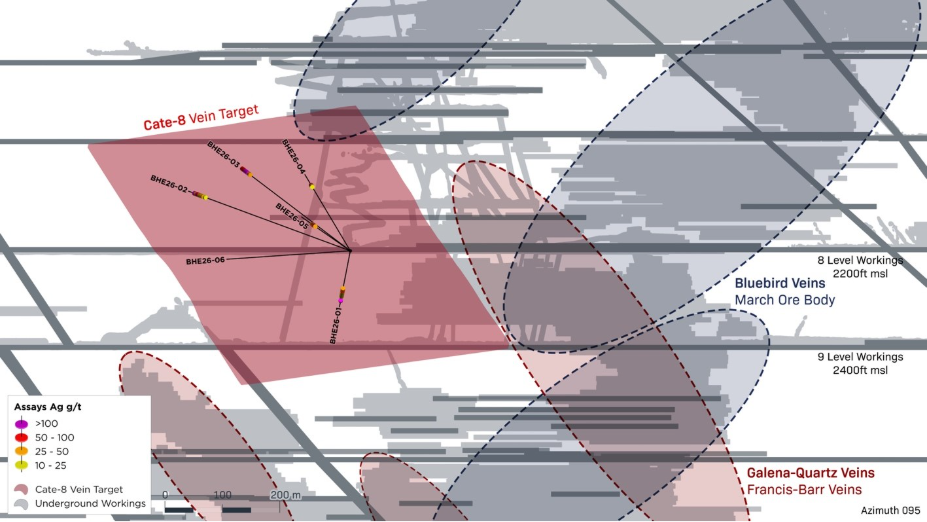
Figure 2: Isometric view of Section of Cate-8 Vein Model with drill intercepts, historic mining areas and downdip untested target area; view flat at 100 azm
Based on the results to date, the Company is refocusing exploration efforts to advance this previously unrecognized mineralization to a drill spacing that will support a future resource estimate. Contingent on ongoing positive drill results, the proximity of the mineralization to existing mine workings would enable rapid inclusion into short-term mine plans. Critically, the identification of "Hybrid-Type" mineralization indicates strong potential for a sizeable, mineralized zone with relatively high combined metal grades and good continuity.
EXPLORATION TARGET ESTIMATES
The Cate-8 Target is currently defined by five modern core holes and three historic drillholes, which outline a tabular zone of continuous lead-silver mineralization between the 7 and the 9 Levels of the Bunker Hill Mine (2,800 feet to 2,400 feet msl). The Cate-8 Veins strike at 340 azimuth, with a dip of 30 degrees to the west, and a current geologically modeled shape extending for 500 feet along strike, and 730 feet down dip based on interpretation of drill intercepts. Two distinct veins have been identified: a lower footwall vein (V01) with a true thickness (from current geologic modeling) of 1.5-4 feet, and an upper vein (V02) with a true thickness of 2-11 feet. These veins are up to 13 feet apart in current modelling and coalesce at certain points.
The Bunker Hill geological team have developed an exploration target estimate for the Cate-8 Vein in Maptek Vulcan 3D mining software, comprising two distinct vein strands, based on 3D modeling of drill intercepts. Tonnage and grade ranges of the exploration target are preliminary and conceptual in nature, are not based on any economic factors other than metal prices and probable metal recoveries, and do not represent any mineral resource estimate. The exploration target estimate is being utilized by the Company for exploration planning only.
Vein geometries were defined by drill intercepts only, with the lower V01 Vein extrapolated for 80 feet along strike and dip, and the upper V02 Vein extrapolated for 135 feet along strike and dip. Grade estimation was completed using inverse-distance cubed weighting and dynamically oriented search ellipses controlled by the block-model dip direction, dip, and plunge fields, allowing the estimation search to follow the interpreted vein geometry. A tonnage factor of 11.38 cu ft/ton was used from mine production and pre-feasibility studies. The statistical estimate is restricted to assay data from five current core holes and three historic core holes drilled by Bunker Hill Mining in the 1970s (1694, 1764, 1768).
Bunker geologists have original logs with hard-copy assay and survey data for the historic drill holes, but the drill cores have been discarded. Although they were drilled and sampled under contemporary industry standards, the holes predate NI 43-101 - Standards of Disclosure for Mineral Projects ("NI 43-101") reporting requirements, and a qualified person has not reviewed the intervals. Bunker Hill geologists consider the historic drill data to be accurate and of adequate quality for exploration planning. These holes will not be used in any future resource estimates until these intervals have been re-drilled.
The exploration target model should be considered preliminary at this stage because the internal sample assays have not yet been returned. As a result, for targeting purposes, the V01 and V02 domains are currently treated together as a combined internal exploration shape. Supporting fields, including sample count, drillhole count, average sample distance, MINDEX, and estimation flag, were retained to provide an internal confidence hierarchy and to allow the model to be reviewed, filtered, and updated as additional assay data become available.
Due to the polymetallic nature of the Hybrid mineralization in the Cate-8 Vein, silver-equivalent grades were determined for each sample interval to directly assess the total metal value of mineralization in the exploration target model. Silver Equivalent grade ("AgEq") was calculated using long-term metal price forecasts of US$76.36/troy ounce silver, $0.89/lb lead and $1.41/lb zinc (CIBC 2026 Consensus), with recovery rates of 91.6% for silver, 88.6% for lead and 86.8% for zinc (Bunker Hill Mining Pre-feasibility Study, 2022). Using these parameters, the metal equivalent factors are 1% zinc = 12.66 g/t AgEq, and 1% lead = 7.99 g/t AgEq, with total AgEq calculated with the formula:
AgEq g/t=Ag g/t + (Zn% * 12.66) + (Pb% * 7.99)
Using an estimated cut-off grade of 4.38 oz/ton AgEq (150 g/t AgEq), the exploration target estimate for the Cate-8 Vein indicates the lower footwall vein, V01, contains 24k tons at a grade of 8.37 oz/ton AgEq (287.11 g/t AgEq) for 202k oz AgEq, and the upper V02 Vein contains 92k tons at 6.41 oz/ton AgEq (219.94 g/t AgEq) for 591k oz AgEq. Tonnage and grade estimates for a range of AgEq cut-off grades are shown in Table 2 below. The nature of the vein deposits indicates that tonnage and grade estimates could fluctuate with further exploration work. Low-grade disseminated galena mineralization was visible in all holes, variably above, between, and below the discrete vein intervals listed here. These shoulder samples are awaiting assay results and have not been included in the current modeling and target estimations.
The potential quantity and grade are conceptual in nature; there has been insufficient exploration to define a mineral resource, and it is uncertain if further exploration will result in the target being delineated as a mineral resource.
Table 2: Exploration target estimate tonnage and grade for a range of estimation cut-off grades for mineralized material for Cate-8 Vein Target
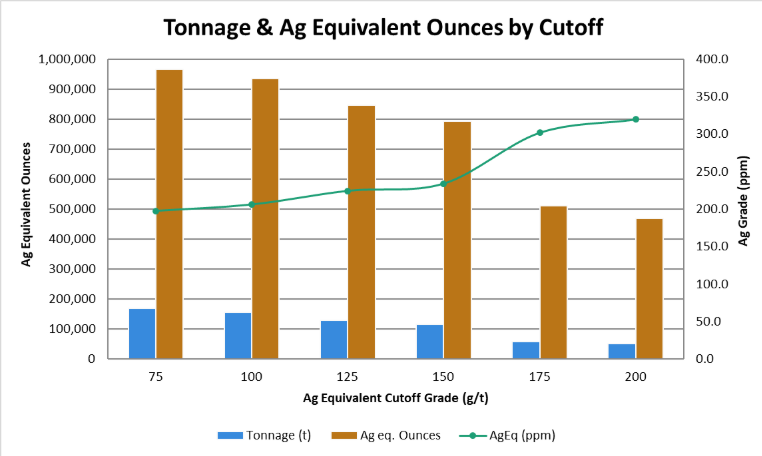
| Cutoff (ppm AgEq) | AgEq (ppm) | Tonnage (t) | Ag eq. Ounces |
| 75 | 197.3 | 167,821 | 965,754 |
| 100 | 205.9 | 155,548 | 934,077 |
| 125 | 224.2 | 129,202 | 844,998 |
| 150 | 233.9 | 116,312 | 793,422 |
| 175 | 301.9 | 57,939 | 510,162 |
| 200 | 319.7 | 50,174 | 467,827 |
This target assessment does not constitute, nor is it implied to be, a mineral resource estimate. The quantity and grade of the exploration target are conceptual in nature, and there has not been sufficient exploration to define a mineral resource. A qualified person has not performed sufficient work on the historic drill data to include it in a current mineral resource, and the Company is only using the target estimate for the Cate-8 Vein for exploration targeting.
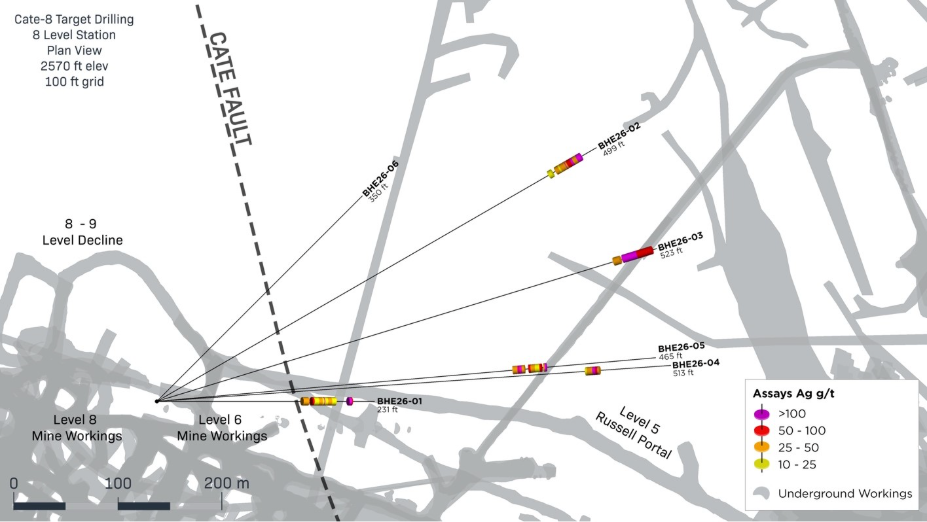
Figure 3: Cate-8 exploration target drill intercepts plan view, historic mine workings in gray
EXPLORATION PLANS
The Company has designed four additional core holes from the existing drill station, for a planned total of ~3,800 feet in 10 holes from the 8 Level of the Bunker Hill Mine. The additional holes target extensions of the modelled Cate-8 Vein Target and infill drilling to provide spacing of intercepts for a potential future mineral resource estimate. Importantly, these drill holes will test the projected intersection of the Cate-8 Vein, the West March Bluebird-Type Vein, and the Barr-Francis series of Galena-Quartz Veins at depth.
Drill stations are being evaluated in the upper levels of the mine for additional drilling to potentially extend known mineralization up-dip on the Cate Vein above the 7 Level, which could add significant tonnage to the Cate-8 Vein Target near-mine exploration potential. Approximately 2,500 feet of drilling is planned from the upper drill stations.
DRILLING DETAILS
Table 3: Summary Table for 2026 Drill Holes at Cate-8 Vein Target
| Hole ID | Azimuth | Inclination | Easting | Northing | Elevation | Length |
| BHE26-01 | 90 | -25 | -3065.67 | 733.63 | 2577 | 231 |
| BHE26-02 | 60 | 12 | -3065.67 | 733.629 | 2577 | 499 |
| BHE26-03 | 73 | 16 | -3065.67 | 733.629 | 2577 | 523 |
| BHE26-04 | 86 | 15 | -3065.67 | 733.629 | 2577 | 513 |
| BHE26-05 | 85 | 7 | -3065.67 | 733.629 | 2577 | 465 |
| BHE26-06 | 45 | -3 | -3065.67 | 733.629 | 2577 | 350 |
Note: Collars have not yet been surveyed, but all holes have been drilled from the same surveyed drill station. Intercepts are listed with drilled length; true thickness is unknown from current data but is estimated at 50% of drilled length for BHE26-02 and 03, 60% for BHE26-04, and 95% for BHE26-02 and 80% for BHE26-05. Coordinates are in the mine grid.
Timberline Drilling is conducting underground core drilling at the Bunker Hill Mine using a Sandvik DE130 compact core drill rig, which is currently running NQ-size rods. Intercepting the Cate-8 Vein Target from the current drill station requires penetrating the Cate Fault Zone, one of the major structures exposed in the mine and subparallel to the Cate-8 Vein. Holes at a low angle of intercept with the Fault and Vein resulted in difficult drilling conditions and poor local recovery within structural zones. Low-recovery intervals were almost entirely within unmineralized intervals, except for BHE26-03 with ~25% recovery from 476.6-503 ft and BHE26-04 with 50.7% recovery from 390-405 ft, both mineralized intervals along the margin of the Cate Fault Zone. These intervals will be redrilled at more ideal intersection angles to provide samples that can be incorporated into future mineral resource estimates.
QUALITY ASSURANCE / QUALITY CONTROL ("QA/QC")
The Company has implemented rigorous QA/QC protocols, including the insertion of blanks and standards in all sample batches.?QA samples inserted into the?assay batches for BHE26-01 and 02, BHE26-03 and BHE26-04 and 05 all passed?the analyses of blanks and certified reference standards.?Core sample?intervals?were selected based on visual geology and mineralization?and were?cut,?bagged?and?delivered to the lab by Bunker Hill geologists.?Samples were split and cut on a core saw where necessary, following a cut line placed by the geologist dividing visible mineralization into equal proportions.
Samples were prepared and analyzed at SVL Lab located in Smelterville, Idaho, using standard industry grind, split, and pulp preparation, followed by microwave digestion and Inductively Coupled Plasma Optical Emission Spectrometry (ICP-OES) analysis, with overlimit samples assayed by fire assay with a gravimetric finish for silver. SVL Analytical, Inc. is a full-service environmental and geochemical laboratory and holds ISO/IEC 17025 accreditation for Fire Assay and Geochemistry. SVL's QA Program meets the quality requirements set forth in the ISO/IEC 17025:2017 Standard, as evidenced by the inclusion and reporting of internal quality control samples with all results.
QUALIFIED PERSON
Sam Bourque- (AIPG CPG?#11775),?Chief Geologist of Bunker Hill, is the Company's designated Qualified Person for this news release within the meaning of National Instrument 43-101. Mr. Bourque has reviewed and approved the technical information contained herein.?
-
ABOUT?BUNKER?HILL?MINING?CORP.
-
Bunker Hill Mining Corp. is a U.S.-based exploration and development company focused on the restart of its flagship asset-the historic Bunker Hill Mine in northern Idaho's prolific Coeur d'Alene mining district. This renowned silver, zinc, and lead deposit is being advanced using modern exploration techniques and responsible development practices to unlock its full potential.?The 1,800tpd operation is due to start in June 2026.
-
The Company's strategy is based on efficiently revitalizing this high-quality asset to deliver long-term value, while upholding strong environmental and operational standards. Bunker Hill is committed to maximizing shareholder returns through the disciplined redevelopment of one of North America's most storied mining operations.?
-
Additional information is available at?www.bunkerhillmining.com?and on the SEDAR+ website (www.sedarplus.ca) or through EDGAR on the SEC website (www.sec.gov).
On behalf of Bunker Hill Mining Corp.
Sam Ash
President and Chief Executive Officer
For additional information, please contact:
Brenda Dayton
Vice President, Investor Relations
T: 604.417.7952
E: brenda.dayton@bunkerhillmining.com
Cautionary Statements
Certain statements in this news release are forward-looking and involve a number of risks and uncertainties. Such forward-looking statements are within the meaning of that term in Section 27A of the U.S. Securities Act of 1933, as amended, and Section 21E of the U.S. Securities Exchange Act of 1934, as amended, as well as within the meaning of the phrase 'forward-looking information' in the Canadian Securities Administrators' National Instrument 51-102 - Continuous Disclosure Obligations (collectively, "forward-looking statements"). Forward-looking statements are not comprised of historical facts. Forward-looking statements include estimates and statements that describe the Company's future plans, objectives or goals, including words to the effect that the Company or management expects a stated condition or result to occur. Forward-looking statements may be identified by such terms as "believes", "anticipates", "expects", "estimates", "may", "could", "would", "will", "plan" or variations of such words and phrases.
Forward-looking statements in this news release include, but are not limited to, statements regarding: the Company's objectives, goals or future plans, including the restart and development of the Bunker Hill Mine and the anticipated timing thereof; Bunker Hill's ability to develop future mining plans and strategies based on the mineralization in the Cate-8 Vein and whether such plans will be developed in the near term; drill programs and assay results; future exploration targets and resource estimates; and the achievement of future short-term, medium-term and long-term operational strategies. Forward-looking statements reflect material expectations and assumptions, including, without limitation, expectations and assumptions relating to; Bunker Hill's ability to receive sufficient project financing for the restart and ongoing development of the Bunker Hill Mine on acceptable terms or at all; the future price of metals; and the stability of the financial and capital markets. Factors that could cause actual results to differ materially from such forward-looking statements include, but are not limited to, those risks and uncertainties identified in public filings made by Bunker Hill with the U.S. Securities and Exchange Commission (the "SEC") and with applicable Canadian securities regulatory authorities, and the following: the Company's inability to raise additional capital for project activities, including through equity financings, concentrate offtake financings or otherwise; capital market conditions; restrictions on labor and its effects on international travel and supply chains; failure to identify mineral resources; failure to convert estimated mineral resources to reserves; the preliminary nature of metallurgical test results; the Company's ability to restart and develop the Bunker Hill Mine and the risks of not basing a production decision on a feasibility study of mineral reserves demonstrating economic and technical viability, resulting in increased uncertainty due to multiple technical and economic risks of failure which are associated with this production decision including, among others, areas that are analyzed in more detail in a feasibility study, such as applying economic analysis to resources and reserves, more detailed metallurgy and a number of specialized studies in areas such as mining and recovery methods, market analysis, and environmental and community impacts and, as a result, there may be an increased uncertainty of achieving any particular level of recovery of minerals or the cost of such recovery, including increased risks associated with developing a commercially mineable deposit, with no guarantee that production will begin as anticipated or at all or that anticipated production costs will be achieved; failure to commence production would have a material adverse impact on the Company's ability to generate revenue and cash flow to fund operations; failure to achieve the anticipated production costs would have a material adverse impact on the Company's cash flow and future profitability; delays in obtaining or failures to obtain required governmental, environmental or other project approvals; political risks; changes in equity markets; uncertainties relating to the availability and costs of financing needed in the future; the inability of the Company to budget and manage its liquidity in light of the failure to obtain additional financing, including the ability of the Company to complete the payments pursuant to the terms of the agreement to acquire the Bunker Hill Mine complex; inflation; changes in exchange rates; fluctuations in commodity prices; delays in the development of projects; and capital, operating and reclamation costs varying significantly from estimates and the other risks involved in the mineral exploration and development industry. Although the Company believes that the assumptions and factors used in preparing the forward-looking statements in this news release are reasonable, undue reliance should not be placed on such statements or information, which only applies as of the date of this news release, and no assurance can be given that such events will occur in the disclosed time frames or at all, including as to whether or when the Company will achieve its project finance initiatives, or as to the actual size or terms of those financing initiatives. The Company disclaims any intention or obligation to update or revise any forward-looking information, whether as a result of new information, future events or otherwise, other than as required by law. No stock exchange, securities commission or other regulatory authority has approved or disapproved the information contained herein.
Readers are cautioned that the foregoing risks and uncertainties are not exhaustive. Additional information on these and other risk factors that could affect the Company's operations or financial results are included in the Company's annual report and may be accessed through the SEDAR+ website (www.sedarplus.ca) or through EDGAR on the SEC website (www.sec.gov).
Photos accompanying this announcement are available at:
https://www.globenewswire.com/NewsRoom/AttachmentNg/c623b664-b8f1-44eb-880f-e3236615db0d
https://www.globenewswire.com/NewsRoom/AttachmentNg/ed5fcea6-2ac3-45b6-930c-e038dff67e43
https://www.globenewswire.com/NewsRoom/AttachmentNg/cf6fb9bc-37b3-4562-8b6d-2a31cf866812
https://www.globenewswire.com/NewsRoom/AttachmentNg/3761d8bc-493f-467e-9278-0a6ed0af5db8