
"As state operators rush DEA applications before a June 27 deadline, courts are quietly reviewing whether the entire rescheduling edifice is built on sand - and whether Medicare is already dosing seniors with products science can't verify are safe" stated Duane Boise CEO MMJ INTERNATIONAL HOLDINGS.
WASHINGTON, D.C. / ACCESS Newswire / June 4, 2026 / The cannabis industry is in a gold rush. Since the Trump administration's April 28 rescheduling order moved state-licensed medical marijuana from Schedule I to Schedule III, multi state operators have been sprinting toward a DEA registration portal with the urgency of a closing bell. Trulieve filed for 200-plus dispensaries the day after the rule published. Verano followed in May. Jushi submitted applications on May 28 - the same day a federal court received the final legal challenge seeking to tear the whole framework down.
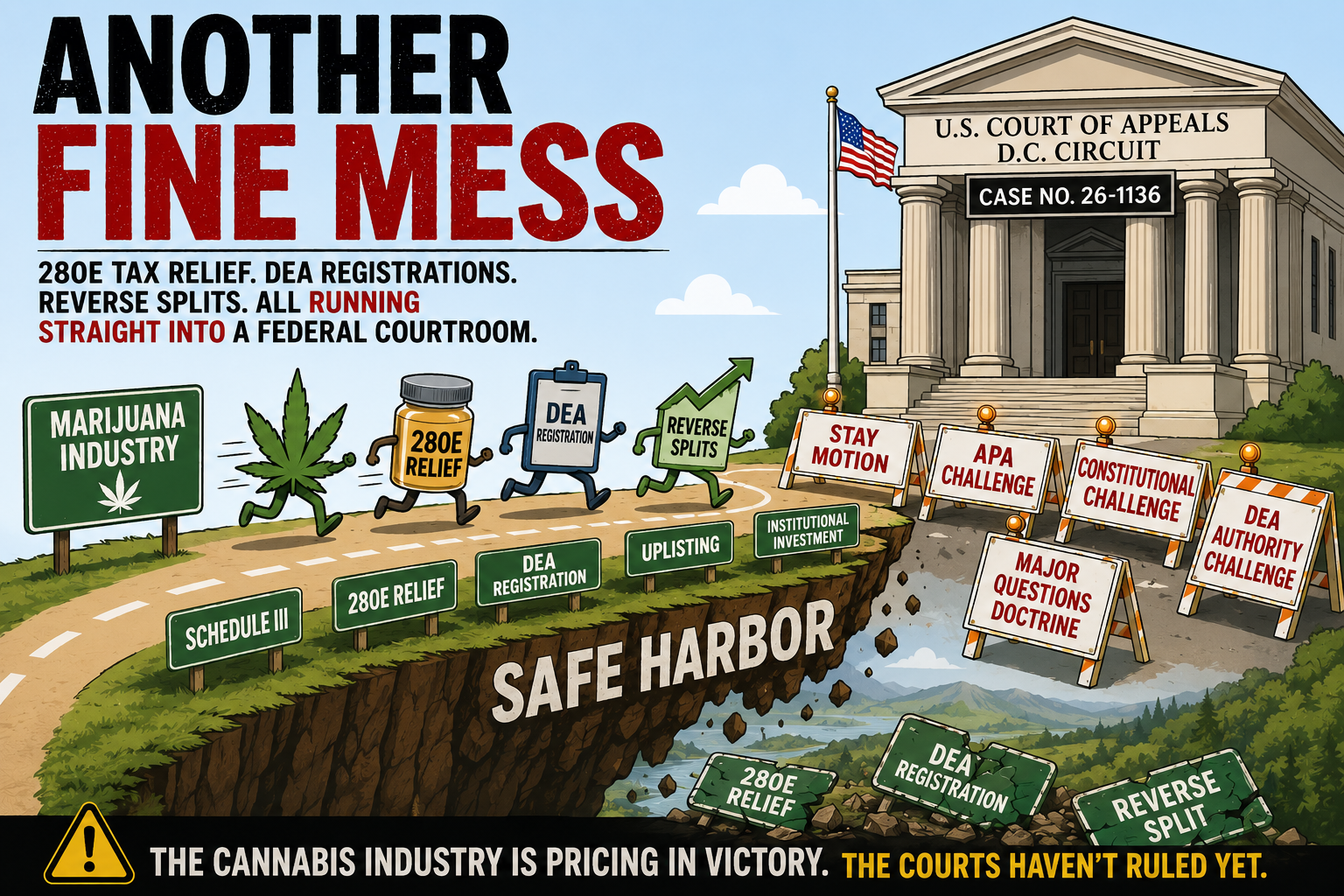
None of these companies appear to have disclosed one inconvenient fact: the DEA's own application now asks them whether they previously manufactured, distributed, or dispensed controlled substances without DEA authorization. For most of the state cannabis industry, the honest answer is yes. For years. That's not a technicality. That's the central question the entire rescheduling challenge turns on.
The Rush to the Door
The 60-day application window - running until approximately June 27, 2026 - grants priority review, a six-month processing target, and safe harbor to keep operating under a state license while DEA considers the application. Miss it, and operators lose that guaranteed continuity. So they're filing fast.
Trulieve, which has more than 200 medical cannabis dispensaries, filed for DEA registration under the expedited Schedule III process on April 29, the day after the order published. Verano submitted applications in May, announcing them as milestone steps toward federal compliance under the landmark rescheduling order. Jushi Holdings followed on May 28, calling DEA registration "an important milestone for Jushi and the medical patients we serve."
What none of these press releases addressed was the other thing that happened on May 28: the filing of the most detailed legal challenge yet to the rescheduling order, which explicitly targets the expedited registration pathway these companies are now using as a centerpiece of its argument.
The Problem No Press Release Can Fix
The DEA's own binding Final Rule published in 2020 states that many of these operators spent years manufacturing marijuana without DEA authorization in violation of federal law - and that prior compliance with federal law would receive "particular emphasis" in registration decisions. The DEA's application now directly asks whether applicants previously dealt in controlled substances without federal authorization. For most large state operators, the honest answer is yes.
This is not a historical footnote. It is live statutory text, still on the books, now directly relevant to every application being submitted. The rescheduling order creates an expedited pathway. It does not expunge the record of operating outside federal law for a decade.
MMJ International Holdings - which has spent more than eight years pursuing the FDA pharmaceutical pathway, holds an active DEA Schedule I laboratory registration, and is now one of the petitioners challenging the rescheduling order in the D.C. Circuit - has been pointed about this contradiction. CEO Duane Boise put it plainly: "DEA told cannabis companies federal compliance mattered. Now the companies that ignored the rules want fast entry into the same federal system."
The Legal Trap Under Every Application
The rescheduling order, AG Order No. 6754-2026, is the legal foundation for every DEA application being filed right now. It is also the subject of three consolidated petitions for review in the U.S. Court of Appeals for the D.C. Circuit, filed May 4, May 22, and May 28. All three coalitions seek a stay, a declaration of unlawfulness, and vacatur of the order in its entirety.
If the D.C. Circuit grants a stay, the order is suspended. Cannabis reverts to Schedule I. Every application built on the Schedule III framework becomes worthless. Every operator who has been running under interim "safe harbor" status during the pendency of their application finds that safe harbor evaporated. And the 280E tax relief - which industry consultants have been telling operators applies to the full 2026 tax year, potentially retroactively - snaps back immediately, with serious exposure for any operator who acted on it.
Congressional researchers have already noted that the DOJ's rescheduling order does not immediately bring state-licensed operators into compliance with federal law. That's not fringe analysis - that's the Congressional Research Service. The gap between what the press releases say and what the law actually provides is significant.
The petitioners' 13 grounds for challenge include arguments that the order exceeds the Attorney General's statutory authority, violates the APA's notice-and-comment requirements, contravenes the major questions doctrine, and was issued under an administrative law judge structure the DOJ itself has already conceded is unconstitutional. That last argument - developed by MMJ through its own prior litigation in MMJ BioPharma Cultivation Inc. v. Bondi - is particularly sharp: DOJ formally acknowledged that the ALJ removal structure violates the separation of powers and Article II, and the same unconstitutional structure is scheduled to conduct the expedited rescheduling hearing starting June 29.
Meanwhile, Medicare Is Already Dosing Seniors
Parallel to the rescheduling fight, a separate federal program has been quietly distributing cannabinoid products to Medicare beneficiaries with no FDA drug approval required, no clinical validation, and safety questions that Europe's top food safety authority says cannot currently be resolved.
The CMS Substance Access Beneficiary Engagement Incentive, which launched April 1, 2026, allows participating Medicare providers to furnish hemp-derived cannabinoid products to eligible seniors under ACO REACH, the Enhancing Oncology Model, and starting January 2027, the LEAD model. The FDA commissioner responded by directing exemptions to drug labeling and other regulatory requirements specifically to avoid interference with the CMS program - a "hands-off" posture that critics say inverts the normal order of federal drug oversight.
A coalition of drug safety groups challenged the program, arguing CMS exceeded its authority by bypassing notice-and-comment rulemaking, acted arbitrarily and capriciously, and violated controlling federal statutes including the 2026 Agriculture Appropriations Act and the Controlled Substances Act. The emergency motion for a temporary restraining order was denied. Then the case was dismissed - not on the merits, but for lack of standing. The judge ruled that while plaintiffs "may not like the BEI, they have not been injured by it," and dismissed for lack of subject matter jurisdiction. Plaintiffs have stated they are reviewing options including an appeal.
The court did not rule these products are safe. It ruled no one had been harmed enough yet to be heard.
Beginning November 12, 2026, hemp-derived cannabinoid products will be restricted to no more than 0.4 milligrams of total THC per container - not per serving, not per gummy, per entire package - a restriction that will disqualify a substantial portion of today's hemp cannabinoid market. Congress passed that restriction while CMS was simultaneously launching a program to distribute those same products to seniors. The policy arms of the federal government are not talking to each other.
The Science Nobody Wants to Talk About
Running beneath all of this is a product safety problem the industry and regulators have jointly decided to treat as background noise.
MMJ's press release, published as the legal challenges mounted, cited peer-reviewed research finding that less than 1% of cannabis research has focused on microbial contamination, and approximately 0.5% has examined pathogens, mycotoxins, and spoilage organisms. California regulators, operating the most mature state cannabis market in the country, issued 63 recalls and 481 product embargoes in 2024 alone. Multiple state-licensed cannabis testing laboratories have faced enforcement actions involving allegations of potency inflation, data manipulation, and failures to identify contaminants.
The European Food Safety Authority issued a scientific opinion in March 2026 concluding that the safety of a major Charlottes Web hemp extract product could not be established, citing incomplete toxicology data and unidentified concerns. Europe said it doesn't know if the product is safe. The United States responded by having CMS distribute it to Medicare beneficiaries.
The rescheduling order places state-licensed marijuana into Schedule III - a schedule historically reserved for drugs that have undergone FDA review. Not one marijuana product dispensed under a state license has received FDA approval. The petitioners argue there is no body of well-controlled scientific studies demonstrating that cannabis as sold in state dispensaries can effectively treat any specific medical condition at the level of rigor historically required for CSA scheduling. The order doesn't dispute this. It simply proceeds anyway.
The Bottom Line for Investors
Every downstream benefit the cannabis industry is pricing in right now is built on a foundation that is actively being litigated:
The 280E relief is contingent. It exists only because the order has not been stayed. A stay restores Schedule I status immediately. Operators who have restructured their tax positions, taken deductions, or filed amended returns on the assumption that Schedule III is permanent are exposed. The IRS has issued no formal safe harbor guidance.
The DEA registrations being filed right now are being filed into a live legal controversy. An operator who receives DEA registration while a stay motion is pending does not receive a guarantee of anything. The registration is only as durable as the order that authorizes it.
The June 27 application deadline creates urgency, but not certainty. Operators are being advised to file fast to lock in safe harbor and priority review. What they are not being told is that the entire legal basis for that safe harbor is before a federal appeals court whose ruling could retroactively eliminate it.
The June 29 DEA hearing is itself constitutionally contested. The petitioners argue it cannot lawfully proceed under an ALJ structure the DOJ has already admitted violates the Constitution.
For pharmaceutical-track operators like MMJ that built within the federal system from inception, a successful challenge would be vindicating. For the broader industry that has spent a decade building outside it and is now sprinting through a door that may not stay open, the moment of reckoning may be approaching faster than the press releases suggest.
CONTACT:
Madison Hisey
MHisey@mmjih.com
203-231-8583
Sources: U.S. Court of Appeals for the D.C. Circuit, Case No. 26-1136; AG Order No. 6754-2026, 91 Fed. Reg. 22,714 (Apr. 28, 2026); Smart Approaches to Marijuana v. Kennedy, No. 1:26-cv-01081 (D.D.C.); MMJ BioPharma Cultivation Inc. v. Bondi, No. 1:24-cv-127 (D.R.I.); CMS Substance Access Beneficiary Engagement Incentive program documentation; public DEA registration guidance; MMJ International Holdings press releases dated May 14 and May 23, 2026.
SOURCE: MMJ International Holdings
View the original press release on ACCESS Newswire:
https://www.accessnewswire.com/newsroom/en/healthcare-and-pharmaceutical/280e-tax-relief.-dea-registrations.-reverse-splits.-the-cannabis-indu-1172955
