
Vancouver, British Columbia--(Newsfile Corp. - August 4, 2026) - KASIS CLEAN WATER TECHNOLOGIES INC. (the "Company" or "Kasis") is advancing summer work plans focused on the preparation, scale-up and cost analysis of a modified-polystyrene version of its patented Kasis redox materials, with particular emphasis on gold recovery and related clean-water and mineral-processing applications.
For more than a century, gold recovery has depended heavily on chemical processes that helped unlock low-grade ore bodies but also created lasting environmental and safety challenges. The MacArthur-Forrest cyanide process, introduced in the late 1880s, became one of the most important breakthroughs in modern gold mining because it made fine gold recoverable from ores that earlier methods could not process economically. Later, activated carbon, carbon-in-pulp/carbon-in-leach circuits, ion-exchange resins and thiosulfate-based systems expanded the industry's toolkit.
Those advances came with trade-offs. Cyanide remains widely used and is managed under strict industry codes, but transport, handling and tailings risks continue to concern communities, regulators and mine operators. Mercury remains a major issue in artisanal and small-scale gold mining. Other proposed alternatives - including thiosulfate, glycine, thiourea, halide systems, activated carbon and resin-in-pulp technologies - have shown promise in specific settings, but many have struggled with cost, selectivity, reagent consumption, regeneration, compatibility with different ore types, or commercial simplicity.
Kasis is working in that long-running problem space: how to recover value from mineral streams while reducing reliance on toxic legacy chemistry.
The company's current focus is a redox-active, modified-polystyrene bead platform. Previous laboratory trials of Kasis redox-active resin beads have been highly effective, with testing indicating gold recovery of up to 99.9%. The company is now concentrating on production technology, repeatability and cost analysis.
| "The polystyrene resin beads are our lead product in the gold recovery area," said Dr. Andrew Grant, Chief Technology Officer of Kasis Clean Water Technologies. "Having examined other Kasis redox materials for use in a variety of applications, we are focusing our attention back to the polystyrene beads. We want to be certain of our production technology, and carry out a detailed cost analysis." |
To support that work, Kasis is in discussions with a Canadian-based chemical company with production facilities in China - which is not being named at this stage - to determine approximate production costs and evaluate pathways toward larger-scale preparation of the modified-polystyrene material.
A key scientific question now under review is why the beads appear to perform beyond what would be expected from simple surface activity alone. In Kasis laboratory observations, a small number of beads precipitated a notable quantity of gold, raising the possibility that activity may not be limited to functional redox centers at the bead surface.
A)
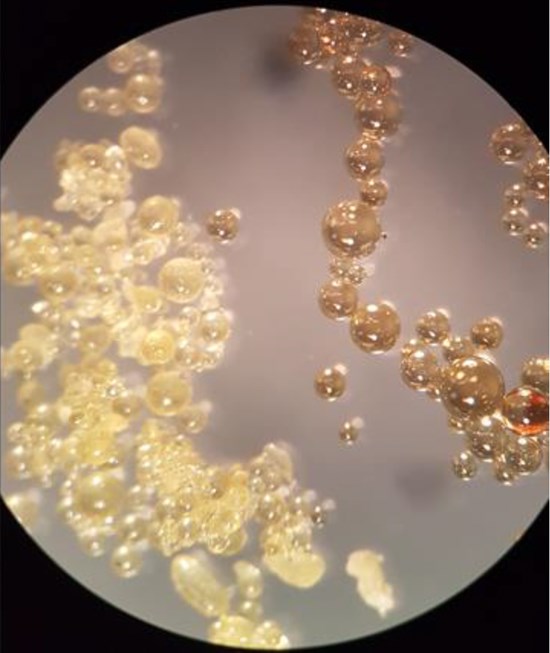
Image A: Modified-polystyrene redox-active resin beads being advanced by Kasis for gold-recovery testing and production optimization
To view an enhanced version of this graphic, please visit:
https://images.newsfilecorp.com/files/10665/307574_5407796df48c9865_003full.jpg
B)
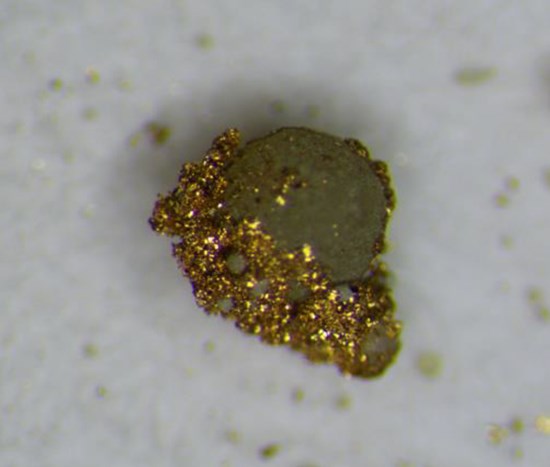
Image B: Laboratory gold precipitation observed during Kasis testing, where a small number of modified-polystyrene beads produced unexpectedly strong recovery behaviour
To view an enhanced version of this graphic, please visit:
https://images.newsfilecorp.com/files/10665/307574_5407796df48c9865_004full.jpg
| "A notable amount of gold was precipitated by just a few beads that we felt there was something more going on than just reaction of functional redox-centers on the surface of the beads," said Dr. Grant. "It's possible that we are dealing with an 'electron hopping' mechanism between redox-centers within the inside volume of the bead." |
If that mechanism is confirmed, Kasis believes the modified-polystyrene platform could have broader implications beyond a single gold-recovery application. A bead material capable of supporting redox activity through its internal structure could point toward additional opportunities in selective metal recovery, industrial process streams, environmental remediation and water-treatment applications where recoverability, regeneration and selectivity matter.
Kasis' approach differs from many historic alternatives because it is being developed around functional materials rather than simply replacing one dissolved reagent with another. The goal is not only to dissolve or capture metals, but to build a reusable material platform that can be engineered, tested, costed and adapted for real-world mineral-processing and clean-water needs.
| "At Kasis, we see clean mining and clean water as linked problems," said Jeff Selder, President of Kasis Clean Water Technologies. "The world still needs metals, but communities increasingly expect technologies that reduce toxic chemical dependency, recover value efficiently and create fewer downstream environmental liabilities. That is the value proposition Kasis is pursuing." |
Kasis' current summer R&D Program is focusing on:
optimizing preparation of the modified-polystyrene redox beads;
evaluating production technology and approximate scale-up costs;
continuing gold-recovery testing and mechanism investigation;
examining whether observed performance is consistent with an internal electron-hopping mechanism; and
identifying additional applications for the patented Kasis redox-material platform.
The company emphasizes that its current work remains technical and developmental. Laboratory results and mechanism observations will require further validation, scale-up work and application-specific testing. However, Kasis believes the early performance of the modified-polystyrene beads supports continued investment in the platform.
| "Gold recovery has seen many proposed alternatives over the years," said Dr. Grant. "The challenge is not only finding chemistry that works in a beaker. The challenge is developing a material and process that can be produced, reused, costed and applied in the real world. That is where our current work is focused." |
Kasis Clean Water Technologies is developing patented redox-active materials for gold recovery, metal adsorption, water treatment and environmental remediation. The company's KCell platform is positioned as part of a new generation of functional materials designed to reduce reliance on toxic legacy processes while improving recoverability and process control.
On Behalf of the board of directors
"Jeffrey Selder"
Mr. Jeffrey Selder
Chief Executive Officer
Kasis Clean Water Technologies Inc.
Office: 778-400-9618
Email: info@Kasis.ca
Website: www.Kasis.ca
About Kasis Clean Water Technologies
Kasis Clean Water Technologies is a Canadian-based chemical technology company bringing novel materials with remarkable chemical properties to market. Its flagship innovation, KCell-a patented synergistic extractant with unique redox properties-is under study for enabling fast, efficient, and eco-friendly solutions across mineral processing, water purification, redox-flow batteries, sensors, and antiviral/antibacterial coatings and surfaces (PPE).
Currently focused on gold extraction and recovery, KCell is being evaluated for high-yield recovery of gold from process solutions and tailings-turning waste into valuable product-while offering a safer, scalable, and sustainable alternative to conventional toxic chemicals.
To view the source version of this press release, please visit https://www.newsfilecorp.com/release/307574
Source: Kasis Clean Water Technologies Inc.
