WPC-35: 5.9m grading 38 g/t (1.2 oz/T) Silver ("Ag") and 12.1% Zinc ("Zn")
Including 3.2m grading 67 g/t (2.1 oz/T) Ag and 16.9% Zn
SS25-04: 4.4m grading 148 g/t (4.6 oz/T) Ag; 0.68% lead ("Pb") and 0.24% Zn
Including 1 m grading 349g/t (10.8 oz/T) Ag 2.2% Pb and 0.20% Zn
Tucson, Arizona--(Newsfile Corp. - January 20, 2026) - Alaska Silver Corp. (TSXV: WAM) (OTCQX: WAMFF) (the "Company", "Alaska Silver" or "WAM") is pleased to report high-grade silver and zinc results in several holes from its limited 2025 drilling program (<3000m) at the 100%-owned Illinois Creek ("IC") Carbonate Replacement Deposit ("CRD") project in western Alaska. The 2025 program comprised 2,057 m of drilling in 4 holes at the Waterpump Creek deposit, with WPC-35 which cut 5.9m (core length) grading 38 g/t (1.2 oz/T) Ag and 12.1% Zn, including 3.2m grading 67 g/t (2.1 oz/T) Ag and 16.9% Zn. In addition, 906.5 m of drilling in 9 shallow scout holes was completed at the newly discovered high-grade silver-lead zone, Silver Sage, located approximately 4.8km south of Waterpump Creek (See press release dated November 3, 2025). Among these holes, SS25-04 cut 4.4m (core length) reporting 148 g/t (4.8 oz/T) Ag; 0.68% Pb and 0.24% Zn, including 1 m grading 349 g/t (11.2 oz/T) Ag 2.2% Pb and 0.20% Zn.
"With the discovery of the blind, high-grade Silver Sage zone and refinement of the architecture of Waterpump Creek South, we feel we had a highly successful season despite having a very limited budget. We think we are zeroing in on the link to the southern extension of our Waterpump Creek resource and want to emphasize the importance of the blind Silver Sage zone, not just in how it expands the Illinois Creek district footprint, but how it indicates that more such mineralized zones are likely hidden beneath our extensive cover," said Kit Marrs, Alaska Silver's President and CEO. "Having completed our US listing and $13.8 million dollar financing after the 2025 field season, we are well poised to put those resources to work through much more aggressive drilling in 2026."
2025 Waterpump Creek Drilling
Alaska Silver completed a limited 4-hole, 2,057m drilling program at the Waterpump Creek to seek extensions of the known high-grade resource, which contains 75 million ounces AgEq at a grade of 279 g/t silver, 11.28 % zinc and 9.87% lead (see press release of February 22, 2024 and disclosures at the end of this release), across a post-mineral fault zone and to identify the structural conduits that channeled mineralizing fluids into carbonate-rock mineralization traps. Two of the four holes hit significant silver-zinc mineralization (See Tables 1 and 2) north of the fault and probably represent the continuation of the high-grade Waterpump Creek resource. The other two holes deviated significantly from their targets, but one hole (WPC25-0037) cut appreciable copper and both cut extensive CRD-style mineralization. The copper here may indicate proximity to a feeder structure. All four holes cut post-mineral faults and provide critical information on the overall architecture of the Waterpump Creek area. The combined results strongly indicate that mineralization continues to the south of the post-mineral fault, and the improved understanding of how the post-mineral faulting created the current deposit geometry will help guide comprehensive step-out drilling to successfully locate the offset mineralization.
Table 1. Waterpump Creek Drilling Results
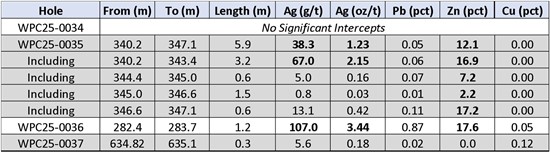
To view an enhanced version of this graphic, please visit:
https://images.newsfilecorp.com/files/7510/280891_alaska%20table%201.jpg
Note: All intervals are core length, as insufficient structural data exists to determine true thicknesses
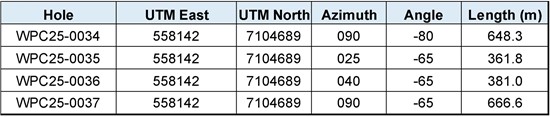
Table 2. Waterpump Creek Drill Hole Information
To view an enhanced version of this graphic, please visit:
https://images.newsfilecorp.com/files/7510/280891_alaska%20table%202.jpg
Silver Sage Discovery
In early July 2025, Alaska Silver identified a new mineralized zone, Silver Sage, through initial trenching along a 1.5 km long transect centered on historical 1980s soil anomalies that had never been followed up on (See press release of November 3, 2025). The program quickly identified a 550m long deeply weathered breccia zone containing distinctive rubbly boulders of massive silver-bearing galena and cerussite (oxidized galena). Trench sampling returned numerous high-grade silver-lead values, including multiple samples reporting assays above 310 g/t silver (10 oz/T), with grades up to 1,235 g/t silver (40 oz/T) (See Fig. 1). Sampling also returned gold values as high as 0.55 g/t.
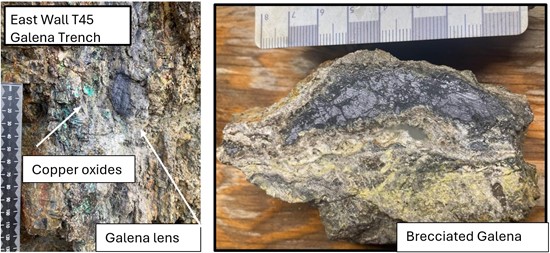
Figure 1. Galena Trench: Brecciated argentiferous galena with copper oxides and yellow-green fine-grained mineral in banded siliceous rock
To view an enhanced version of this graphic, please visit:
https://images.newsfilecorp.com/files/7510/280891_alaska%20figure%201.jpg
Late in the season, nine short, widely spaced drill holes totaling 906.5 m were drilled across and along the inferred axis of the breccia zone to evaluate stratigraphy, alteration, and potential structural controls. Four of the holes hit significant localized silver and lead with widespread anomalous zinc values and gold locally exceeding 1 g/t and copper approaching 1% (See Tables 3 and 4). The mineralization was deeply oxidized with geochemistry indicating the dissolution and removal of a substantial proportion of the zinc. The drilling shows that the mineralization is concentrated at the top of a thick section of reactive carbonate rocks directly beneath an impermeable schist layer - a classic CRD setting. Follow-up drilling of the area to locate the feeder for this mineralization and coherent mineralization is a priority goal for the 2026 field season.
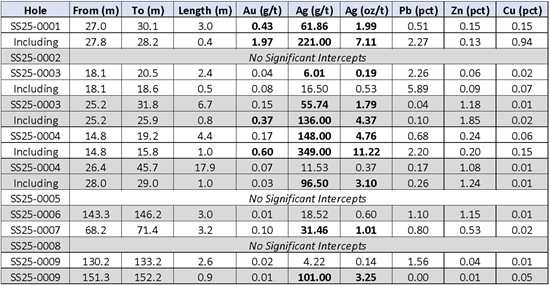
Table 3. Silver Sage Drilling Results
To view an enhanced version of this graphic, please visit:
https://images.newsfilecorp.com/files/7510/280891_alaska%20table%203.jpg
Note: All intervals are core length, but insufficient data exists to determine true thicknesses
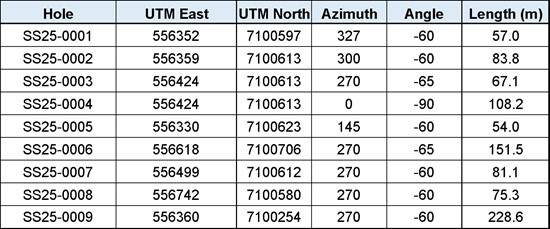
Table 4. Silver Sage Creek Drill Hole Information
To view an enhanced version of this graphic, please visit:
https://images.newsfilecorp.com/files/7510/280891_86f68fe774acc89c_013full.jpg
2025 Waterpump Creek Drilling Program
Alaska Silver has delineated a significant high-grade Ag-Pb-Zn Inferred Resource at Waterpump Creek (See Press Release of February 22, 2024). Believed to be part of much more extensive integrated CRD mineralization system, the resource ends abruptly against a post-mineral fault, so the Company's focus for 2025 has been to find the offset continuation of the deposit to the south across this fault. During the 2025 field season, Alaska Silver completed a limited drilling program of four holes totaling 2,057 metres in an initial attempt to locate this continuation (Fig. 2). Two holes (WPC-35 and 36) were designed to refine the location of the post mineral fault and continue to depth to seek extensions to the Waterpump Creek resource itself. Both succeeded, first cutting the fault and then significant silver and high-grade zinc mineralization (See Table 1). The second two holes were designed to determine the direction of offset on the post mineral fault, but both deviated significantly from their targets. Nonetheless, both cut significant CRD-style alteration and one (Hole WPC25-0037) cut appreciable copper, which may indicate proximity to a feeder structure. In combination, the 4 holes demonstrate continuation of the favorable reactive carbonate host stratigraphy and that mineralizing fluids affected the south block. The drilling also identified at least 2 strands of post-mineral faults, providing important information on the current structural architecture of the Waterpump Creek area and improved understanding of the post-mineral faulting.
The two holes completed south of the post-mineral 4700N fault (WPC25-0034 and WPC25-0037) both intersected the schist-carbonate contact at about 500 metres depth and showed moderate to weak CRD-style alteration. The alteration was stronger in WPC25-0034 than WPC25-0037 suggesting the mineralized zone lies to the west and indicating the 4700N fault has both vertical and lateral movement. This defines potential targets to the west of WPC25-0034 for drilling in 2026. In contrast, holes WPC25-0035 and WPC25-0036 drilled north of the fault confirmed the continuation of the mineralization and alteration patterns of the known Waterpump Creek deposit. Hole WPC25-0036 returned 1.23 metres of 107 g/t silver and 17% zinc surrounded by strong, characteristic CRD-style alteration with elevated geochemistry. This hole is interpreted to have narrowly missed the continuation of the principal mineralized body.
Aggressive drilling is planned for 2026 to better understand the structure, locate mineralization in the south block and follow that mineralization back towards its source.
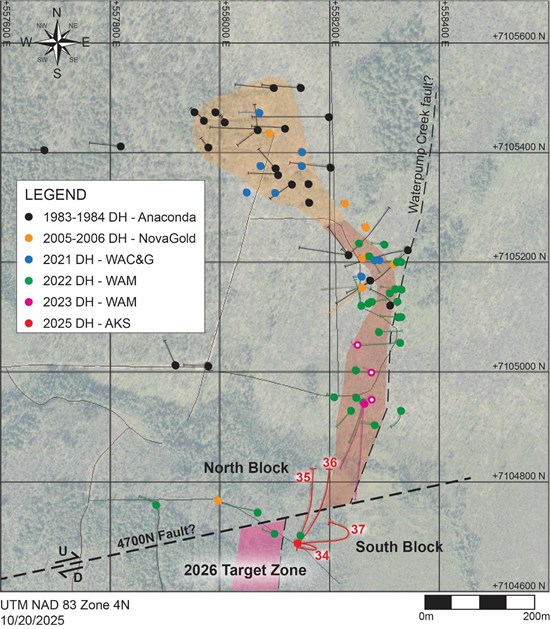
Figure 2. Map of the Waterpump Creek area with 2025 drill hole traces illustrated in red.
To view an enhanced version of this graphic, please visit:
https://images.newsfilecorp.com/files/7510/280891_86f68fe774acc89c_014full.jpg
2025 Silver Sage Drilling Program
In addition to the discovery trenching and fieldwork, 9 shallow "Scout" holes totaling 906.5 meters were drilled at Silver Sage to get a preliminary idea of the area's geological framework (See Fig. 3 below). The first 8 holes had an average depth of 100m, and with the exception of Hole SS25-0006, were drilled along an east-west section to determine stratigraphy and if a feeder structure could be defined. Hole SS25-0006 was drilled 120m north of this line and Hole SS25-0009, the deepest hole (228m), was drilled 500m to the south to test a CSAMT anomaly. The drilling shows that the mineralized carbonate package is about 100m thick and is sandwiched between an overlying schist package that crops out to the east and an underlying greenstone unit that appears on the west. The strongest hydrothermal activity is concentrated along the upper carbonate contact just below the capping schist unit but also affects a series of layers in the basal part of the schist. This contact zone hosts the deeply weathered breccia with fragments of massive high-grade argentiferous galena that led to the discovery in Trench T45, the "Discovery" or "Galena" trench. In the drillholes that cut this contact (Holes S25-005 and S25-008 respectively, were drilled below and above it), this contact is marked by heavily sanded, muddy gossans that range in color from nearly black to rusty orange. The darker gossans are very rich in manganese (to 10%). All of the gossan zones returned strong gold, silver, copper, lead, zinc and manganese values along with a basket of trace elements. Zinc values are low because the intense weathering dissolved the zinc minerals and "flushed out" the zinc.
"The concentration of hydrothermal activity at the top of a favorable reactive carbonate, immediately below an impermeable "seal" is a hallmark feature of distal CRDs and in many instances mineralizing fluids are known to have traveled many hundreds of meters from their source feeder along this type of contact," said Peter Megaw, Ph.D., Alaska Silver's Technical Advisor. Furthermore, Dr. Megaw stated, "Locating this feeder is an important early exploration goal but the drilling done to date at Silver Sage is so shallow that structural determinations are nearly impossible because the rocks in the upper parts of all holes drilled through the breccia and gossan zones were highly broken and jumbled. Nonetheless, the location and composition of the higher-grade oxidized mineralization gives some initial clues that will be used to guide 2026 drill targeting (See Fig 4 below)."
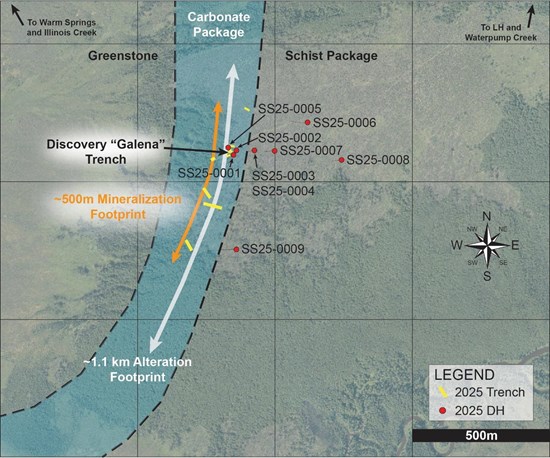
Figure 3. Map of the Silver Sage zone showing trench locations, drill hole collars, and generalized geology.
To view an enhanced version of this graphic, please visit:
https://images.newsfilecorp.com/files/7510/280891_86f68fe774acc89c_015full.jpg
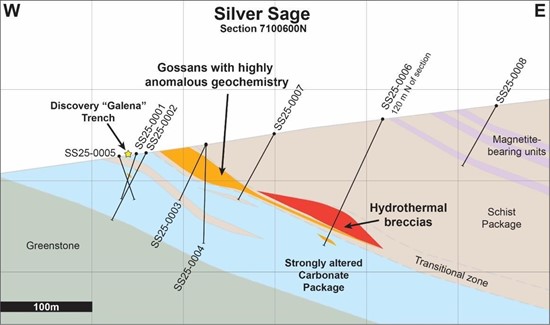
Figure 4. East-west cross section on line 7100600N at Silver Sage showing geologic units and mineralized zones.
To view an enhanced version of this graphic, please visit:
https://images.newsfilecorp.com/files/7510/280891_86f68fe774acc89c_016full.jpg
The Company believes that the most important drillholes are SS25-0001, 0003 and 0004, each of which cut strong gossans with good values (See Table 3).
SS25-0001
Collared approximately 15m southeast of the Galena Trench (T45), this hole was aimed directly at the projection of the galena zone exposed in the trench. The hole mostly cut highly altered and weathered dolostone interlayered with schist. Much of the core was highly sanded or brittle and tended to crumble quickly. A strong gossan package was cut between 27.0 and 30.1 meters, which reported 0.43 g/t gold and 61.9 g/t silver, including 0.4 meters with 1.97 g/t gold, 2,221 g/t silver and 0.94% copper.
SS25-0003
Collared approximately 85m east of SS25-0001, this hole targeted the main schist-carbonate contact downdip from the previous two holes. Most of the hole was in highly sanded interlayered schist and dolostone and drilling was difficult. However, along and below the schist and dolostone contact multiple, parallel gossan zones were cut carrying high iron, manganese and silver, with modest gold values. The most significant intercept was 6.7 meters (core length) from 25.2 meters that contained 55.7 g/t silver, with an internal high-grade zone 0.8 meters thick carrying 0.37g/t gold and 136 g/t silver.
SS25-0004
Hole SS25-0004 is the best hole drilled at Silver Sage to date. Drilled off the same pad as SS25-0003, it was designed to cut the same gossans at greater depth. Drilling conditions were equally poor due to pervasive sanding and weathering. Overall lithologies were similar to SS25-0003 and, like SS25-0003, the extreme disruptions prevented structural determinations. Two principal gossan zones were cut. The first was a 4.4-meter zone (core length) from 14.8 meters depth containing 0.17 g/t gold, 148 g/t silver and 0.68% lead, within which the uppermost 1 meter ran 0.60 g/t gold, 349 g/t silver, 0.15% copper and 2.20% lead. The second gossan interval was a broad, multi-layer zone with a combined thickness of 17.9 meters (core length) beginning at 26.4m downhole, that averaged 11.5 g/t silver and just over 1% zinc. Within this at 28 m depth, was a 1-meter interval that ran 96.5 g/t silver and 1.24% Zn.
Quality Assurance and Quality Control
Drill core samples were transported in sealed containers from site to the ALS Minerals laboratory in Fairbanks, Alaska for sample submission. The samples were then shipped to ALS Minerals in Reno, Nevada, for sample preparation. Analyses were completed at both ALS's Mineral's Reno and North Vancouver laboratories, which are certified under ISO 9001 and accredited under ISO/IEC 7025.
The gold content is determined by fire assay of a 30-gram charge with an AA finish (Au-AA23). Silver, lead, copper, and zinc along with other elements are analyzed by ICP-MS utilizing a four-acid digestion (ME-MS61). Over-limit samples for silver, lead, copper, and zinc are determined by using either an ore grade four-acid digestion and ICP-ES finish (ME-OG62) or ore-grade titration analysis (VOL50 or VOL70) for very high-grade samples.
Control samples consisting of certified reference samples, duplicates, and blank samples were systematically inserted into the sample stream and analyzed as part of the Company's quality assurance / quality control protocol.
Qualified Person
Patrick Donnelly P.Geo, Executive Vice President of Alaska Silver, a Qualified Person under National Instrument 43-101, has reviewed and approved the scientific and technical information in this news release.
About Alaska Silver
Alaska Silver is the pioneer of one of North America's major high-grade silver and critical minerals districts at the Illinois Creek (IC) Project in western Alaska. Anchored by the high-grade silver mineralization of the Waterpump Creek zone, 75 Moz @ 980 g/t AgEq (Inferred) 1,2, open to the north and south and the historic Illinois Creek mine, 525 Koz AuEq - 373 Koz @ 1.3 g/t AuEq (Indicated), 152 Koz @ 1.44 g/t AuEq (Inferred) 3,4, Alaska Silver's 100% owned carbonate replacement deposit shows significant exploration potential across its 8-km length. Located approximately 38 kilometers from the Yukon River, the region's marine highway, the claims of the IC project cover a 100% owned land package of 80,895 acres (126.36 sq miles or 32,337 hectares). Headquartered in both Alaska and Arizona, Alaska Silver brings together a team with a proven track record of large-scale mine discoveries.
1 Please refer to the NI 43-101 Technical Report titled "Illinois Creek Project Update, Illinois Creek Mining District, Western Alaska, USA" dated April 2, 2024 (effective date of February 20, 2024).
2 For Waterpump Creek, the formulas for AgEq are AgEq (g/t)= Ag (g/t) + 28.56 x Pb(%) + 37.12 x Zn(%) and assume metal prices of US$24/oz Ag, US$1.30/lb Zn, and US$ 1.00/lb Pb.
3 Please refer to the NI 43-101 Technical Report titled "Illinois Creek Project Update" dated September 22, 2023 (effective date of May 22, 2023).
4 For Illinois Creek, AuEq values are based only on gold and silver values using metal prices of US$1,600/oz Au and US$20/oz Ag.
"Kit Marrs"
Kit Marrs
President & CEO
kit@alaskasilver.com
Phone: 1-520-200-1667
For further information, please contact:
Patrick Donnelly
Executive Vice President
pat@alaskasilver.com
Or visit our website at: www.alaskasilver.com
Neither the TSXV nor its Regulation Services Provider (as that term is defined in the policies of the TSXV) accepts responsibility for the adequacy or accuracy of this release.
Forward-Looking Information
This news release contains "forward-looking information" within the meaning of applicable Canadian securities legislation. "Forward-looking information" includes, but is not limited to, statements with respect to the activities, events or developments that the Company expects or anticipates will or may occur in the future. Generally, but not always, forward-looking information can be identified by the use of words such as "plans", "expects", "is expected", "budget", "scheduled", "estimates", "forecasts", "intends", "anticipates", or "believes" or the negative connotation thereof or variations of such words and phrases or state that certain actions, events or results "may", "could", "would", "might" or "will be taken", "occur" or "be achieved" or the negative connotation thereof. This forward-looking information relates to, among other things, ongoing and anticipated exploration work at the Illinois Creek Project, including the Company's intention to complete more aggressive drilling in 2026; the potential for an entirely new area of mineralization at Silver Sage; the potential continuity of the Waterpump Creek resource and the expectation that mineralization continues to the south of the post-mineral fault; the belief that the presence of copper may indicate proximity to a feeder structure; the implementation of the objectives, goals and future plans of the Company including the proposed advancement of the Illinois Creek Project as currently contemplated; the expectation that exploration activities (including drill results) will accurately predict mineralization; the expectation that the Company will implement its drilling, geoscience and metallurgical work on its properties and work plans generally; the effective targeting activities proposed by the Company; and the anticipated benefits of the Company's approach to exploration.
Such forward-looking information is based on numerous assumptions, including among others, that exploration work at the Illinois Creek Project will occur as anticipated; assay results will be received when anticipated; Silver Sage will represent an entirely new area of mineralization; the CRD property will exhibit the anticipated continuity; the Company will be able to implement its objectives, goals and future plans, including the proposed advancement of the Illinois Creek Project and drilling in 2026 as currently contemplated; exploration activities (including drill results) will accurately predict mineralization; the Company will be able to implement its drilling, geoscience and metallurgical work on its properties and work plans generally; the targeting activities proposed by the Company will be effective; and the Company's approach to exploration will result in the expected benefits. Although the assumptions made by the Company in providing forward-looking information is considered reasonable by management at the time, there can be no assurance that such assumptions will prove to be accurate and actual results and future events could differ materially from those anticipated in such information.
Important factors that could cause actual results to differ materially from the Company's plans or expectations include: the risk that exploration work at the Illinois Creek Project will not occur as anticipated; the risk that assay results will not be received when anticipated; the risk that Silver Sage will not represent a new area of mineralization as anticipated; the risk that the CRD property will not exhibit the anticipated continuity; the risk that the Company will not be able to implement its objectives, goals and future plans, including the proposed advancement of the Illinois Creek Project as currently contemplated; the risk that exploration activities (including drill results) will not accurately predict mineralization; the risk that Company will not be able to implement its drilling, geoscience and metallurgical work on its properties and work plans generally; the risk that the targeting activities proposed by the Company will not be effective; the risk that the Company's approach to exploration will not result in the expected benefits; risks related to market conditions and metal prices; delays in obtaining or failures to obtain required governmental, environmental or other project approvals; uncertainties relating to the availability and costs of financing needed in the future; changes in equity markets; inflation; fluctuations in commodity prices; the other risks involved in the mineral exploration and development industry; and those risks set out in the Company's public disclosure record on SEDAR+ (www.sedarplus.ca) under the Company's issuer profile. Although the Company has attempted to identify important factors that could cause actual results to differ materially from those contained in the forward-looking information or implied by forward-looking information, there may be other factors that cause results not to be as anticipated, estimated or intended. There can be no assurance that forward-looking information will prove to be accurate, as actual results and future events could differ materially from those anticipated, estimated or intended. Accordingly, readers should not place undue reliance on forward-looking information. Readers are cautioned that reliance on such information may not be appropriate for other purposes. The Company does not undertake to update any forward-looking information or financial outlook that are incorporated by reference herein, except in accordance with applicable securities laws. Any forward-looking information contained in this news release is expressly qualified in their entirety by this cautionary statement. We seek safe harbor.
To view the source version of this press release, please visit https://www.newsfilecorp.com/release/280891
Source: Alaska Silver Corp.