Edmonton, Alberta--(Newsfile Corp. - March 25, 2026) - Torr Metals Inc. (TSXV: TMET) ("Torr" or the "Company") is pleased to announce that the drill-permitted Lodi and Kirby Zones have emerged as a compelling secondary drill target for the 2026 exploration program, based on newly integrated interpretations of geological, geochemical, and geophysical datasets.
Torr believes the Lodi-Kirby area represents a highly prospective copper (Cu) - gold (Au) porphyry cluster system, with the potential to host multiple preserved mineralized intrusive centres, including the Lodi and Kirby occurrences, at shallow to moderate depths beneath a broader interpreted hydrothermal footprint measuring approximately 24.5 km² (Figure 1).
The Lodi-Kirby Zones provides a strong complement to the Company's primary focus at the Bertha Zone, where Phase 1 drilling completed in late 2025 delivered strong vectoring toward high-priority target areas where potential source porphyry intrusions are interpreted to be located (see January 22, 2026 news release). Lodi-Kirby is situated within the Company's 100%-owned highway-accessible Kolos Cu-Au Project in southern British Columbia.
A follow-up update on the Bertha targeting progress is expected in the near term.
Highlights:
The Company's current interpretation indicates that Lodi-Kirby exhibits several characteristics commonly associated with concealed porphyry Cu-Au systems, including:
- Large magnetic anomaly with a central zone of magnetic destruction (Figure 1) with rock grabs assays around the margins returning up to 0.52% Cu and 4.24 g/t Au.
- A coincident conductive core indicative of sulfide-bearing hydrothermal alteration as evidenced by Cu-Au mineralization hosted in exposed biotite-phase (potassic alteration) diorite intrusions at Kirby, located on the margins of the interpreted core.
- Surrounding polymetallic geochemical footprint silver (Ag) - molybdenum (Mo) - tellurium (Te) - bismuth (Bi), together with lead (Pb) - zinc (Zn), consistent with the interpreted inner and outer alteration shells respectively (Figure 2).
- Mineralized brecciated volcanic sequence at Lodi suggests proximity to a causative porphyry system, vectoring towards a mineralized core at depth.
- Alteration zonation from propylitic to phyllic with increasing quartz-carbonate veining toward the interpreted high conductivity core (Figure 1, Figure 3).
"Lodi-Kirby has rapidly advanced as a compelling drill target and adds meaningful momentum to our 2026 exploration program," stated Malcolm Dorsey, CEO of Torr Metals. "With strong vectoring already established at Bertha, the addition of Lodi-Kirby strengthens our pipeline of high-quality targets and potentially increases our chances of success in Phase 2 drilling. Importantly, Torr is fully funded for up to 6,000 metres of drilling within the drill-permitted Bertha and Lodi-Kirby zones, positioning us to efficiently advance both targets this season. Together, these targets highlight the growing scale and discovery potential of the Kolos Project and positions the Company for an active and results-driven exploration season."
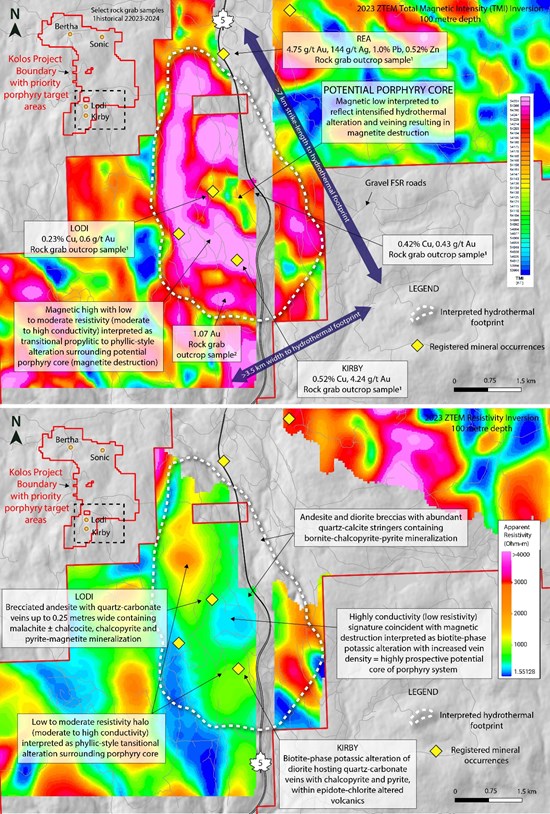
Figure 1. Newly inverted 2023 ZTEM total magnetic intensity (TMI) (above) and resistivity (below) geophysical surveys with outlined hydrothermal footprint, annotated registered mineral occurrences, and select rock grab samples.
To view an enhanced version of this graphic, please visit:
https://images.newsfilecorp.com/files/6794/289788_cb05d79c4423c83a_001full.jpg
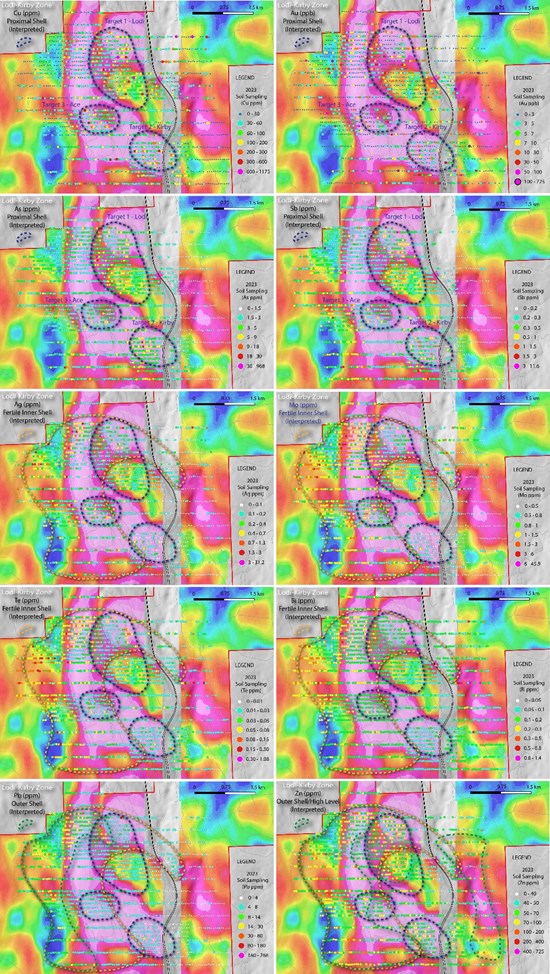
Figure 2. 2023 soil samples displaying pathfinder elements for the interpreted proximal, inner, and outer shells of a large-scale cluster porphyry system including the Lodi, Kirby, and Ace targets; overlying newly inverted 2023 ZTEM total magnetic intensity (TMI) geophysics.
To view an enhanced version of this graphic, please visit:
https://images.newsfilecorp.com/files/6794/289788_cb05d79c4423c83a_002full.jpg
Geological and Geophysical Interpretation
Based on surface sampling and ZTEM (Z-Axis Tipper Electromagnetic) airborne geophysics Torr interprets the central magnetic low to reflect intensified hydrothermal alteration and veining resulting in magnetite destruction, coincident with a conductive core interpreted to represent a potential sulfide-rich, pyrite-dominant (phyllic) alteration zone (Figure 1, Figure 3).
Importantly, the surrounding magnetic high with coincident low to moderate resistivity is interpreted to represent a fertile inner hydrothermal shell, where magnetite-bearing intrusive and volcanic rocks have been variably overprinted by sulfide-bearing fluids. The inner margin of this zone is considered highly prospective, as it commonly marks the transitional environment between outer alteration and the concealed porphyry core.
Rock samples recovered from the conductive core area include intrusive phases characterized by strong epidote alteration, calcite veining, and abundant pyrite, interpreted to reflect earlier calc-potassic to propylitic alteration subsequently overprinted by pyrite-rich hydrothermal fluids. This overprinting relationship is consistent with telescoped porphyry systems, where earlier alteration assemblages are preserved but modified by later fluid events associated with mineralization.
Strong Geochemical Pathfinders and Copper Leakage Model
The Lodi-Kirby target displays well-defined geochemical zonation consistent with modern porphyry vectoring models.
A Cu-Au-dominant core signature is spatially associated with intrusive-hosted mineralization, while a surrounding polymetallic halo is enriched in Ag, Mo, Pb, Zn, Te, and Bi. The presence of Mo, Bi, and Te is considered particularly significant, as these elements are commonly associated with fertile intrusive systems and may define an inner shell to a concealed mineralized porphyry centre.
Notably, copper-in-soil anomalism is concentrated along the margins of the conductive core rather than directly above it. This distribution is interpreted to reflect potential copper leakage from a buried porphyry core, where:
- The conductive core is dominated by pyrite-rich alteration and lies at depth.
- Copper is preferentially transported upward through permeable structural and lithological pathways along the shoulders of the system.
- Soil geochemistry therefore defines the most effective surface expression of fluid escape.
This relationship is consistent with buried porphyry systems, where surface copper anomalies commonly form halos around a concealed core, providing a vector toward potential primary mineralization.
In addition, the presence of As and Sb associated with the Cu-Au core is interpreted to reflect a high-level porphyry environment, potentially with late-stage hydrothermal overprinting.
Highest-priority drill targets are interpreted to occur along the transition from the magnetic hydrothermal shell into the conductive core and at depth beneath this interface.
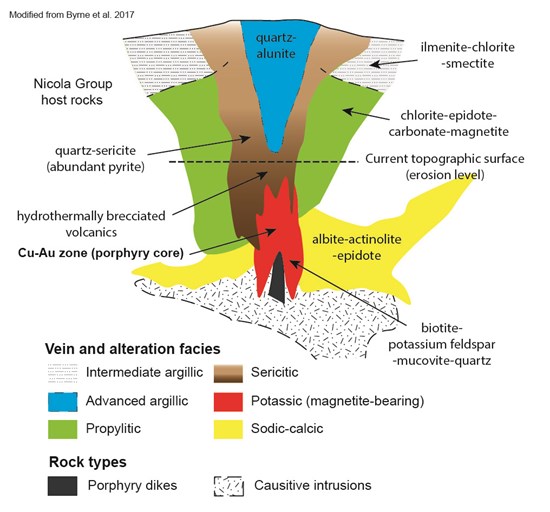
Figure 3. Schematic alteration zonation at the Lodi-Kirby Zones with exposure level. Modified from Byrne et al. 20171.
To view an enhanced version of this graphic, please visit:
https://images.newsfilecorp.com/files/6794/289788_cb05d79c4423c83a_003full.jpg
Quality Assurance and Control
Results from 2023 samples were analyzed at ALS Global Laboratories (Geochemistry Division) in Kamloops, Canada (an ISO/IEC 17025:2017 and ISO 9001:2015 accredited facility). A secure chain of custody is maintained in transporting and storing of all samples. At ALS the samples were digested using Aqua Regia and analyzed via ICP-MS and ICP-AES using a 25g sample aliquot under the ALS code AuME-TL43. The Company follows industry standard procedures for the work carried out on the Kolos Project. Due to the reconnaissance nature of the soil sampling the Company relied on the internal quality assurance quality control ("QA/QC") measures of ALS. Torr Metals detected no significant QA/QC issues during review of the data.
Qualified Person
The technical content of this news release has been reviewed and approved by Michael Dufresne, M.Sc., P.Geol., P.Geo., a consultant to the Company who is a non independent qualified person defined under National Instrument 43-101.
About Torr Metals
Torr Metals, headquartered in Edmonton, AB, is focused on unlocking new copper and gold discovery potential within proven, highly accessible mining districts across Canada, areas with both established infrastructure and a growing need for near-term feed. Torr's 100%-owned, district-scale assets are strategically located for cost-effective, year-round exploration and development. The 275 km² Kolos Copper-Gold Project and strategically option 57 km2 Bertha Property, situated in southern British Columbia's prolific Quesnel Terrane, lies just 30 km southeast of the Highland Valley Copper Mine, Canada's largest open-pit copper operation, and 40 km south of the city of Kamloops directly along Highway 5. In northern Ontario, the 261 km² Filion Gold Project covers a virtually unexplored greenstone belt with high-grade orogenic gold potential. It sits just off the Trans-Canada Highway 11, approximately 42 km from Kapuskasing and 202 km by road from the Timmins mining camp, home to world-class operations like Hollinger, McIntyre, and Dome. To learn more, visit Torr Metals online or view company documents via SEDAR+ at www.sedarplus.ca.
On behalf of the Board of Directors
Torr Metals Inc.
"Malcolm Dorsey"
Malcolm Dorsey
President, CEO and Director
For further information:
Malcolm Dorsey
Telephone: 236-982-4300
Email: malcolmd@torrmetals.com
Neither the TSX Venture Exchange nor its Regulation Services Provider (as that term is defined in the policies of the TSX Venture Exchange) accepts responsibility for the adequacy or accuracy of this press release.
Cautionary Statement Regarding Forward-Looking Information
This press release contains "forward-looking information" within the meaning of applicable Canadian securities legislation. Forward-looking information includes, without limitation, statements regarding the use of proceeds from the Company's recently completed financings, and the future plans or prospects of the Company. Generally, forward-looking information can be identified by the use of forward-looking terminology such as "plans", "expects" or "does not expect", "is expected", "budget", "scheduled", "estimates", "forecasts", "intends", "anticipates" or "does not anticipate", or "believes", or variations of such words and phrases or state that certain actions, events or results "may", "could", "would", "might" or "will be taken", "occur" or "be achieved". Forward-looking statements are necessarily based upon a number of assumptions that, while considered reasonable by management, are inherently subject to business, market and economic risks, uncertainties and contingencies that may cause actual results, performance or achievements to be materially different from those expressed or implied by forward-looking statements. Although the Company has attempted to identify important factors that could cause actual results to differ materially from those contained in forward-looking information, there may be other factors that cause results not to be as anticipated, estimated or intended. There can be no assurance that such information will prove to be accurate, as actual results and future events could differ materially from those anticipated in such statements. Accordingly, readers should not place undue reliance on forward-looking information. Other factors which could materially affect such forward-looking information are described in the risk factors in the Company's most recent annual management's discussion and analysis which is available on the Company's profile on SEDAR at www.sedarplus.ca. The Company does not undertake to update any forward-looking information, except in accordance with applicable securities laws.
To view the source version of this press release, please visit https://www.newsfilecorp.com/release/289788
Source: Torr Metals Inc.