
Statewide outreach initiatives across Northern California, Southern California, the Bay Area and the Inland Empire seeks stories, records and evidence for future legislative and community action
SACRAMENTO, CA / ACCESS Newswire / May 12, 2026 / The Center for Incubation & Findings Research (CIFR), through its Institute for Houselessness Prevention and in partnership with Compassion Center, today announced a California expansion focused on a troubling and underexamined pathway into homelessness: people losing housing, financial stability and inherited property after alleged fraud, fiduciary negligence, legal abandonment, probate breakdowns, trust-related irregularities, and the mishandling of personal injury, estate and tort-related matters.
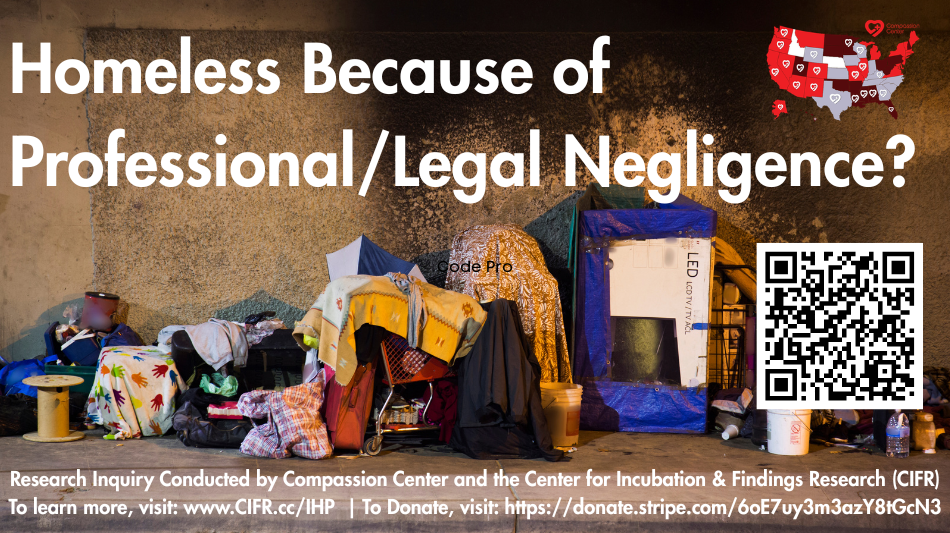
The expansion covers the entire State of California with coordinators in Northern California, Southern California, the Bay Area and the Inland Empire, and follows CIFR's recent receipt of substantial documentary materials, corroborating accounts and case-related records indicating that some individuals and families in California may have been pushed toward houselessness, not simply by poverty, but by the possible collapse, fiduciary neglect and misconduct of trusted intermediaries who were court authorized, supposed to protect their legal and financial interests.
CIFR said it is particularly concerned by reports involving unfinished estates, cash settlements that never materialized within expected timeframes, funds that were allegedly delayed, diverted or withheld, and legal matters that appeared to have been represented to courts and families as complete even when beneficiaries, heirs and injured parties were still waiting on money, titles or distributions or lawful closure. In case after case, the result appears to be the same: people who should have remained housed instead found themselves drained, destabilized and vulnerable.
"This is not just a legal ethics issue, no. This is a homelessness prevention issue," said James B. Creel on behalf of CIFR: IHP. "When people lose access to inheritances, settlements, estate assets or any other lawfully expected recoveries because someone failed in a fiduciary duty, abandoned a matter, mishandled funds or simply disappeared, the downstream harms can often be catastrophic. Housing can be lost. Families can fracture. Already deteriorating health can be accelerated. Grieving people can be left carrying burdens they should never have been forced to carry."
According to CIFR, many of the affected individuals do not fit conventional assumptions about homelessness. Some were expecting to inherit homes or trusts. Some were waiting on probate distributions. Some believed personal injury or tort matters had been resolved. Some were told filings had been made, administration had been completed, or final payment was forthcoming. Instead, many were left with depleted savings, unresolved legal exposure, lost housing security and little meaningful recourse. CIFR emphasized that these cases do not appear to be driven by probate advances; rather, the individuals interviewed appear to have been pushed toward housing instability after being cut off from funds, support systems and resources they were lawfully expecting.

CIFR also said some of the affected individuals were already managing mental illness, addiction, developmental disabilities or other significant vulnerabilities before losing access to housing, financial support or legal closure, often while also losing their core support systems. In those cases, alleged fiduciary failures and legal breakdowns do not just create financial harm - they can force people out of stable environments, sever continuity of care and trusted support systems, intensify existing health and behavioral challenges, and place even greater strain on community programs that are already understaffed and underprepared. CIFR said taxpayers and public systems should not be left absorbing costs that may have been avoidable had those individuals received the funds, distributions or resources they were lawfully expecting.
CIFR's California initiative will investigate patterns involving probate and estate administration failures, trust account concerns, personal injury and tort claim irregularities, noncommunication, nonpayment, false assurances, questionable case closures and other forms of alleged legal or fiduciary breakdown that may be contributing to otherwise preventable housing loss.
As part of the expansion, CIFR is identifying qualified, conflict-free legal, forensic auditors and compliance partners to help assess viable avenues for accountability, restitution and systemic reform. The Institute is also seeking collaboration with appropriately resourced California counsel, allied professionals and organizations experienced in probate failures, fiduciary misconduct, financial tracing, trust-related irregularities, legal abandonment and complex recovery matters, including professionals willing to work alongside CIFR's researchers, former federal prosecutors, compliance experts and social services personnel engaged in this effort.
"We believe this issue may be larger than many people realize, and more structurally linked to homelessness than current policy conversations acknowledge," Creel said. "If innocent people are becoming homeless because money was mishandled, or family estates were never lawfully completed, settlements were not properly distributed, or legal representatives walked away from duties they were paid and trusted to perform, that sort of misconduct and negligence deserves exposure, evidence, accountability and reform."
CIFR is calling on Californians, former clients, heirs, injured parties, whistleblowers, advocates, professionals and community partners to come forward with their stories, you can remain totally anonymous. CIFR is seeking referrals, evidence and documentation. Relevant materials may include any court filings, probate records, correspondence, settlement documents, engagement agreements, notices of closure, demand letters, trust or accounting records, proof of contact, proof of nonpayment, timelines, audio and video recordings, and other records that may help establish patterns and identify where fiduciary oversight failed.
Submissions and referrals may be sent to cifr@compassion-center.org. CIFR humbly asks respondents to include a concise summary of what happened, where the matter occurred, the approximate timeline, the parties involved, and how the issue affected their housing stability, finances, access to property or ability to remain safely housed.
The CIFR Institute for Houselessness Prevention is a community-based research initiative that examines overlooked drivers of homelessness and houselessness, especially where housing loss may be tied to administrative breakdowns, abuse of process, financial exploitation, fiduciary failures, institutional neglect or other failures within the systems that were expected to protect vulnerable people. CIFR said its California expansion is intended to support evidence gathering, public education, community action and legislative development. CIFR and Compassion Center do not provide individualized legal advice, and this initiative does not replace independent legal counsel. An extension of Compassion Center, a public charity organization, all donations to the CIFR: IHP are tax deductible to the extent of your individual tax situation.
About Compassion Center and the Center for Incubation & Findings Research (CIFR)
Compassion Center, headquartered in Hillsboro, Oregon, is dedicated to improving quality of life through integrative healthcare, social services and patient-centered innovation. Through its socioeconomic research institute, the Center for Incubation & Findings Research, Compassion Center works to identify, foster and advance solutions addressing housing instability, food security, access to clean water, integrative healthcare, mental health, education and other social determinants of health.
CIFR collaborates with communities, advocates and thought leaders to develop practical solutions that improve quality of life, stability and overall biophysical wellness. In partnership with Compassion Center International and other initiatives, CIFR works with local advocates, NGOs and experts to help drive meaningful change in underserved communities in the United States and beyond.
To learn more about Compassion Center, visit: https://compassion-center.org/
To learn more about CIFR, visit: https://cifr.cc
To donate to the IHP, visit: https://donate.stripe.com/6oE7uy3m3azY8tGcN3
To contact the CIFR for media inquiries, please email:
James B. Creel, PgM, Chief Research Administrator
James@compassion-center.org
1-844-842-COMPASSION Ext 707
To contact the CIFR investigation team, please email:
cifr@compassion-center.org
In all cases, someone will be in touch with you shortly.
SOURCE: Compassion Center
View the original press release on ACCESS Newswire:
https://www.accessnewswire.com/newsroom/en/healthcare-and-pharmaceutical/cifr-expands-into-california-to-investigate-whether-fraud-probate-fai-1166222