

Step-Out Drilling Continues to Expand the Contention zone of Oxide Au/Ag Mineralization
These drill holes expand the northern portion of the Contention target to the west and depth, with multiple mineralized zones
Drill holes TR26 15-19 have encountered multiple mineralized zones expanding the northern Contention target area including intersections of 121.9 m averaging 0.29 gpt Au and 11.3 gpt Ag (0.50 gpt AuEq), 53.2 m of 0.78 gpt Au and 31.94 gpt Ag (1.36 gpt AuEq) and of 66.9 m averaging 1.05 gpt Au and 23.21 gpt Ag (1.47 gpt AuEq)
70 RC holes including 5 pre-collars and 8 core holes have now been drilled in the 2025-2026 drill program with 9 drill holes pending final analysis as the drilling campaign continues
VANCOUVER, BC / ACCESS Newswire / May 14, 2026 / Aztec Minerals Corp. (TSX-V:AZT)(OTCQB:AZZTF) ("Aztec" or the "Company") announces the results from 5 drill holes from its reverse circulation ("RC") portion of the 2025-2026 drilling program at the Tombstone Property in Southeastern Arizona. Step out drilling expanding to the west and north Contention target area of the property has discovered additional strong, wide, shallow oxide gold-silver intersections. The Contention mineralized zone has been further extended to the west and to depth. The 17,000m 2025-2026 drilling program has now completed 70 RC and 8 core drill holes.
Highlights from the RC drilling reported for the Contention target include:
Hole TR26-17 encountered multiple zones of oxide mineralization in the lower Bisbee sediments including 121.9 m averaging 0.29 gpt Au and 11.3 gpt Ag (0.5 gpt AuEq) from 82.3 m, including 12.2 m averaging 1.02 gpt Au and 14.54 gpt Ag (1.28 gpt AuEq), it TD'd in mineralization. TR26-17 demonstrated the continuity of mineralization in the northern end of the Contention target and expanded the potential to depth
Hole TR26-18 was drilled as a high angle fan to TR25-26 and found oxidized Au-Ag mineralization over most of its length. From surface to 53.2 m intercepted 0.77 gpt Au and 31.94 gpt Ag (1.36 gpt AuEq), including 18.2 m of 1.91 gpt Au and 79.07 gpt Ag (3.35 gpt AuEq). Subsequent intercepts were at 79.0 m depth a length of 21.3 m of 0.13 gpt Au and 4.41 gpt Ag (0.21 gpt AuEq), and at 111.0 m depth an intercept of 53.2 m length of 0.08 gpt Au and 6.25 gpt Ag (0.2 gpt AuEq).
Hole TR26-19 crossed multiple zones of oxide mineralization, including 66.9 m averaging 1.05 gpt Au and 23.21 gpt Ag (1.47 gpt AuEq) 13.7 m from surface, including 27.4 m averaging 2.31 gpt Au and 43.23 gpt Ag (3.10 gpt AuEq), it TD'd in mineralization. TR26-19 was a fan to TR25-16 and has demonstrated the continuity of mineralization down dip in the northern end of the Contention target and expanded the potential to depth.
All of the five RC drillholes reported herein intersected Au-Ag mineralization and have joined and expanded portions of the Contention target area to the west and to depth. The intercepts show broad continuity of mineralization. All reported intersection lengths are apparent widths of mineralization, not true widths, which can range at the property from 30% to 100% of apparent widths.
Aztec Minerals CEO Simon Dyakowski commented: "The results from TR26-15 through TR26-19 are another step in what we believe is a significant expansion of the Tombstone project. These multiple thick, near-surface high-grade intercepts continue to extend the Contention zone to the west and to depth, with several holes ending in mineralization. What was historically considered as a modest open pit appears to be the upper portion of a much larger oxide gold-silver system that remains open in multiple directions. With nine RC holes pending and our first-pass drilling underway across the Westside, Hard-up and Southwest targets - including the Ingersoll and Independence areas more than a kilometre from the historic pit - each new round of results adds to the case that the project's ultimate scale will look very different from the historic footprint."
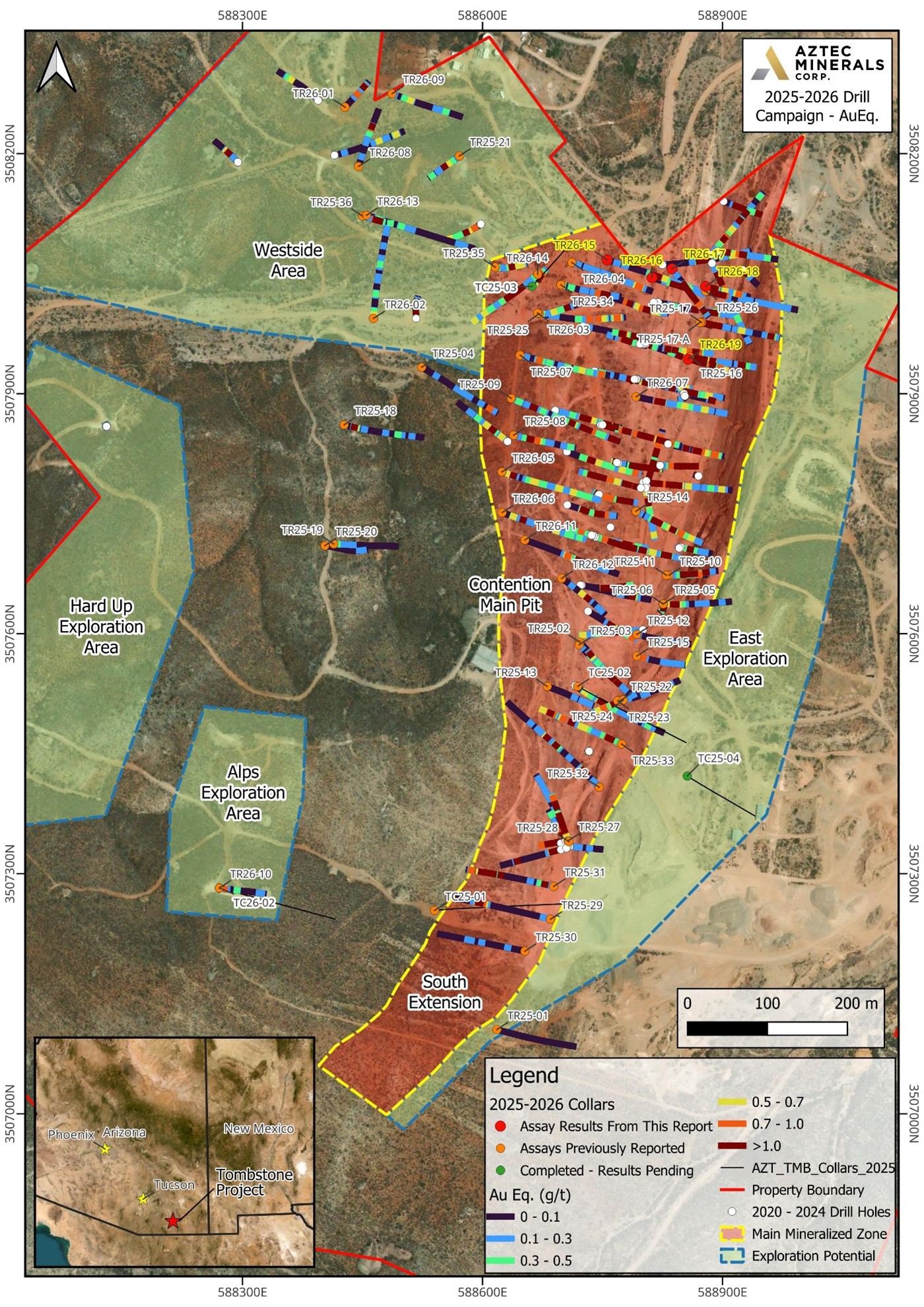
Figure 1. Plan map showing drill hole collars from the 2025-2026 drill campaign at the Tombstone Property, southeastern Arizona.
Core Drilling Update
The core drilling portion of the program in 2026 continues with drilling ongoing with 8 attempted core holes in the program and one in progress. TC26-05 is currently targeting the northern CRD target after a downhole EM survey of TC25-03 was completed last month. Eight core holes (TC25-01, 02, 03, 04 and TC26-01, 02, 03, 04) have been attempted and a ninth (TC26-05) is currently being advanced (650m) testing the northern CRD target. Core hole TC26-02 is the deepest in the program to date, drilled to 862m.
The core drilling program was designed to test the deep targets of the Project comprising the targeting of the large, southern and southwestern NSAMT targets and the historic T-8 drillhole CRD intercept, with some metallurgical core sample collection as well.
A synopsis for the core drilling follows:
Drill hole TC25-01 targeted the southern AMT target by drilling from west to easterly across the Contention system and reached 373.4m. It was stopped due to difficult ground conditions in fractured and faulted Bisbee Formation rock after a 182.9m pre-collar was completed. No significant zones of mineralization were encountered in this hole.
Drill hole TC25-02 targeted the southern AMT target from west to southeasterly across the Contention system and reached 348.4m. This drill hole also encountered difficult drilling conditions in the fractured and faulted Bisbee Formation after the 273.6m RC pre-collar and no significant mineralization was found by the core drilling.
Drill hole TC25-03 targeted the historic T-8 CRD intercept in the northern portion of the Project. A high angle drill hole first had pre-collar of 182.9m that intercepted two zones of oxide mineralization and penetrated a historic mine working within 0.5m - 1.0m of estimated depth. The drill hole reached a depth 690.9m, and it was in the stable Paleozoic carbonates from 228.6m depth onwards. Oxidation stopped by 320.1m. Three moderate to minor intensity zones of CRD mineralization were found at 382.6-388.7m, 411.6-416.1m, and 545.7-551.8m. This later depth is equivalent to that of the T-8 CRD mineralization. This entire zone is associated with notable argillic and occasional silicic alterations to 594.5m depth. It is considered that significant CRD mineralization should be nearby due the strong presence of argillic alteration. Final geochemical analytical results for this drill hole are pending.
Drill hole TC25-04 targeted the southern NSAMT target by drilling from above at a high angle after a 91.4m pre-collar was made in the Lower Bisbee Formation sediments. While the drilling was difficult, steady advances were made and the drill hole reached a depth of 831.5m before being lost to caving. The NSAMT target was estimated prior to drilling to start at 503.0m depth while the potential NSAMT anomaly retrograde skarn zone was found lower in depth 579.3m. TC25-04 encountered mild to moderate strength retrograde exoskarns in the hornfels of the lower Cretaceous basal Bisbee siliciclastic sediments at 579.3 m depth and it continued for the rest of the drillhole. The skarns are typified by epidote and chlorite with associated hematite staining. The skarns are accompanied by several silicified hydrothermal breccia dikes with occasional Qfp clasts and with evidence of potential "B-type" porphyry veinlets over that thickness. The hydrothermal breccia (Hbx) dikes with occasional Qfp clasts within them were intercepted from 354.3m to 728.7m. It was notable that the oxidation was considerably deeper than found elsewhere in the Project. Sulfides start to appear at 643m and oxides end at 838.4m. The contact with underlying Paleozoic carbonates is also considerably deeper compared to the north CRD target area, finding the Naco Limestone at 778.9m. It is interpreted that the retrograde skarns and Hbx dikes are the origin of the AMT anomaly but there should be a source porphyry intrusive not too far away, perhaps <500m. Final geochemical analytical results for this drill hole are pending.
Drillhole TC26-01 targeted the western, downdip extension of the Contention/Grand Central system but was stopped due to difficult ground conditions for drilling and the drill moved to next pre-collar just being finished. The drillhole had a depth of 53.6m with only minor mineralization.
Drillhole TC26-02 targeted the southern NSAMT target by drilling towards the east for a depth of 861.7m. The ground rock was the Lower Bisbee Formation until 705.8m when the Paleozoic carbonates were intersected. As the contact is at about 200 meters higher than in TC25-04, the interpretation is that this reflects the Contention fault system dropping its eastern side. The NSAMT anomaly targeted is probably a response to the retrograde skarn found starting at 332.2m depth. Traces of galena were found at 771.3m, as well as a Hbx dike at 414.6m, noting that the oxidation ended at 478.6m. It is interpreted that the retrograde skarns and Hbx dikes are the origin of the AMT anomaly but there could be a source porphyry intrusive in close proximity, perhaps <500m. Final geochemical analytical results for this drill hole are pending.
Drillhole TC26-03 was drilled on the western side of the central portion of the Contention pit towards the east. It was a designed as a metallurgical sample hole in the Lower Bisbee Formation and stopped at 176.6m due to adverse ground conditions before reaching the target Qfp dike. One mineralized Qfp/Hbx dike was transversed at 86.9-97.6m while much of the drillhole had argillic alteration, strong Fe oxides and the presence of quartz veinlets, which are positive indications of potential precious metal mineralization. Final geochemical analytical results for this drill hole are pending.
Drillhole TC26-04 was drilled on the far west side of the central portion of the known Contention system. It was designed as a fan to TR25-09 to demonstrate the western, down-dip extension of the Contention system at depth. Final geochemical analytical results for this drill hole are pending.
Drillhole TC26-05 is currently targeting the historic T-8 CRD intercept in the northern portion of the Project following positive indications in a bore hole EM survey recently completed of TC25-03. The easterly, steep angle drill hole first had a pre-collar of 182.9m that intercepted oxide mineralization in the Lower Bisbee Formation. The drill hole reached a depth 650m, and it was in the stable Paleozoic carbonates from 259.1m depth onwards. Oxidation stopped by 243.9m. Two moderate to minor intensity zones of CRD mineralization were found at 361.8-365.9m and 383.1-384.8m. This depth is equivalent to that of the TC25-03 CRD mineralization and higher than that of the T-8 CRD mineralization. This entire zone is associated with notable argillic and occasional silicic alterations to 594.5m depth.
Core drilling to-date has confirmed the NSAMT targets as based on geologic (Skarn) anomalies within the upper portion of the NSAMT targets. It was planned to continue drilling to depth in TC25-04; however, drillhole caving terminated the hole. Aztec had previously identified several large, strong, conductive bodies, underneath the historic gold-silver project through NSAMT (natural-source audio-frequency magneto-telluric surveys) anomalies1.
The continued, successful drilling of the Contention pit area was supported by Aztec's 3D geologic and underground workings model that was constructed to assist in targeting potential expansion of the Contention system. The overall Contention system has yet to be defined and marks the confluence of other mineralized zones including the Westside Anticline.
Detailed Drillhole Summary Highlights (see Table 1 & 2 below):
Hole TR26-15 - Collared on the western limits of the Contention Target with the Westside anticline, it was drilled to the east to a depth of 200.6 m. It demonstrated the oxide mineralization towards the Contention pit. The drill hole intersected at depth two zones of oxidized mineralization, from 92.7m to 139.8m depth for 47.1m averaging 0.21 gpt Au and 13.26 gpt Ag (0.46 gpt AuEq) and then from 156.6m to 200.6m for 44.0 meters averaging 0.10 gpt Au and 3.46 gpt Ag (0.16 gpt AuEq). The drillhole ended in mineralization. TR26-15 demonstrated the oxidized Au-Ag mineralization is joined between the two targets. The drillhole leaves the mineralization open to depth and to the north directions.
Hole TR26-16 - Was collared north of TR21-01 on the western edge of the pit in the northern portion of the Contention Target area to test for mineralization towards TR25-26. It was drilled easterly and to a depth of 198.1 meters. The drill hole intersected three zones of oxidized mineralization. The intersections are: 57.9-147.8m, 89.9m averaging 0.22 gpt Au and 10.96 gptAg (0.42 gpt AuEq); then 164.6-181.3m,16.7m averaging 0.06 gpt Au and 5.54 gpt Ag (0.17 gpt AuEq); and the drill hole ending in 195.1-198.1m, 3.0 m averaging 0.08 gpt Au and 5.7 gpt Ag (0.18 gpt AuEq). Drillhole failed to reach target depths and leaves the mineralization open to depth.
Hole TR26-17 encountered multiple zones of oxide mineralization in the lower Bisbee sediments including 121.9 m averaging 0.294 gpt Au and 11.3 gpt Ag (0.50 gpt AuEq) from 82.3 m, including 12.2 m averaging 1.02 gpt Au and 14.54 gpt Ag (1.28 gpt AuEq), it TD'd in mineralization. TR26-17 demonstrated the continuity of mineralization in the northern end of the Contention target and expanded the potential to depth. The drillhole crossed two historic underground mine workings and the drill hole failed while still in mineralization before reaching its main target, the Qfp dike and associated mineralization found in TR25-17. TR26-17 drilled southeasterly across the western portion of the Contention pit from TR24-06 towards TR25-26, leaving mineralization open north and to depth.
Hole TR26-18 was drilled as a high angle fan to TR25-26 and found oxidized Au-Ag mineralization over most of its length. From surface to 53.2 m intercepted 0.77 gpt Au and 31.94 gpt Ag (1.36 gpt AuEq), including 18.2 m of 1.91 gpt Au and 79.07 gpt Ag (3.35 gpt AuEq). Subsequent intercepts were at 79.0 m depth a length of 21.3 m of 0.13 gpt Au and 4.41 gpt Ag (0.21 gpt AuEq), and at 111.0 m depth an intercept of 53.2 m length of 0.08 gpt Au and 6.25 gpt Ag (0.2 gpt AuEq). TR26-18 was drilled az 105 in the northern portion of the Contention pit from TR25-26 towards the eastern side of the pit. The drillhole ends near the mineralization, demonstrating width, and leaves mineralization open to depth and to the north.
Hole TR26-19 crossed multiple zones of oxide mineralization, including 66.9 m averaging 1.05 gpt Au and 23.21 gpt Ag (1.47 gpt AuEq) 13.7 m from surface, including 27.4 m averaging 2.31 gpt Au and 43.23 gpt Ag (3.1 gpt AuEq). This was followed by intercepts at 88.2m-107.9m, 19.8m averaging 0.16 gpt Au and 6.68 gpt Ag (0.28 gpt AuEq), 114.0m-135.3m, 21.3m averaging 0.39 gpt Au and 12.37 gpt Ag (0.62 gpt AuEq), 142.9m-167.2m, 24.3m averaging 0.092 gpt Au and 7.14 gpt Ag (0.221 gpt AuEq), and 174.8m-199.1m, 24.3m averaging 0.10 gpt Au and 9.97 gpt Ag (0.29 gpt AuEq), with the drill hole ending in mineralization. TR26-19 was a fan to 25-16 and has demonstrated the continuity of mineralization down dip in the northern end of the Contention target and expanded the potential to depth. TR26-19 was drilled az 105 in the central portion of the northern Contention system from TR25-16 towards the eastern side of the pit.
View drill sections here:
Link to section view holes TR26-15 TR26-16 and TR26-18
Link to section view hole TR26-17
Link to section view holes TR26-19
Table 1A: Drill Results Currently Reported
Drill Hole | From (m) | To (m) | Interval (m)* | Au (gpt) | Ag (gpt) | AuEq (gpt) | Comments |
|---|---|---|---|---|---|---|---|
TR26-15 | 92.7 | 139.8 | 47.1 | 0.214 | 13.26 | 0.456 |
|
| 156.6 | 200.6 | 44.0 | 0.096 | 3.42 | 0.157 | TD in minz |
|
|
|
|
|
|
|
|
TR26-16 | 57.9 | 147.8 | 89.8 | 0.223 | 10.96 | 0.423 |
|
| 164.6 | 181.3 | 16.7 | 0.065 | 5.54 | 0.166 |
|
| 195.1 | 198.1 | 3.0 | 0.077 | 5.7 | 0.181 | TD in minz |
|
|
|
|
|
|
|
|
TR26-17 | 62.5 | 67.1 | 4.6 | 0.613 | 2.13 | 0.651 |
|
| 82.3 | 204.2 | 121.9 | 0.294 | 11.3 | 0.499 | TD in minz, workings @ 111.2-114.3 m, 118.9-121.9 m |
Including | 85.3 | 97.5 | 12.2 | 1.017 | 14.54 | 1.281 |
|
|
|
|
|
|
|
|
|
TR26-18 | 0.0 | 53.2 | 53.2 | 0.775 | 31.94 | 1.356 |
|
Including | 25.8 | 44.1 | 18.2 | 1.909 | 79.07 | 3.346 |
|
| 79.0 | 100.3 | 21.3 | 0.132 | 4.41 | 0.212 |
|
| 111.0 | 164.2 | 53.2 | 0.084 | 6.246 | 0.198 |
|
|
|
|
|
|
|
|
|
TR26-19 | 13.7 | 80.6 | 66.9 | 1.050 | 23.21 | 1.472 |
|
Including | 30.4 | 57.8 | 27.4 | 2.309 | 43.23 | 3.095 |
|
| 88.2 | 107.9 | 19.8 | 0.162 | 6.68 | 0.283 |
|
| 114.0 | 135.3 | 21.3 | 0.395 | 12.37 | 0.620 |
|
| 142.9 | 167.2 | 24.3 | 0.092 | 7.14 | 0.221 |
|
| 174.8 | 199.1 | 24.3 | 0.105 | 10.0 | 0.286 | TD in minz |
|
|
|
|
|
|
|
|
Note 1: Gold and Silver equivalents are calculated using the recovery percentages from third party metallurgical testing of RC drill pulps completed Jan. 21, 2026 of 81.5% for Au and 75.9% for Ag and using the average prices from Jan.1 2026 to May 1,2026 (US$4,817 Au, US$81.36 Ag) a ratio of 59.2:1, with the elemental recovery differences a 55:1 silver:gold ratio for holes reported. Note has been reported 70:1 for November 2025 to February 2026, 90:1 in 2025 prior to November, 80:1 in 2023 and 2024, and a 70:1 silver:gold ratio in 2021.
2025-2026 Drill Program
The 70 RC drill holes in the current 2025-26 program completed to date primarily are part of a "fan grid pattern" being drilled in the Contention area since 2020. Most of the RC drill holes are oriented to test for extensions on the western, eastern borders, the southern extensions, and underneath the north-trending main Contention target zone which hosts the historic underground and open pit Contention mine. Several RC drill holes tested targets in the Westside and Hard-up areas on projected anticline, dike and fissure vein intersections under mineralized outcrops and historic shafts. The drill program has continued to identify to depth and horizontally pervasively oxidized and hematite-rich, silicified hydrothermal breccias composed of quartz feldspar porphyry dike and Bisbee Group clastic sedimentary fragments, typical of the material mined historically at the Contention Mine.
Additional mineralization types continued to be outlined by the current drilling including: manganese replacements in limestone beds and skarns, quartz veinlets, oxidized sulfide relicts as disseminations, silicification of altered hornfels, quartz feldspar porphyries and hydrothermal breccias.
The RC drilling program is targeting shallow zones associated with surface exploration and 3D geological modelling, prospective for wide oxide gold-silver mineralization, and drilling pre-collars for the deeper CRD targets. The drill program has completed 40 RC and RC precollar drill holes in 2025 and 27 RC and one RC precollar drill hole since the start of 2026, focusing on testing both the Contention Main and Southern Extension areas as step out targets and Westside and Hard-up areas first pass targets, with results from the five RC holes (TR26-15 - 19) now announced. Initial assay results continue to validate the oxide gold-silver geological setting as outlined in Aztec's geological exploration model. Eight core holes (TC25-01, 02, 03, 04 and TC26-01, 02, 03, 04) have been attempted and a ninth (TC26-05) is currently being advanced (650m) testing the northern CRD target.
The primary objectives of the 2025-26 drilling program were to: Expand the known mineralization horizontally to the west, north and south, and down dip beyond the holes drilled by Aztec in 2020-24 at the Contention Pit with step outs to enlarge the shallow, broad, bulk tonnage gold-silver mineralization discovered there; test by core drilling the initial deep CRD targets and also, to explore with first pass drilling new targets identified in the Westside area. The drilling results showed that the Contention area mineralization is still open at depth and the mineralized volume is expanding.
Table 1B: Tombstone 2026 Reported Results
Drill Hole | From (m) | To (m) | Interval (m)* | Au (gpt) | Ag (gpt) | Au Eq (gpt) (1) | Comments |
|---|---|---|---|---|---|---|---|
TR26-01 | 51.7 | 72.9 | 21.3 | 0.038 | 11.76 | 0.208 | Working 71.4 - 73.0 m no sample |
| 86.6 | 110.9 | 24.3 | 0.039 | 13.37 | 0.230 | Last 4 samples in working, no recovery |
TR26-02 | 0.0 | 19.8 | 19.8 | 0.136 | 12.62 | 0.316 |
|
| 54.7 | 60.8 | 6.1 | 0.088 | 13.67 | 0.284 |
|
| 91.2 | 100.3 | 9.1 | 0.094 | 5.65 | 0.175 |
|
| 130.7 | 147.4 | 16.7 | 0.076 | 2.76 | 0.115 |
|
TR26-03 | 147.4 | 161.1 | 13.7 | 0.069 | 3.73 | 0.122 |
|
| 167.2 | 177.8 | 10.6 | 0.103 | 7.21 | 0.206 |
|
| 193.0 | 205.2 | 12.2 | 0.149 | 8.7 | 0.273 |
|
TR26-04 | 53.2 | 63.8 | 10.6 | 0.057 | 8.17 | 0.173 |
|
| 147.4 | 161.1 | 13.7 | 0.040 | 4.16 | 0.1 |
|
| 168.7 | 188.5 | 19.8 | 0.220 | 13.75 | 0.416 |
|
TR26-05 | 16.7 | 36.5 | 19.8 | 0.223 | 8.78 | 0.358 |
|
| 60.8 | 73.0 | 12.2 | 0.117 | 3.85 | 0.172 |
|
| 80.6 | 130.7 | 50.2 | 0.112 | 4.90 | 0.182 |
|
| 136.8 | 158.1 | 21.3 | 0.117 | 11.44 | 0.280 |
|
| 165.7 | 174.8 | 9.1 | 0.086 | 4.65 | 0.152 |
|
| 182.4 | 217.4 | 35.0 | 0.119 | 5.95 | 0.204 |
|
| 231.0 | 255.3 | 24.3 | 0.091 | 3.6 | 0.142 | TD in minz |
TR26-06 | 31.9 | 47.1 | 15.2 | 0.124 | 4.06 | 0.182 |
|
| 62.3 | 69.9 | 7.6 | 0.223 | 11.66 | 0.390 |
|
| 88.2 | 120.1 | 31.9 | 0.159 | 3.86 | 0.214 |
|
| 130.7 | 158.1 | 27.4 | 0.057 | 29.22 | 0.474 |
|
| 202.2 | 261.5 | 59.3 | 0.104 | 4.96 | 0.175 | TD in minz |
TR26-07 | 50.2 | 162.6 | 112.4 | 0.479 | 12.64 | 0.659 | Working 59.3 to 62.3 m |
| 173.2 | 185.4 | 12.2 | 0.127 | 8.11 | 0.243 |
|
| 221.9 | 238.6 | 16.7 | 0.049 | 7.49 | 0.156 | TD in minz |
TR26-08 | 121.6 | 129.2 | 7.6 | 0.576 | 8.4 | 0.696 |
|
TR26-09 | 35.0 | 45.6 | 10.6 | 0.069 | 9.06 | 0.199 |
|
| 53.2 | 59.3 | 6.1 | 0.181 | 13.1 | 0.367 |
|
| 158.1 | 164.1 | 6.1 | 0.041 | 7.37 | 0.147 |
|
TR26-10 PC | 112.5 | 118.6 | 6.1 | 0.162 | 9.15 | 0.293 |
|
TR26-11 | 100.3 | 200.6 | 100.3 | 0.173 | 11.46 | 0.337 |
|
TR26-12 | 100.3 | 149.0 | 48.6 | 0.172 | 18.04 | 0.430 |
|
TR26-13 | 18.2 | 27.4 | 9.1 | 0.056 | 8.27 | 0.174 |
|
| 63.8 | 68.8 | 4.6 | 0.132 | 3.33 | 0.180 |
|
| 85.1 | 91.2 | 6.1 | 0.039 | 5.00 | 0.110 |
|
| 194.5 | 200.6 | 6.1 | 0.062 | 4.275 | 0.123 |
|
TR26-14 | 0.0 | 10.6 | 10.6 | 0.195 | 13.00 | 0.381 |
|
| 39.5 | 147.4 | 107.9 | 0.618 | 24.80 | 0.972 |
|
| 176.3 | 225.0 | 48.6 | 0.091 | 8.11 | 0.206 |
|
| 234.1 | 243.2 | 9.1 | 0.121 | 10.67 | 0.267 | TD in minz |
|
|
|
|
|
|
|
|
TR26-15 | 92.7 | 139.8 | 47.1 | 0.214 | 13.26 | 0.456 |
|
| 156.6 | 200.6 | 44.0 | 0.096 | 3.42 | 0.157 | TD in minz |
TR26-16 | 57.9 | 147.8 | 89.8 | 0.223 | 10.96 | 0.423 |
|
| 164.6 | 181.3 | 16.7 | 0.065 | 5.54 | 0.166 |
|
| 195.1 | 198.1 | 3.0 | 0.077 | 5.7 | 0.181 | TD in minz |
TR26-17 | 62.5 | 67.1 | 4.6 | 0.613 | 2.13 | 0.651 |
|
| 82.3 | 204.2 | 121.9 | 0.294 | 11.3 | 0.499 | TD in minz, workings @ 111.2-114.3 m, 118.9-121.9 m |
Including | 85.3 | 97.5 | 12.2 | 1.017 | 14.54 | 1.281 |
|
TR26-18 | 0.0 | 53.2 | 53.2 | 0.775 | 31.94 | 1.356 |
|
Including | 25.8 | 44.1 | 18.2 | 1.909 | 79.07 | 3.346 |
|
| 79.0 | 100.3 | 21.3 | 0.132 | 4.41 | 0.212 |
|
| 111.0 | 164.2 | 53.2 | 0.084 | 6.246 | 0.198 |
|
TR26-19 | 13.7 | 80.6 | 66.9 | 1.050 | 23.21 | 1.472 |
|
Including | 30.4 | 57.8 | 27.4 | 2.309 | 43.23 | 3.095 |
|
| 88.2 | 107.9 | 19.8 | 0.162 | 6.68 | 0.283 |
|
| 114.0 | 135.3 | 21.3 | 0.395 | 12.37 | 0.620 |
|
| 142.9 | 167.2 | 24.3 | 0.092 | 7.14 | 0.221 |
|
| 174.8 | 199.1 | 24.3 | 0.105 | 10.0 | 0.286 | TD in minz |
Table 2 - 2026 Drillhole Coordinates
Drill Hole | UTM East | UTM North | Azimuth | Inclination | Total Depth (m) |
|---|---|---|---|---|---|
TR26-01 | 588429 | 3508259 | 40 | 70 | 117.4 |
TR26-02 | 588463 | 3507996 | 10 | 60 | 231.7 |
TR26-03 | 588670 | 3508001 | 105 | 80 | 274.4 |
TR26-04 | 588712 | 3508065 | 105 | 60 | 207.3 |
TR26-05 | 588625 | 3507804 | 105 | 60 | 256.1 |
TR26-06 | 588625 | 3507751 | 105 | 65 | 262.2 |
TR26-07 | 588792 | 3507896 | 100 | 60 | 239.3 |
TR26-08 | 588445 | 3508184 | 18 | 65 | 175.3 |
TR26-09 | 588487 | 3508275 | 114 | -65 | 219.5 |
TR26-10 | 588271 | 3507282 | 105 | -80 | 274.4 |
TR26-11 | 588653 | 3507717 | 109 | -60 | 250.0 |
TR26-12 | 588699 | 3507669 | 125 | -70 | 237.8 |
TR26-13 | 588455 | 3508123 | 110 | -50 | 219.5 |
TR26-14 | 588669 | 3508049 | 230 | -68 | 243.9 |
TR26-15 | 588756 | 3508067 | 105 | -58 | 201.2 |
TR26-16 | 588812 | 3508045 | 105 | -68 | 198.2 |
TR26-17 | 588837 | 3508056 | 145 | -70 | 204.3 |
TR26-18 | 588879 | 3508034 | 105 | -75 | 182.9 |
TR26-19 | 588857 | 3507943 | 105 | -75 | 208.8 |
Drill samples are collected every 1.52 m from RC chips and every 1.5m from sawing the core drill holes. The samples are analyzed by Bureau Veritas for gold with a 30-gram sample size using the method FA430 followed by MA300. Bureau Veritas is independent of the Company and of the Qualified Person. Over limits, when present, are analyzed by MA370 or FA530. The company uses quality assurance-quality control as a standard part of its sampling-assaying-assessments in conjunction with its exploration sampling programs. Samples and their collection are controlled by an industry standard conforming QAQC program including all drill holes containing certified blanks, standards, and duplicates. The samples are being regularly shipped to and received by the Bureau Veritas Minerals laboratory in Hermosillo, Mexico for geochemical analysis. The QAQC for the drilling programs has been evaluated and found to have good results.
Tombstone Project Overview
Aztec Minerals holds a 85.0% interest in the Tombstone Property Joint Venture, which includes most of the original patented mining claims in the main district as well as some recently acquired properties.
The main target of the current drilling is to continue testing the shallow, bulk tonnage, potentially heap leachable, mesothermal gold-silver oxide mineralization adjacent and below the previously mined Contention pit by step-out drilling. Future drilling is expected to focus on follow-up on the current program's results. It is anticipated that possible targeting could include strike and dip extensions of the shallow oxide mineralization, and move along those trends deeper into the sulfide zone as historically there was significant production to 300 m depth*2.
The Tombstone project is located 100 kilometers (km) southeast of Tucson, Arizona and covers much of the historic Tombstone silver district. Tombstone is renowned for its high grade, oxidized, silver-gold mesothermal stringer lode veins, hydrothermal breccias and manto CRD orebodies that were mined in the late 1800's and early 1900's. The historic silver production in the Tombstone district from 1878 to 1939 was estimated at 32 million ounces and 250,000 ounces of gold*2.
The district geology consists of a mix of shallow-level, oxidized Au-Ag and base metal deposits related to CRD and skarns hosted in folded and thrusted sediments, intrusive dikes, and lode veins, and as well the under explored, sulfide versions located below the water table.
Host rocks to the mineralization are primarily the clastic sediments of the lowest portion of the Cretaceous Bisbee Formation. Between 50 and 300 meters (m) in depth, the Bisbee is underlain by approximately two kms thick of the same Paleozoic carbonate formations that host the Hermosa-Taylor zinc-lead-silver deposit of South32 located 60 km southwest of Tombstone.
Aztec believes that the historic silver mines at Tombstone could be related to a much larger mesothermal system with CRD mineralization below the old mines. Since 2017, Aztec has completed geological mapping, geochemical sampling and geophysical surveying to identify the most prospective areas for Au-Ag mineralization around and below the Contention open pit, and CRD zinc-lead-copper-silver-gold mineralization below the entire district. Aztec management views the district as highly prospective for the discovery of mesothermal and CRD mineralization.
Summary Tombstone Project Highlights
Well located property on patented (33) and unpatented (73) claims (663 hectares / 1639 acres), covers much of the historic Tombstone silver mining district, great infrastructure, local town, road access, full services, water, power
Historic silver district*2 produced 32 million ounces of silver and 250,000 ounces of gold from 1878-1939, in high grade, oxidized, silver-gold-lead-zinc-copper vein, breccia and CRD deposits, and small open pit heap leach production in late 1980's
Drilling by Aztec in 2020-25 has demonstrated that the Contention Pit target has significant, shallow. oxidized Au-Ag bulk tonnage mineralization which is open in all directions
Multiple other prospective targets in Cretaceous and Paleozoic rocks related to major NW and NNE trending structures hosting porphyritic intrusions crosscutting a possible caldera ring structure
* Aztec has not verified these historic results and is not relying on them. Aztec has in its possession the historic drill logs, maps and reports but does not have any information on the quality assurance or quality control measures taken in connection with these historical exploration results.
Noted References:
1 - "Zonge International, AMT Survey, Tombstone Project, Cochise County, AZ, Data Acquisition and Processing Report, Prepared for Aztec Minerals, 18 May 2020, Zonge Job #20013"
2 - Greeley, Michael N., A Brief History and Review of Ore Grades and Production in the Tombstone Mining District with Emphasis on the Contention Mine Area, June 1984
The scientific and technical information contained in this news release has been reviewed and approved by Allen David Heyl, B.Sc., CPG - AIPG No.11277, VP Exploration of Aztec, a Qualified Person under NI43-101. Mr. Heyl supervises the Tombstone exploration programs. Mr. Heyl has verified the data, which included a review of the sampling, analytical and test methods underlying the data, information and opinions disclosed herein.
"Simon Dyakowski"
Simon Dyakowski, Chief Executive Officer
Aztec Minerals Corp.
About Aztec Minerals - Aztec is a mineral exploration company focused on two emerging discoveries in North America. The Cervantes project is an emerging porphyry gold-copper discovery in Sonora, Mexico. The Tombstone project is an emerging gold-silver discovery with high grade CRD silver-lead-zinc potential in southern Arizona. Aztec's shares trade on the TSX-V stock exchange (symbol AZT) and on the OTCQB (symbol AZZTF).
Contact Information - For more information, please contact:
Simon Dyakowski, President & CEO, Director
Tel: (604) 685-9770
Fax: (604) 685-9744
Email: info@aztecminerals.com
Website: www.aztecminerals.com
Neither the TSXV nor its Regulation Services Provider (as that term is defined in the policies of the TSXV) accepts responsibility for the adequacy or accuracy of this release. No stock exchange, securities commission or other regulatory authority has approved or disapproved the information contained herein.
Forward-Looking Statements:
This news release contains "forward-looking information or statements" within the meaning of applicable securities laws, which may include, without limitation, completing ongoing and planned work, statements relating to advancing the Tombstone Project, drill and sampling results including additional potential work and results therefrom, the Company's plans for its Tombstone Project, potential for further expansion of the mineralization at the Tombstone Project, expected results and outcomes, the technical, financial and business prospects of the Company, its project and other matters. All statements in this news release, other than statements of historical facts, that address events or developments that the Company expects to occur, are forward-looking statements. Although the Company believes the expectations expressed in such forward-looking statements are based on reasonable assumptions, such statements are not guarantees of future performance and actual results may differ materially from those in the forward-looking statements. Such statements and information are based on numerous assumptions regarding present and future business strategies and the environment in which the Company will operate in the future, including the price of metals, the ability to achieve its goals, that general business and economic conditions will not change in a material adverse manner, that financing will be available if and when needed and on reasonable terms. Such forward-looking information reflects the Company's views with respect to future events and is subject to risks, uncertainties and assumptions, including the risks and uncertainties relating to the interpretation of exploration results, risks related to the inherent uncertainty of exploration and cost estimates and the potential for unexpected costs and expenses, and those filed under the Company's profile on SEDAR+ at www.sedarplus.ca. Factors that could cause actual results to differ materially from those in forward looking statements include, but are not limited to, continued availability of capital and financing and general economic, market or business conditions, adverse weather or climate conditions, failure to maintain or obtain all necessary government permits, approvals and authorizations, failure to obtain or maintain community acceptance (including First Nations), decrease in the price of gold, silver and other metals, increase in costs, litigation, and failure of counterparties to perform their contractual obligations. The Company does not undertake to update forward-looking statements or forward-looking information, except as required by law.
SOURCE: Aztec Minerals Corp.
View the original press release on ACCESS Newswire:
https://www.accessnewswire.com/newsroom/en/oil-gas-and-energy/aztec-drilling-expands-oxide-gold-silver-zone-step-outs-at-tombstone-intersectin-1166831
