
VANCOUVER, BC / ACCESS Newswire / March 31, 2026 / SKY GOLD CORP. ("Sky" or the "Company") (TSX.V:SKYG)(OTC PINK:SRKZF) is excited to report results from recent fieldwork at the Evening Star Property, Nevada (the "Property"), which further support the presence of a large, mineralized copper-gold porphyry system at the High Life target, ahead of an upcoming ~2,400 metre drill program.
Alteration mapping highlights a core area where the porphyry system potentially daylights. Recent sampling within the High Life target area returned 0.9 g/t Au in altered granodiorite within the interpreted porphyry core, coincident with strong silica-sericite alteration, secondary copper mineralization, and proximity to intrusive apophyses defined by magnetic inversion.
Fieldwork Highlights
Alteration mapping at High Life combined with previous geophysical survey results define a compelling case for a fertile porphyry system at High Life.
A potential CRD system was mapped and sampled southwest of High Life, where the granodiorite is in a faulted contact with limestone. The CRD target area aligns with an IP conductive high anomaly. Gold assay results include 1.87 g/t Au for a chip sample across a 3.0-meter-wide fault zone with secondary copper and massive sulphides that may represent the tip of a manto.
Multiple strong gold values from grabs and chip channel samples from along the periphery of the High Life porphyry system, including:
The 2-3m wide Good Hope fault zone, immediately East of High Life, was sampled along 500 meter strike length with strong gold assay results, such as a chip sample across 1.8 m for 5.58 g/t Au, quartz veins assaying 5.61, 5.06, 5.02, and 9.25 g/t Au, and brecciated granodiorite with secondary copper returning 11.11 and 14.07 g/t Au.
A narrow high-grade quartz vein at Golden bomber, West of High Life, returned an average of 10.33 g/t Au across 4 meters of strike.
A grab sample of a 2.0-meter-wide mineralized fault zone at Evening Star, south of CRD Hill, returned 8.67 g/t Au.
Copper, silver, and multi-element results are pending for all samples.
Drill pads and permits have been prepared for the upcoming approximate 2,400 diamond core drill program that will drill test the High Life porphyry system and CRD Hill.
"The recent alteration mapping increases our confidence that we are vectoring into a robust copper-gold porphyry system. These results continue to validate our geophysical interpretation and reinforce High Life as a compelling drill target ahead of our upcoming program.
In addition to High Life, we are also excited to drill CRD Hill, where a historic 1969 drill hole intersected 166 metres of polymetallic mineralization grading 0.22% Cu, 3.24% Pb, 1.41% Zn, and 76 g/t Ag*. Notably, this interval was never assayed for gold. We look forward to following up on this mineralization - and we will definitely be assaying for gold this time."
*Agnerian, H.G. (1970): Geological Report on the Digmore Claims, Garfield Hills, Mineral Country, Nevada, U.S.A. for Rose Pass Mines Ltd, Calgary, Alberta, 22p.
High Life Porphyry Target
At High Life, 3D geophysical magnetic inversion highlights an anomaly that is one-kilometer across, and combined with IP survey results, outlines a potential intrusive porphyry stock that is positioned just below the surface (see News Release dated 15 January 2025).
The High Life porphyry stock is strongly magnetic and, based on recent alteration mapping on the Property, displays a well-developed zoned alteration system characteristic of copper-gold porphyry models, including the outer epidote, intermediate sericite and pyrite, and proximal core with strong silica, biotite and copper.
Figure 1 shows the results from recent alteration mapping at High Life and the planned drill collars. The core of the porphyry daylights where the granodiorite contains high silica, secondary biotite and copper alteration, and is surrounded by very strong phyllic alteration (sericite and pyrite). Figure 2 shows a section through the High Life system, with 3D magnetic inversion results and 2D IP survey Resistivity results, and the planned drill hole traces. High Life has a positive magnetic signature with a coincident resistivity high. Note the finger-like apophyses of the magnetic porphyry intrusion that reach up in the same areas as where the 'core' was mapped based on the mineral alteration.
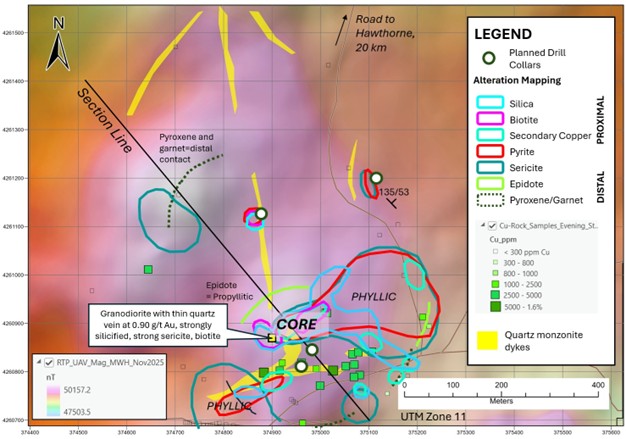
Figure 1. Results from recent alteration mapping at High Life and surrounding area. The core of the porphyry daylights where the granodiorite contains high silica, secondary biotite and copper alteration, and is surrounded by very strong phyllic alteration (sericite and pyrite).
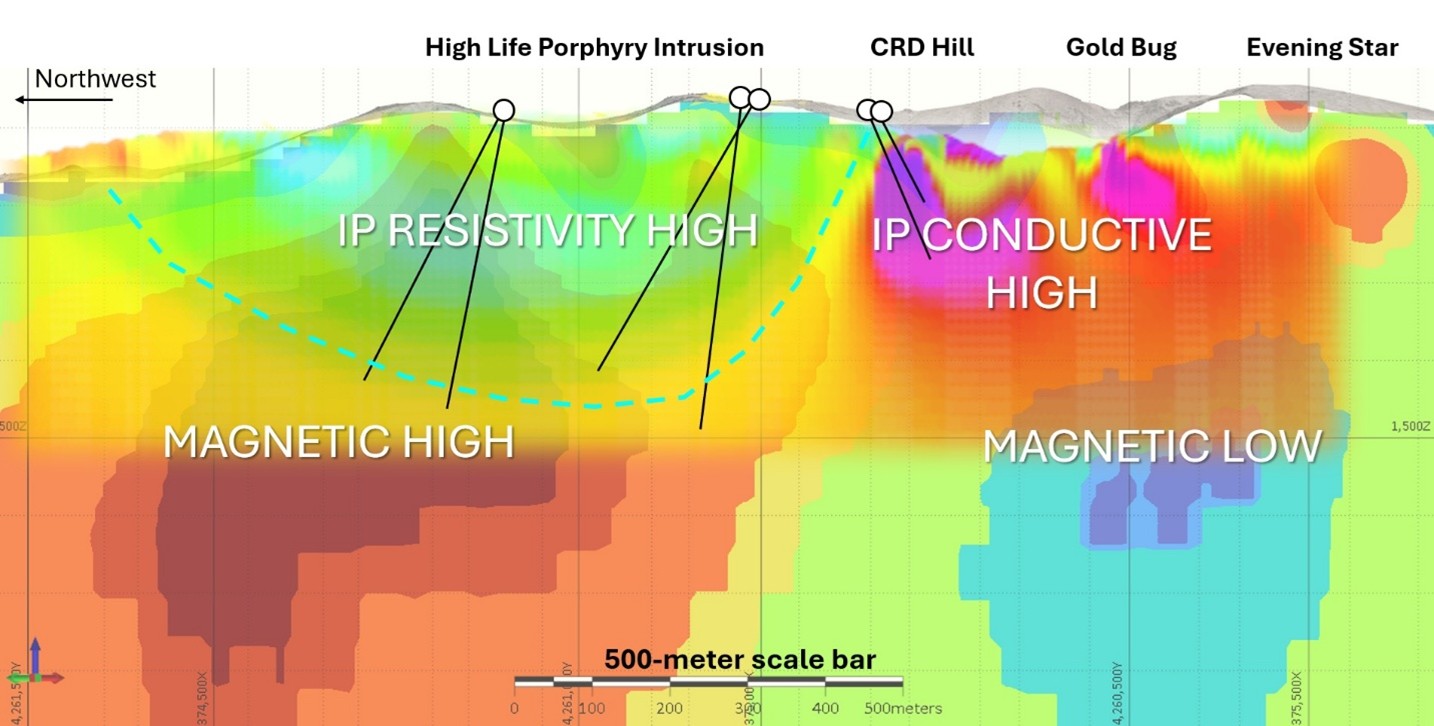
Figure 2. A section through the High Life system, with 3D magnetic inversion results and 2D IP survey Resistivity results, and the planned drill hole traces aimed at the core and apophyses of High Life, and also the planned holes for CRD HIll. Note that IP survey lines can image to about 300m depth maximum.
CRD Hill
Additional wide fault zones were mapped and sampled to the southwest of High Life, at CRD Hill, where historically (1969) a drill hole returned 0.22% Cu, 3.24% Pb, 1.41% Zn, and 76 g/t Ag over 166m.* It was not analyzed for gold.
Figure 2 shows a section through CRD Hill, which has a very strong conductive anomaly below the surface that overlaps with a coincident magnetic low. Hydrothermal fluids responsible for CRD mineralization are typically acidic and silica-rich, resulting in magnetic destruction and the development of conductive sulphide bodies.
Finding bedding-parallel fault zones with semi-massive sulphides and coarse pyrite crystals in the strongly altered limestone suggests these are the tips of the mantos for a CRD system. Gold assay results from recent fieldwork on CRD Hill include 1.87 g/t Au for a chip sample across a 3.0-meter wide fault zone on CRD Hill (see Figure 3),with copper, lead and silver values pending.This high gold value is significant and indicates a significant gold credit for the potential CRD system, which is typically Cu-Ag-Pb-Zn.
*Agnerian, H.G. (1970): Geological Report on the Digmore Claims, Garfield Hills, Mineral Country, Nevada, U.S.A. for Rose Pass Mines Ltd, Calgary, Alberta, 22p.
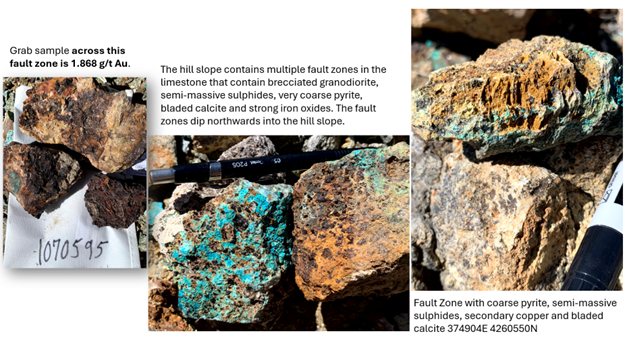
Figure 3. Rocks from a fault zone on CRD Hill with coarse pyrite and bright secondary copper (middle), strong iron oxides, bladed calcite textures (right), and heavier semi-massive sulphides (on the left).
Peripheral Gold Mineralization
Gold and copper mineralization occur in multiple styles surrounding High Life, strongly suggesting a fertile system and supporting the presence of a copper-gold porphyry source at depth.
Good Hope
The Good Hope fault zone is located immediately East of the High Life. It is a significant structural feature measuring 2 to 3 meters in width and has been traced for 500 meters along strike. See Figure 5. There are two historic mine shafts along the fault zone.
The Good Hope Fault Zone dips to the East, away from the High Life porphyry centre. This orientation suggests a normal fault structure caused by rise and doming of the underlying High Life porphyry system.
Sampling of the Good Hope fault zone was done either selectively-from remaining vein fragments discarded by the early miners (late 1800s), or when exposed, a representative grab sample was taken across the fault zone, such as the 5.58 g/t Au across 1.8m (see Figure 6).
The Company cautions that grab samples are selective by nature and are not necessarily representative of the mineralization hosted on the property. These results are used to identify the presence of mineralization and to prioritize future drilling targets.
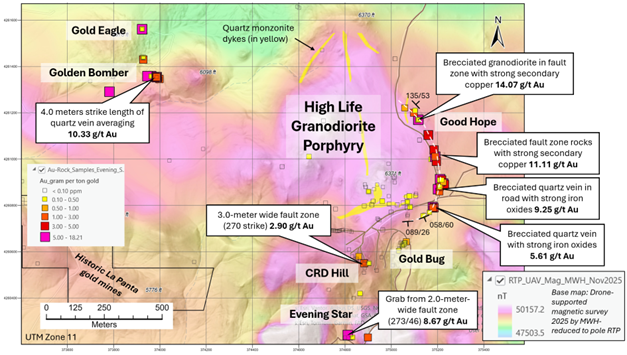
Figure 4. Gold assay results from the recent field program at the Evening Star Property. Base map is Reduced to Pole (RTP) magnetic survey results, which highlights a 1-kilometer diameter magnetic granodiorite porphyry stock at High Life.
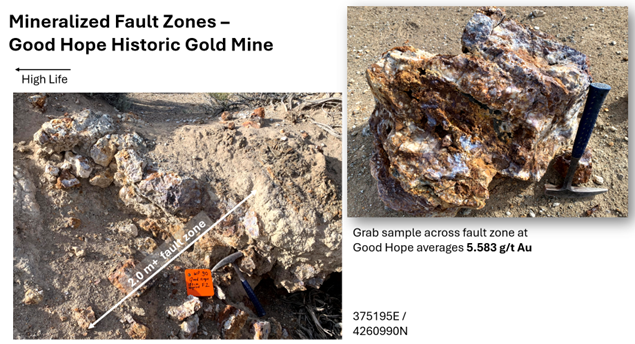
Figure 5. Photographs of the 2-to 3-meter-wide fault zone at Good Hope that extends for at least 500 meters along strike. Large blocks of gold-bearing brecciated chalcedonic quartz veins.
Table 1. Gold assay results for the 33 rock and vein samples from the Good Hope fault zone obtained by PhotonAssayTM method.
SampleID | Easting | Northing | Au_CPA_Au1 | Description |
1070559 | 375180 | 4260790 | 2.82 | Brecciated epithermal quartz vein Feox chalcedony |
1070560 | 375185 | 4260790 | 5.61 | Epithermal quartz vein brecciated iron oxides 12cm to 20cm wide coarse pyrite |
1070561 | 375165 | 4260770 | 0.07 | Quartz vein breccia chalcedonic quartz to 30cm wide |
1070562 | 375165 | 4260770 | 0.93 | Quartz vein breccia chalcedonic lenses, opal, to 17 cm wide |
1070563 | 375143 | 4260760 | 0.04 | Outcrop of quartz vein breccia with iron oxides, vein up to 50cm wide 058/60 |
1070564 | 375188 | 4260810 | 0.26 | Garnet-altered granodiorite phlogopite biotite and chalcedonic rock pile next to old trench. |
1070565 | 375188 | 4260810 | 0.11 | Garnet-altered granodiorite phlogopite biotite and chalcedonic rock pile next to old trench. |
1070566 | 375202 | 4260870 | 9.25 | 17 cm wide quartz vein with strong iron oxides |
1070567 | 375208 | 4260860 | 2.47 | Quartz vein breccias with strong iron oxides in the road |
1070568 | 375208 | 4260870 | 0.20 | Quartz breccia in road with iron oxides |
1070569 | 375209 | 4260880 | 0.53 | Quartz breccia with iron oxides and possible black tourmaline small needles |
1070570 | 375210 | 4260880 | 2.43 | Quartz vein breccias and chalcedonic quartz with iron oxides on side of road |
1070571 | 375230 | 4260890 | 5.06 | South side of old mine shaft. Chalcedonic quartz with minor dendritic pyrolusite on fracture |
1070572 | 375225 | 4260900 | 1.46 | Chalcedonic quartz minor epidote large drusy quartz, purple pink hematite |
1070573 | 375217 | 4260900 | 2.49 | Quartz vein breccia with bluish opal like chalcedonic quartz |
1070575 | 375218 | 4260910 | 0.41 | Inside historic pit mine shaft 22 cm quartz vein chalcedonic |
1070576 | 375208 | 4260910 | 0.53 | Hematite rich quartz vein grab along pit wall of small old shaft |
1070599 | 375103 | 4261210 | 0.71 | Good Hope 16 cm epithermal quartz vein banded |
1070603 | 375117 | 4261170 | 14.07 | Open shaft 260 cm wide fault zone- sample brecciated copper-rich granodiorite in footwall |
1070604 | 375117 | 4261170 | 0.99 | Open shaft 260 cm wide fault zone- sample chalcedonic and opal lenses |
1070605 | 375117 | 4261170 | 0.05 | Open shaft 260 cm wide fault zone- sample crystal breccia in hanging wall |
1070606 | 375117 | 4261170 | 1.47 | Open shaft 260 cm wide fault zone- chip sample across exposed wall |
1070607 | 375117 | 4261170 | 1.56 | Prep Duplicate of 1070606 |
1070526 | 375071 | 4260760 | <0.015 | Granodiorite with secondary copper and en echelon quartz veins in fault zone 089/26 |
1070527 | 375071 | 4260760 | 0.28 | 10-15cm quartz veins in fault zone in granodiorite cut by late quartz monzonite dyke |
1070528 | 375203 | 4260960 | 0.25 | Grab quartz vein breccia from fault zone |
1070529 | 375195 | 4260990 | 5.58 | Chip across fault zone180 cm exposed in shaft with 50 cm purplish chalcedonic quartz veins |
1070530 | 375190 | 4261010 | 3.17 | Pit with big pieces-up to 50 cm- of quartz vein breccia with secondary copper |
1070531 | 375190 | 4261010 | 11.11 | Pit with big pieces-up to 50 cm- of quartz vein breccia with secondary copper |
1070533 | 375159 | 4261110 | 0.18 | Fault zone with chalcedonic quartz vein fragments |
1070534 | 375218 | 4260910 | 5.02 | Next to old mine, grab sample chalcedonic quartz |
1070536 | 375098 | 4261200 | 3.2 | Good Hope trench fault zone rocks strong chalcedonic quartz - no secondary copper |
1070538 | 375185 | 4261040 | 6.54 | Potential fault zone rocks- many quartz vein breccia fragments - no secondary copper |
Multiple samples contain the classic blue and green colours of secondary copper, see Figure 7. Copper, silver and other multi-element results are pending for all samples.
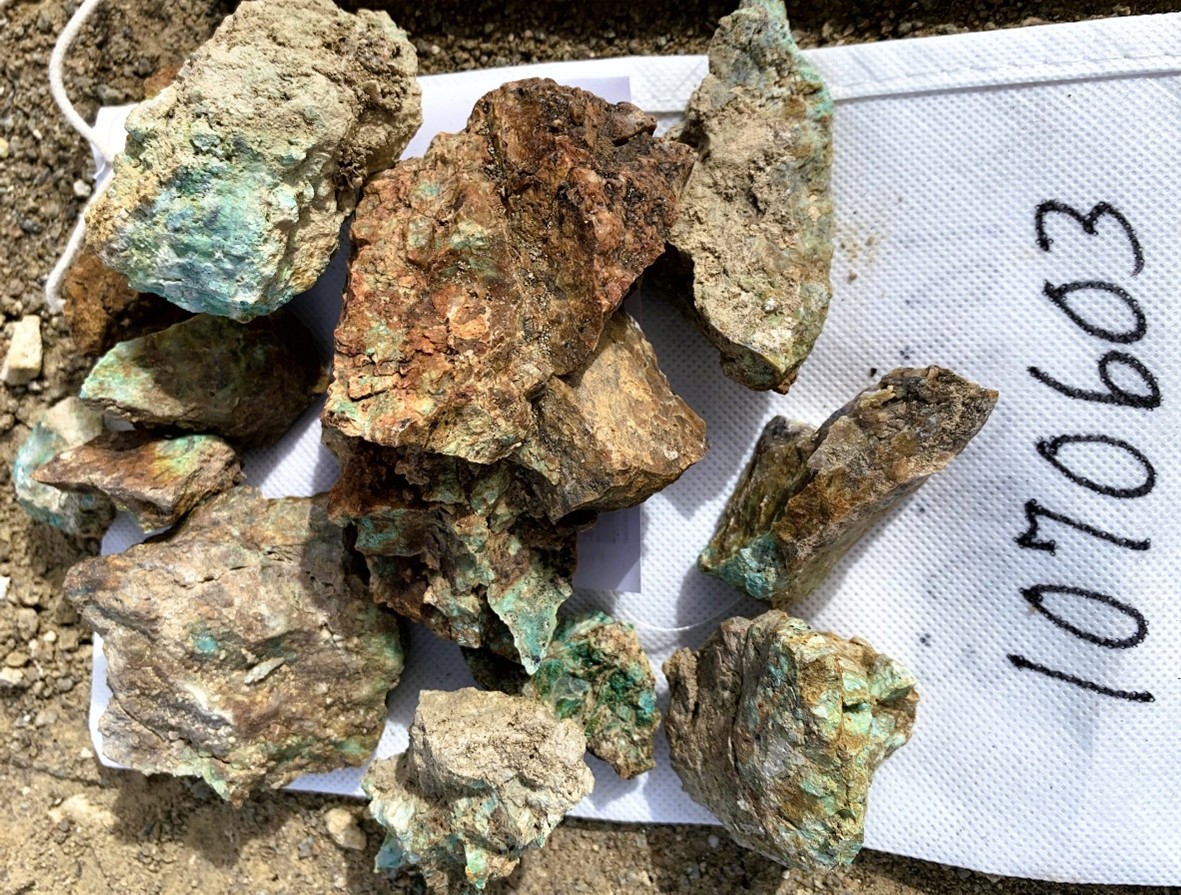
Figure 6. Good Hope Fault Zone. Brecciated and altered granodiorite rocks from a 2.6-meter wide fault zone returned 14.07 g/t Au and contains secondary copper minerals like chrysocolla and malachite.
Golden Bomber
Golden Bomber is located West of High Life, and a chalcedonic quartz vein with strong secondary copper and altered wall rocks was uncovered near the bottom of a historic trench. Four meters of the vein was exposed, mapped and sampled. Figure 8 shows a trench map with gold assay results; copper, silver and multi-elements pending. The vein averages 10.33 g/t Au along 4 meters strike length.
The mineralized zone measures about 20 cm, with potentially wider portions removed by early miners. There are multiple narrow-high grade veins at Golden Bomber, and this area also has never been drilled.
Evening Star
To the south of Gold Bug and CRD Hill lies the historic Evening Star gold mine with several steep mine shafts. Recent investigation reveals gold mineralization is concentrated along multiple wide fault zones that are similar to the fault zones in CRD Hill, with granodiorite rocks in faulted and mineralized contact with limestone. A grab sample from a 2.0-meter-wide fault zone returned 8.67 g/t Au.
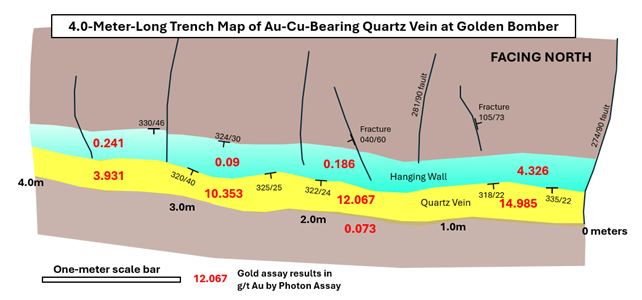
Figure 7. Simplified diagram of a high-grade chalcedonic quartz vein and wallrock at Golden Bomber. Gold assay results and structures. Multi-elements, including copper, are pending.
Qualified Person
Danae Voormeij, MSc, PGeo, a Director of Sky Gold Corp. and a Qualified Person under National Instrument 43-101, supervised the collection of samples, and has reviewed and approved the scientific and technical information in this news release. Ms. Voormeij is not independent of Sky Gold Corp.
QAQC and Sample Methodology
The Company submits rock and drill core samples MSA Labs in Elko, Nevada, for gold content by Chrysos PhotonAssayTM technology. This process is non-destructive and analyzes 500-gram samples, which is more representative than the 50-gram sample required for Fire Assay method and this innovative method catches more gold in the sample, reducing the nugget effect.
Samples are dried and crushed to P80 minus 2mm, and 500 grams is riffle split for PhotonAssayTM method. Another 250 grams of the crushed material is pulverized to P85 minus 75 microns for ultra-trace 48 elements by ICP-Ms following a 4-acid digest.
About Sky Gold Corp.
Sky Gold Corp. is a mineral exploration company focused on advancing precious and base metal projects in North America. The Company's flagship Evening Star Property, located in the prolific Walker Lane Gold Trend, hosts multiple high-priority gold and copper targets, including Tower Gold, High Life, Gold Bug, and Evening Star. The project site has excellent infrastructure.
ON BEHALF OF THE BOARD
Mike England
CEO, PRESIDENT & DIRECTOR
FOR FURTHER INFORMATION PLEASE CONTACT
Tel: 1-604-683-3995
mike@engcom.ca
Neither the TSX Venture Exchange nor its Regulation Services Provider (as that term is defined in the policies of the TSX Venture Exchange) accepts responsibility for the adequacy or accuracy of this release.
Forward Looking Statements
Certain statements in this release are forward-looking statements, which reflect the expectations of management regarding the matters described herein. Forward-looking statements consist of statements that are not purely historical, including any statements regarding beliefs, plans, expectations, or intentions regarding the future. Such statements are subject to risks and uncertainties that may cause actual results, performance, or developments to differ materially from those contained in the statements, including with respect to the completion of the Consolidation or the identification or acquisition of additional mineral assets. No assurance can be given that any of the events anticipated by the forward-looking statements will occur or, if they do occur, what benefits the Company will obtain from them. These forward-looking statements reflect management's current views and are based on certain expectations, estimates and assumptions which may prove to be incorrect. A number of risks and uncertainties could cause our actual results to differ materially from those expressed or implied by the forward-looking statements, including factors beyond the Company's control. These forward-looking statements are made as of the date of this news release.
SOURCE: Sky Gold Corp.
View the original press release on ACCESS Newswire:
https://www.accessnewswire.com/newsroom/en/metals-and-mining/sky-gold-advances-high-life-cu-au-porphyry-target-with-strong-surface-gold-result-1153536
