
VANCOUVER, BC / ACCESS Newswire / May 27, 2026 / Kalo Gold Corp. (TSXV:KALO)(OTCID:KLGDF)(FSE:9M51) ("Kalo", "Kalo Gold" or the "Company") is pleased to announce an updated structural and geological interpretation for its 100%-owned Vatu Aurum Project on Vanua Levu, Fiji. The updated interpretation integrates recently acquired LiDAR topography, surface mapping, the 2026 lineation survey, the high-resolution airborne magnetic survey, and historical regional geophysical datasets, and supports a refined exploration-targeting framework for the project.
KEY HIGHLIGHTS
Updated interpretation frames the Vatu Aurum Project as a single, multi-phase, structurally reactivated volcanic complex, integrating early intrusive and diatreme activity, regional extension, oblique faulting, and a hydrothermal overprint into one coherent geological model.
West-East Transfer Zone ("WETZ") - an interpreted regional accommodation corridor expressed as a continuous magnetic low, interpreted to link segmented fault systems across the project area and to act as a first-order control on fluid migration.
Nubu Graben reinterpreted as segmented, en-echelon, and locally offset rather than continuous, producing relay zones and step-overs interpreted as prime dilation sites.
NW-SE oblique fault network - interpreted as the dominant gold-hosting structural grain on present interpretation, with mapped gold-in-soil anomalies and recent trenching results aligning with this orientation.
Coastal belt of arcuate volcanic features interpreted as caldera-related centres, potentially representing a deeper magmatic source for hydrothermal fluids.
Wainikoro target defined by coincident magnetic low and arsenic-gold soil anomaly, located within dilational structures linked to the WETZ.
Updated targeting focus on intersections of the NW-SE oblique faults with the WETZ and the Nubu Graben, and on the interaction of structural intersections with the Qiriyaga vent field.
Recently completed 6,212 line-kilometre high-resolution airborne magnetic survey, flown at 100 m line spacing with infill at 50 m over priority areas, is expected to refine the definition of structural features at the project scale and improve targeting precision.
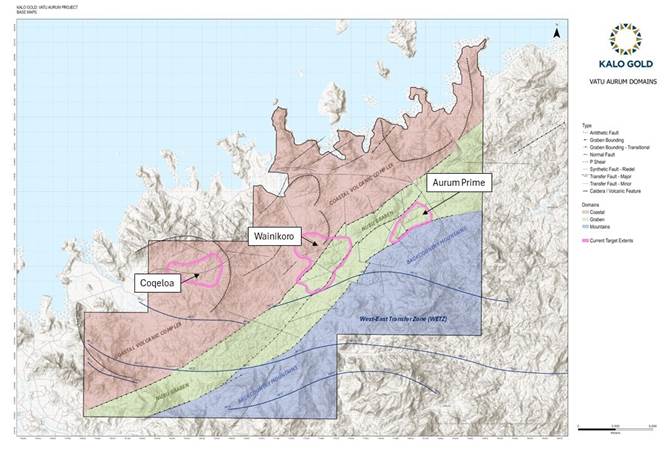
Figure 1 - Vatu Aurum Structural Model
Management Commentary
Terry L. Tucker, P.Geo., President and Chief Executive Officer of Kalo Gold, commented: "The most important interpretive shift in this update is the recognition that Vatu Aurum behaves as a single, multi-phase, structurally reactivated volcanic complex rather than as a series of separate prospects. That reframing - combined with the high-resolution airborne magnetic survey and the active programme of trenching, traverse mapping, and soil-grid expansion across the Wainikoro area - gives us a much sharper and more defensible framework for prioritising the next phase of exploration and targeting.
The Updated Interpretation
On the integration of LiDAR topography, the 2026 lineation survey, surface mapping, and the project's evolving geophysical and geochemical datasets, the Company now interprets the Vatu Aurum Project as a single, multi-phase, structurally reactivated volcanic complex rather than as a series of separate prospects. The interpretation comprises four overprinting elements that the Company believes together control the location of gold mineralisation across the project area: early intrusive and diatreme activity that created radial fracture permeability and established the Qiriyaga vent field and equivalent vent structures; regional extension that formed the Nubu Graben as a segmented, en-echelon system; subsequent oblique NW-SE faulting that cut the graben and reactivated earlier structures, creating relay ramps, pull-aparts, and dilation zones; and a hydrothermal overprint that exploited both the early diatreme-related permeability and the later structural intersections.
Key Structural and Volcanic Elements
At the regional scale, the Company has defined a broad east-west trending structural corridor referred to as the West-East Transfer Zone ("WETZ"). The WETZ is expressed geophysically as a continuous magnetic low - observed in the historical AusAID dataset and increasingly resolved in the ongoing high-resolution airborne magnetic survey - and is interpreted as a long-lived accommodation corridor linking segmented fault systems across the project area.
Superimposed on the WETZ corridor is the Nubu Graben, which the updated interpretation describes as structurally segmented, en-echelon, and locally offset rather than a single continuous structure. The Company further interprets a network of NW-SE oblique faults, Riedel shears, P-shears, and minor transfer faults that cut across the graben and align with mapped gold-in-soil anomalies and recent surface trenching results. On the integrated dataset, this NW-SE oblique fault network is interpreted to perform the dominant structural work hosting gold mineralisation at Vatu Aurum, with the highest fracture density and dilation expected at intersections of the oblique fault network with the WETZ and with the graben margins.
A coastal belt of arcuate volcanic features identified in the LiDAR and lineation datasets is interpreted as a zone of caldera-related volcanic centres, considered to reflect a deeper magmatic control on the project and a potential source for hydrothermal fluids. At a more localised scale, the Qiriyaga Complex is interpreted to host approximately fourteen potential diatreme and breccia-pipe structures within an approximately 1 km × 1 km zone proximal to the Company's camp, with additional candidate vent structures identified at 1K and Vunisea. The spatial relationship between the caldera belt, the WETZ corridor, the NW-SE oblique fault network, and the Qiriyaga vent field is interpreted to record a vertically integrated mineral system, with magmatic fluids channelled into structurally favourable zones at depth and subsequently focused into dilational sites at shallower structural levels.
Targeting Implications
The updated interpretation refines the Company's targeting framework. Highest-priority ground is interpreted to occur at intersections of the NW-SE oblique faults with the WETZ and with the Nubu Graben, particularly where those intersections occur at or near the margins of interpreted caldera-related features. Parallel splays to the graben, step-over relay zones, and the inter-prospect corridor between Aurum Prime and Wainikoro are considered secondary-priority targets where structural grain is interpreted to continue but where existing geochemical coverage remains incomplete. Continuous, straight fault segments lacking structural complexity are considered lower priority.
Refinement Through High-Resolution Airborne Magnetic Survey
The current interpretation is supported by regional geophysical datasets including the historical AusAID magnetic data, which provide valuable regional context but are relatively low resolution. The Company's 6,212 line-kilometre high-resolution airborne magnetic survey is complete - was flown at 100 m line spacing with infill at 50 m over priority target areas - is expected to materially enhance the definition of structural features at the project scale, allowing for more precise mapping of intersection geometries, fault traces, and prospective zones identified in the updated interpretation. Final processed datasets will be integrated with existing geological and geochemical data to support the next phase of exploration and targeting on the project.
Qualified Person
The technical information in this news release was prepared, reviewed, and approved by Andrew Randell, P.Geo., CEO and Principal Geoscientist of SGDS-Hive, Technical Director of the Vatu Aurum Project, and a Qualified Person as defined by National Instrument 43-101 - Standards of Disclosure for Mineral Projects. Mr. Randell is independent of the Company and has verified the data disclosed, having conducted multiple site visits (2023-2026) and direct supervision of the exploration programme. The structural and geological interpretations summarised in this news release are based on integration of LiDAR topography, the 2026 lineation survey, surface mapping, historical AusAID geophysical data, and preliminary results from the ongoing high-resolution airborne magnetic survey, and are subject to revision as additional data are acquired and processed.
Stock Options and DSU Grant
The Company is pleased to announce that, pursuant to the Company's Long Term Incentive Plan, it has issued an aggregate of 7,500,000 Deferred Share Units (DSUs) to certain officers, directors, and advisors of the Company. The DSUs will vest on May 26, 2027. Each DSU represents the right to receive one common share in the share capital of the Company.
The Company has also granted 7,500,000 stock options to certain officers, directors, advisors and consultants of the Company to purchase 7,500,000 shares (the "Shares") in the capital of the Company pursuant to the Company's share option plan. The Options are exercisable at an exercise price of $0.185 per Share for a period of five (5) years from the date of grant. The Options will be vesting 50% in 12 months and 50% in 24 months.
About Kalo Gold Corp.
Kalo Gold Corp. is a gold exploration company focused on low-sulphidation epithermal gold systems at its 100%-owned Vatu Aurum Project (Special Prospecting Licences 1511 and 1464), a 367 km² land package on Vanua Levu, Fiji, located in a preserved volcanic back-arc setting. The Company's technical programme is led by SGDS-Hive. Kalo Gold Corp. is headquartered in Vancouver, British Columbia, and is listed on the TSX Venture Exchange (KALO), the OTCID Market (KLGDF), and the Frankfurt Stock Exchange (9M51). For further information, visit www.kalogoldcorp.com.
On behalf of the Board of Directors of Kalo Gold Corp.
Terry L. Tucker, P.Geo.
President and Chief Executive Officer
Kevin Ma, CPA, CA
Executive Vice President, Capital Markets and Director
For further information: info@kalogoldcorp.com | www.kalogoldcorp.com
Neither the TSX Venture Exchange nor its Regulation Services Provider (as that term is defined in the policies of the Exchange) accepts responsibility for the adequacy or accuracy of this press release.
Cautionary Statement Regarding Forward-Looking Information
This news release contains "forward-looking statements" and "forward-looking information" within the meaning of applicable Canadian securities laws. Forward-looking statements can often be identified by the use of words such as "will", "may", "should", "could", "would", "anticipate", "believe", "estimate", "expect", "intend", "plan", "potential", "continue", "target", "scheduled", and similar expressions.
Forward-looking statements in this news release include, but are not limited to, statements regarding: (i) the Company's updated structural and geological interpretation for the Vatu Aurum Project, including the interpretation that the project records a single, multi-phase, structurally reactivated volcanic complex; (ii) the interpretation of the West-East Transfer Zone ("WETZ") as a regional accommodation corridor controlling fluid migration; (iii) the interpretation that the Nubu Graben is structurally segmented and en-echelon and that NW-SE oblique faults, Riedel shears, and transfer faults represent the dominant gold-hosting structural grain on present interpretation; (iv) the interpretation of a coastal belt of arcuate volcanic features as caldera-related centres potentially representing a magmatic source for hydrothermal fluids; (v) the interpretation of the Qiriyaga Complex as a vent field comprising approximately fourteen interpreted diatreme/breccia-pipe structures, with additional candidate vent structures at 1K, Vunisea, and Wainikoro; (vi) the prioritisation of intersections of the NW-SE oblique faults with the WETZ and the Nubu Graben as high-priority targeting areas; (vii) the expectation that the ongoing high-resolution airborne magnetic survey will refine structural definition at the project scale and improve targeting precision; and (viii) the Company's ability to secure financing, permits, regulatory approvals, and contractor capacity to advance exploration on the Vatu Aurum Project.
All structural, geological, geophysical, and geochemical interpretations disclosed in this news release are Qualified Person interpretations based on currently available data and are preliminary in nature. They do not constitute, and should not be read as implying, a mineral resource estimate at the Vatu Aurum Project, which has not been the subject of a mineral resource declaration. Geological interpretations are subject to revision as additional data are acquired and processed.
Forward-looking statements are based on a number of assumptions that the Company considers reasonable but which may prove to be inaccurate, including: that the LiDAR, geological mapping, lineation survey, historical AusAID datasets, and current airborne magnetic data underpinning the updated interpretation are accurate and complete; that the ongoing high-resolution airborne magnetic survey will be completed within the anticipated operating window and will deliver data of the expected quality; that the Company will be able to fund and execute its planned exploration programmes; that permits, tenure, and licences will remain in good standing; that there will be no adverse change in the political, regulatory, or operational environment in Fiji, including potential fuel-supply constraints; and that commodity prices and capital markets conditions will support continued exploration.
Forward-looking statements are subject to known and unknown risks and uncertainties that may cause actual results, performance, or achievements to differ materially from those expressed or implied, including: exploration risk (no guarantee of an economically viable mineral resource); the risk that the structural, geological, geochemical, and geophysical interpretations underpinning the updated interpretation may change with additional data; weather and operating risk affecting completion of the airborne magnetic survey and other field programmes; permit, tenure, and title risk; risks of operating in Fiji, including fuel supply, logistics, weather, and currency risk; dependence on key personnel and third-party service providers; environmental, health, and safety risk; financing and dilution risk; and commodity price volatility. This list is not exhaustive and many factors are beyond the Company's control. Readers are cautioned not to place undue reliance on forward-looking statements.
The Company does not undertake any obligation to update or revise any forward-looking statements, whether as a result of new information, future events, or otherwise, except as required by applicable securities laws. Readers are directed to the Company's continuous disclosure filings available on SEDAR+ at www.sedarplus.ca, including its most recent Management's Discussion and Analysis, for a more complete discussion of the risks affecting the Company and its business.
SOURCE: Kalo Gold Corp.
View the original press release on ACCESS Newswire:
https://www.accessnewswire.com/newsroom/en/metals-and-mining/kalo-gold-updates-structural-and-geological-model-at-vatu-aurum-project-fiji-1170877
