Drill Program Confirms Graphitic Fault Zone and Associated Hydrothermal Alteration
Results Highlight Potential for Basement-Hosted Uranium Mineralization
Saskatoon, Saskatchewan--(Newsfile Corp. - June 23, 2026) - CanAlaska Uranium Ltd. (TSXV: CVV) (OTCQX: CVVUF) (FSE: DH7) ("CanAlaska" or the "Company") is pleased to announce results from the winter drill program on its Key Extension project (the "Project") in the southeastern Athabasca Basin (Figure 1). The drill program focused on multiple high-priority target areas identified from recent airborne geophysical surveys and the results of historical drilling. During the program, the Company successfully confirmed the presence of strongly graphitic stratigraphy with re-activated semi-brittle basement fault zones containing associated hydrothermal alteration. The results from the drill program highlight the potential for discovery of basement-hosted uranium mineralization on the Project. The Key Extension project is 100% CanAlaska-owned and is located approximately 15 km southwest of the past-producing Key Lake Mine and current operating Key Lake Mill (Figure 1).
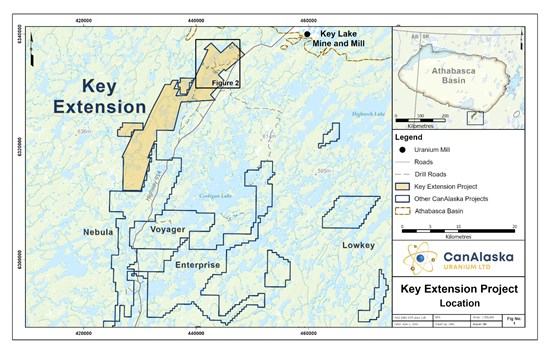
Figure 1 - Project Location Map
To view an enhanced version of this graphic, please visit:
https://images.newsfilecorp.com/files/2864/302477_6609c788e4886970_002full.jpg
CanAlaska CEO, Cory Belyk, comments, "Early results from the Key Extension project are very good. The presence of graphitic fault zones with alteration, in places deep into the basement, are leading indicators of potential uranium-bearing fluids penetrating the right basement rocks. Basement-hosted uranium deposits like Eagle Point and Arrow can extend to depths reaching 1,000 metres below surface leaving abundant opportunity for significant uranium deposit discovery at depth on the Key Extension project. I look forward to the summer drilling program that is designed to test for the source of the nearby radioactive boulder train."
2026 Key Extension Exploration Drill Program
The 2026 winter drill program on the Key Extension project consisted of five diamond drill holes for a total of 1,251 metres in two target areas (Table 1; Figure 2). The program was focused on early-stage evaluation of a series of high-priority target areas identified based on the recent airborne geophysical surveys and the review of historical drilling. Results from the winter program on the Project are highlighted by the consistent intersection of graphitic stratigraphy containing re-activated graphitic fault zones with associated hydrothermal clay and chlorite alteration.
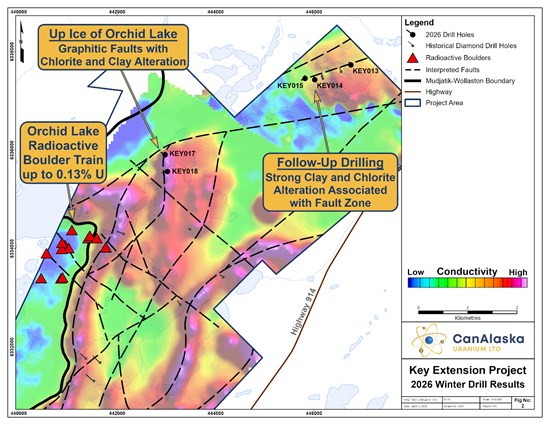
Figure 2 - Key Extension Winter Drill Program Results
To view an enhanced version of this graphic, please visit:
https://images.newsfilecorp.com/files/2864/302477_6609c788e4886970_004full.jpg
During the drill program, two high-priority target areas were successfully tested:
Follow Up on Historical Drilling: Three drillholes were completed to test conductive stratigraphy along strike of anomalous historical drillholes that contained a graphitic fault zone associated with clay, chlorite, and hematite alteration, and 487.3 ppm uranium over 0.15 m in drillhole KEY-001. KEY013, KEY014, and KEY015 successfully extended the strike length of the graphitic corridor in the target area. KEY014, which was the deepest test of the graphitic corridor, displayed the strongest chlorite and clay alteration associated with re-activated fault structures at depth (Figure 3). These results suggest that additional drilling in this target area should focus on testing deeper below surface on the conductive corridor for increasing hydrothermal alteration and the potential for basement-hosted uranium mineralization.
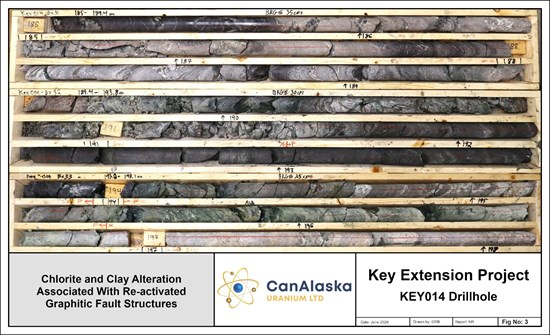
Figure 3 - KEY014 Core Photograph
To view an enhanced version of this graphic, please visit:
https://images.newsfilecorp.com/files/2864/302477_6609c788e4886970_006full.jpg
Up-Ice of the Orchid Lake Radioactive Boulder Field: Two drillholes were completed to test a series of conductive targets up-ice along the interpreted glacial ice direction of the historically reported Orchid Lake radioactive boulder field. KEY017 and KEY018 successfully intersected graphitic stratigraphy containing semi-brittle fault zones associated with localized chlorite and clay alteration. Results from the drillholes in this target area did not explain the source of the Orchid Lake radioactive boulder field. Additional drilling should be completed both closer to, and further along strike of, the conductive stratigraphy to continue to evaluate for the source of the Orchid Lake radioactive boulder field.
Due to seasonal access challenges, the Company was unable to test several additional high-priority target areas on the Project including the Western Conductive Trend, the Eastern Conductive Trend, and drill targets more proximal to the Orchid Lake radioactive boulder field. The high-priority target areas on the Key Extension project remain focused on a series of long-linear magnetic low corridors associated with conductivity high corridors that are interpreted to extend from the Key Lake Mine and Mill complex area through the Company's Key Extension and Nebula projects. The magnetic lows with associated conductivity highs are interpreted to represent the graphitic metasedimentary rocks of the lower Wollaston Domain in the highly prospective Wollaston-Mudjatik transition zone. Drill targets on the Key Extension project within the graphitic metasedimentary package are focused on areas of interpreted structural complexity, where interpreted bends and breaks in the conductive rocks may create the potential for transport and trap of hydrothermal uranium-bearing mineralizing fluids.
Next Steps
The Company is currently in the process of planning a helicopter-supported fall drill program on the Key Extension project. Priority targets for the planned program will be those that were inaccessible due to seasonal access challenges, including the Western Conductive Trend, the Eastern Conductive Trend, and drill targets more proximal to the Orchid Lake radioactive boulder field. The Company will provide details about the planned fall drilling program, which is anticipated to begin in September, in the coming weeks.
Geochemical assay results from the winter drill program on the Key Extension project are pending.
Table 1 - 2026 Winter Drill Hole Collar Summary
| Drill Hole | Easting | Northing | Elevation (m A.S.L.) | Azimuth () | Dip () | EOH (m) |
| KEY013 | 446750 | 6337731 | 563 | 324 | -74 | 233 |
| KEY014 | 446016 | 6337431 | 533 | 335 | -75 | 281 |
| KEY015 | 445817 | 6337458 | 539 | 350 | -75 | 220 |
| KEY017 | 442972 | 6335906 | 518 | 300 | -70 | 245 |
| KEY018 | 443020 | 6335565 | 518 | 255 | -68 | 272 |
| Notes: Easting and Northing coordinates are reported in UTM Zone 13N (NAD83 datum). EOH = end of hole. m A.S.L. = metres above sea level. | ||||||
Technical Disclosure - Geochemical Assay Sampling Procedures, Historical Results, and Neighbouring Properties
All assay drill core samples from the program, completed as NQ-sized core, were shipped to the Saskatchewan Research Council Geoanalytical Laboratories (SRC) in Saskatoon, Saskatchewan in secure containment for preparation, processing, and multi-element analysis by ICP-MS and ICP-OES using total (HF:NHO3:HClO4) and partial digestion (HNO3:HCl), boron by fusion, and U3O8 wt% assay by ICP-OES using higher grade standards. Assay samples are chosen based on downhole probing radiometric equivalent uranium grades and scintillometer (SPP2 or CT007-M) peaks. Assay sample intervals comprise 0.3 - 0.8 metre continuous half-core split samples over the mineralized intervals. With all assay samples, one half of the split sample is retained and the other sent to the SRC for analysis. The SRC is an ISO/IEC 17025/2005 and Standards Council of Canada certified analytical laboratory. Blanks, standard reference materials, and repeats are inserted into the sample stream at regular intervals by CanAlaska and the SRC in accordance with CanAlaska's quality assurance/quality control (QA/QC) procedures. Geochemical assay data are subject to verification procedures by qualified persons employed by CanAlaska prior to disclosure.
The historical results contained within this news release have been captured from the Saskatchewan Mineral Assessment Database (SMAD) as available and may be incomplete or subject to minor location inaccuracies. Management cautions that historical results collected and reported by past operators unrelated to CanAlaska have not been verified nor confirmed by a Qualified Person; however, the historical results form a scientific basis for ongoing work on the subject projects. Any historical rock / boulder samples are selective samples by nature and as such are not necessarily representative of the mineralization hosted across the property.
This news release refers to neighbouring properties in which the Company has no interest. Results, discoveries, or mineralization on proximate land or neighboring properties, whether in stated current resource estimates or historical resource estimates, are not necessarily indicative of results, discoveries, or mineralization on the Company's properties.
All reported depths and intervals are drill hole depths and intervals, unless otherwise noted, and do not represent true thicknesses, which have yet to be determined.
About CanAlaska Uranium
CanAlaska is a leading explorer of uranium in the Athabasca Basin of Saskatchewan, Canada. With a project generator model, the Company has built a large portfolio of uranium projects in the Athabasca Basin. CanAlaska owns numerous uranium properties, totaling approximately 330,000 hectares, with clearly defined targets in the Athabasca Basin covering both basement and unconformity uranium deposit potential. The Company has recently concentrated on the West McArthur high-grade uranium expansion with targets in 2024 and 2025 leading to significant success at Pike Zone. Fully financed for the 2026 drill season, CanAlaska is focused on uranium deposit discovery and delineation in a safe and secure jurisdiction. The Company has the right team in place with a track record of discovery and projects that are located next to critical mine and mill infrastructure.
The Company's head office is in Saskatoon, Saskatchewan, Canada with a satellite office in Vancouver, BC, Canada.
The Qualified Person under National Instrument 43-101 Standards of Disclosure for Mineral Projects for this news release is Nathan Bridge, MSc., P. Geo., Vice-President Exploration for CanAlaska Uranium Ltd., who has reviewed and approved its contents.
On behalf of the Board of Directors
"Cory Belyk"
Cory Belyk, P.Geo., FGC
CEO, President and Director
CanAlaska Uranium Ltd.
Contacts:
| Cory Belyk, CEO and President | General Enquiry |
| Tel: +1.306.668.6900 | Tel: +1.306.668.6915 |
| Email: cbelyk@canalaska.com | Email: info@canalaska.com |
Neither TSX Venture Exchange nor its Regulation Services Provider (as that term is defined in the policies of the TSX Venture Exchange) accepts responsibility for the adequacy or accuracy of this release.
Forward-looking information
All statements included in this press release that address activities, events or developments that the Company expects, believes or anticipates will or may occur in the future are forward-looking statements. Forward-looking statements are frequently identified by such words as "may", "will", "plan", "expect", "anticipate", "estimate", "intend" and similar words referring to future events and results. Forward-looking statements are based on the current opinions and expectations of management. These forward-looking statements involve numerous assumptions made by the Company based on its experience, perception of historical trends, current conditions, expected future developments and other factors it believes are appropriate in the circumstances. In addition, these statements involve substantial known and unknown risks and uncertainties that contribute to the possibility that the predictions, forecasts, projections and other forward-looking statements will prove inaccurate, certain of which are beyond the Company's control. Actual events or results may differ materially from those projected in the forward-looking statements and the Company cautions against placing undue reliance thereon.
The Company believes that the expectations reflected in forward-looking statements included herein are reasonable, but no assurance can be given that these expectations will prove to be correct and such forward-looking statements included herein should not be unduly relied upon. These statements speak only as of the date hereof. The Company does not intend, and does not assume any obligation, to revise or update these forward-looking statements, except as required by applicable law.
To view the source version of this press release, please visit https://www.newsfilecorp.com/release/302477
Source: CanAlaska Uranium Ltd.