
"The window to shape the oral GLP-1 market is open now...."
Early-stage discussions with several multinational pharmaceutical companies currently underway
KELOWNA, BC / ACCESS Newswire / March 24, 2026 / Lexaria Bioscience Corp. (NASDAQ:LEXX), (the "Company" or "Lexaria"), a global innovator in drug delivery platforms provides this update of developments within the glucagon-like peptide-1 ("GLP-1") market.
Lexaria has been listening and responding to the concerns of those using GLP-1 drugs, who overwhelmingly indicate their preference for oral versus injected delivery and who are desperately seeking safer options whose side effects do not make them feel sick. This has driven Lexaria's mission to develop better tolerated oral GLP-1 capsule and tablet alternatives. After far-reaching proprietary formulation advancements and the establishment of intellectual property in 2024 and 2025, Lexaria is currently developing additional enhancements to its DehydraTECH GLP-1 platform that we are hopeful could instigate commercial development with leading industry partners.
Lexaria first began reporting on the momentum within the fast-moving GLP-1 drug sector during 2023. Growth in the sector has been, if anything, even more significant than we anticipated at the time and has supported our business strategy of pursuing opportunities within the GLP-1 market. Examples of this growth and the challenges abound:
Eli Lilly's tirzepatide is expected to be the #1-selling drug in the world for 2026, with revenue estimated at $45 billion. Novo Nordisk's semaglutide - previously the #1 GLP-1 drug - is expected to generate nearly $40 billion in revenue in 2026. In concert with the sector growth, many analysts have significantly increased their revenue projections. TD Cowen raised their previous 2030 sales forecast from $101 billion to $139 billion, Roots Analysis is forecasting sales of $180 billion by 2035, while UBS Investment Bank expects 2029 GLP-1 sales to reach $126 billion.
Injected GLP-1 drugs often produce very similar results to oral GLP-1 drugs. For instance, in a 2021 study, patients who took once-weekly semaglutide injections lost an average of ~15% of their body weight - as compared to a 2023 study of oral semaglutide which also resulted in patients losing ~15% of their body weight. However, regardless of the mode of administration, most patients using GLP-1 drugs experience unwanted side effects (or adverse events) that are primarily gastrointestinal ("GI") in nature. In the 2021 study of injected semaglutide, 74% of patients experienced GI side effects, whereas in the 2023 study of oral semaglutide, 80% of patients experienced GI side effects.
In a very large 6-year study of over 125,000 patients, it was reported that 46.5% of patients with, and 64.8% of patients without, type 2 diabetes, discontinued use of their GLP-1 drugs within 1 year. Equally interesting, 47.3% of patients with, and 36.3% of patients without, type 2 diabetes subsequently reinitiated use of GLP-1 medications within 1 year. Given that GLP-1 drugs were initially approved for use by diabetics, it is not surprising that those with this serious medical condition were less likely to discontinue use, and more likely to reinitiate subsequent use, than those people who used GLP-1 primarily for weight loss benefits.
From a strategic perspective, Lexaria understood that losing roughly half your customers could not have been a welcome development for the manufacturers of GLP-1 drugs. That's why we focused on the goals of improving patient experiences via the preferred oral delivery method whilst preserving the efficacy of the underlying medication. To do so, we had to better understand the needs of the market to bolster our business case.
In a survey of 2,173 patients who discontinued the use of GLP-1 drugs, a majority of the patients identified two main areas of concern: the GI-related discomfort or the negativity associated with injections:
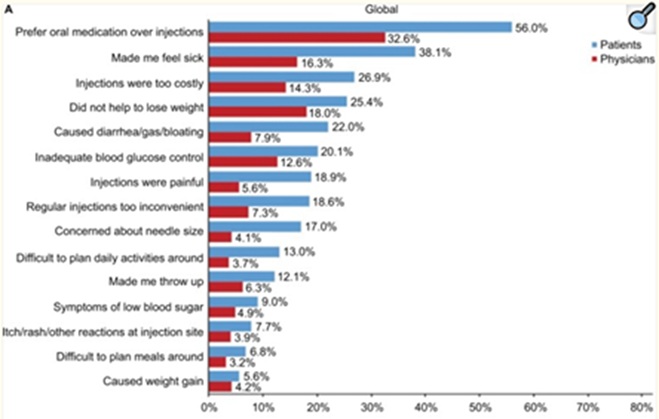
In a separate survey published in March 2026, of 1,536 Canadians and 1,012 Americans, Leger Healthcare market research reported a number of key findings related to GLP-1 use and intentions across North America:
11% of American adults and 8% of Canadian adults are currently taking a GLP-1 prescription
Extrapolated, this suggests that 28M+ American adults and 3M+ Canadian adults are currently using GLP-1 prescriptions
12% of Americans and 6% of Canadians are interested in taking a GLP-1 prescription
71% of Americans and 58% of Canadians cite weight loss as a primary reason for their interest in GLP-1 drugs
Given that nearly two-thirds of GLP-1 customers focused on weight loss tend to discontinue use of the drugs within the first year, Lexaria knew that our attempts to improve the patient experience could provide a profoundly positive business case. With less than 5% of the entire 2025 GLP-1 revenue attributed to the sole oral drug, Rybelsus, Lexaria's management understood earlier than most, both the risk and the tremendous opportunity in pursuing such a relatively small portion of the market at that time; our strategy was and remains forward looking.
By the beginning of 2025, the sector was buzzing with anticipation of Pfizer's orally-delivered GLP-1 candidate, danuglipron, which had shown great promise in Phase I and II studies. Then on April 14, 2025, Pfizer reported that they were discontinuing development of danuglipron because in an ongoing Phase III study of 1,400 people, one person experienced elevated liver enzymes that resolved after its discontinuation. Pfizer had little choice but to forego a potential multi-billion-dollar drug blockbuster because the adverse events were simply not acceptable. This was a devastating blow to Pfizer and to all those hoping for a new oral alternative in GLP-1.
But industry development of GLP-1 drugs has not ended. If anything, it has only intensified. In May of 2025, it was reported that 39 new GLP-1 medications were under development. Companies such as Viking Therapeutics and Structure Therapeutics are both pursuing oral GLP-1 drug candidates.
Similarly, Eli Lilly is developing orforglipron, a small-molecule GLP-1 candidate. The New England Journal of Medicine published an article detailing the outcomes of orforglipron, being investigated as an oral treatment for obesity. This Phase III multinational study provided average weight loss of up to 11.2% at the maximum dose by the completion of the 72-week study. Roughly 5% - 10% of the patients in the study discontinued use due to adverse events. This drug has not yet been approved for use by the FDA, but that approval is expected as soon as April 2026. In anticipation of same, Eli Lilly has reportedly already built a pre-launch drug inventory of $1.5 billion, to minimize or eliminate shortages after approval.
While orforglipron has shown in studies to be slightly more effective at reducing body weight and reducing blood sugar levels than semaglutide, "Orforglipron showed higher rates of adverse side effects such as nausea, vomiting and other gastrointestinal issues compared with semaglutide. More people discontinued orforglipron during the trial than those who stopped taking semaglutide, too." (Scientific American)
Novo Nordisk's semaglutide received FDA approval for an oral tablet for weight loss in January 2026 and reached over 26,000 prescriptions within two weeks of launch. Novo Nordisk expects oral GLP-1 tablets to represent over 33% of the GLP-1 market by 2030, compared to less than 5% realized in 2025. Goldman Sachs is forecasting that oral GLP-1s will capture 24% of the 2030 market for obesity drugs.
These forecasts imply that oral GLP-1 markets for all conditions could represent a $40 billion to $45 billion annual market within just 4 years: a stunning anticipated growth curve that represents what might truly be called a once-in-a-lifetime market opportunity.
According to PRC, "the window to shape the oral GLP-1 market is open now-and it will not remain open for long. Decisions made today across manufacturing and commercialisation will determine which companies are best positioned as these therapies move from promise to scale. As the landscape evolves rapidly, early, deliberate investment in the right capabilities and strategic partnerships will be critical to securing a leadership position."
Lexaria is executing its strategy of developing must-have technology that delivers solutions to meet patient's #1 requests: an effective GLP-1 drug delivered orally with reduced side effects.
Our 2026 R&D and business development plans are designed to foster commercial relationships with pharmaceutical companies around the world, including those located in heavily populated countries such as India, China, and Brazil where key semaglutide patents expire in 2026, opening new opportunities for generic GLP-1 candidates utilizing Lexaria's patented DehydraTECH technology. Lexaria is currently in early-stage discussions with several multinational pharmaceutical companies related primarily but not exclusively to our work in GLP-1.
About Lexaria Bioscience Corp. & DehydraTECH
DehydraTECH is Lexaria's patented drug delivery formulation and processing platform technology which improves the way a wide variety of drugs enter the bloodstream, always through oral delivery. DehydraTECH has repeatedly evidenced the ability to increase bio-absorption, reduce side-effects, and deliver some drugs more effectively across the blood brain barrier. Lexaria operates a licensed in-house research laboratory and holds a robust intellectual property portfolio with over 60 patents granted and additional patents pending worldwide. For more information, please visit www.lexariabioscience.com.
CAUTION REGARDING FORWARD-LOOKING STATEMENTS
This press release includes forward-looking statements. Statements as such term is defined under applicable securities laws. These statements may be identified by words such as "anticipate," "if," "believe," "plan," "estimate," "expect," "intend," "may," "could," "should," "will," and other similar expressions. Such forward-looking statements in this press release include, but are not limited to, statements by the Company relating to the intended use of proceeds from the offering and relating to the Company's ability to carry out research initiatives, receive regulatory approvals or grants or experience positive effects or results from any research or study. Such forward-looking statements are estimates reflecting the Company's best judgment based upon current information and involve a number of risks and uncertainties, and there can be no assurance that the Company will actually achieve the plans, intentions, or expectations disclosed in these forward-looking statements. As such, you should not place undue reliance on these forward-looking statements. Factors which could cause actual results to differ materially from those estimated by the Company include, but are not limited to, market and other conditions, government regulation and regulatory approvals, managing and maintaining growth, the effect of adverse publicity, litigation, competition, scientific discovery, the patent application and approval process, potential adverse effects arising from the testing or use of products utilizing the DehydraTECH technology, the Company's ability to maintain existing collaborations and realize the benefits thereof, delays or cancellations of planned R&D that could occur related to pandemics or for other reasons, and other factors which may be identified from time to time in the Company's public announcements and periodic filings with the US Securities and Exchange Commission on EDGAR. The Company provides links to third-party websites only as a courtesy to readers and disclaims any responsibility for the thoroughness, accuracy or timeliness of information at third-party websites. There is no assurance that any of Lexaria's postulated uses, benefits, or advantages for the patented and patent-pending technology will in fact be realized in any manner or in any part. No statement herein has been evaluated by the Food and Drug Administration (FDA). Lexaria-associated products are not intended to diagnose, treat, cure or prevent any disease. Any forward-looking statements contained in this release speak only as of the date hereof, and the Company expressly disclaims any obligation to update any forward-looking statements or links to third-party websites contained herein, whether as a result of any new information, future events, changed circumstances or otherwise, except as otherwise required by law.
INVESTOR CONTACT:
George Jurcic - Head of Investor Relations
ir@lexariabioscience.com
Phone: 250-765-6424, ext 202
SOURCE: Lexaria Bioscience Corp.
View the original press release on ACCESS Newswire:
https://www.accessnewswire.com/newsroom/en/consumer-and-retail-products/lexarias-oral-glp-1-drug-strategy-validated-by-industry-1151080
